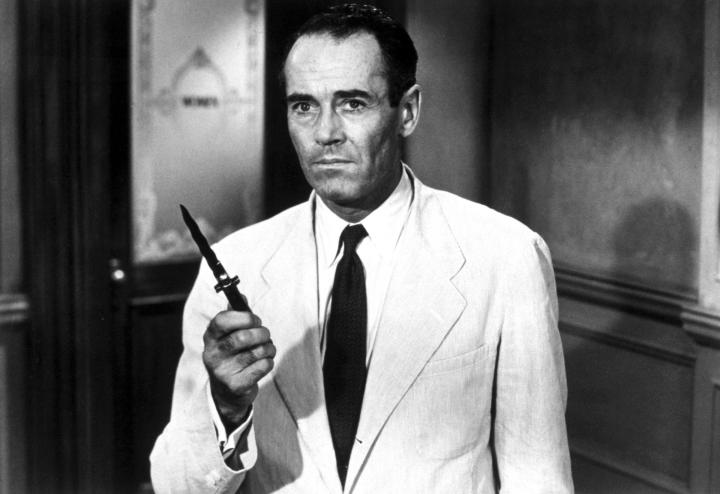
Starring: Henry Fonda, Martin Balsam, John Fielder, Lee J. Cobb, E.G. Marshall, Jack Klugman, Edward Binns, Jack Warden, Joseph Sweeney, Ed Begley, George Voskovec, Robert Webber
12 jury members are in a locked room deliberating a murder case. That’s it. That’s the plot. Sound boring? Not at all! It’s tense, dramatic and very well acted, and it will keep you engaged throughout the entire 96 minutes.
“Raise your hand if you think this film makes the most of its premise!”
Human nature, society, male pride, racism and prejudice all play a part in the “neutrality” of the justice system, and it’s important to question what people tell you is the truth. Also, Juror #8 should have been the defense lawyer. And that’s all we’ll say, apart from watch this film. It’s fantastic.
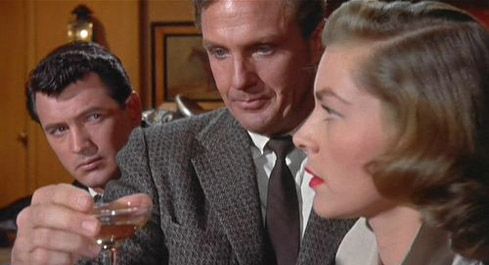
After a very brief encounter, aspiring ad-lady Lucy Moore (Bacall) marries philandering alcoholic millionaire oil-heir Kyle Hadley (Stack) when he promises to change for her… This despite her initial attraction to his best (but not as rich) friend Mitch Wayne (Hudson).
“You are so charming! I hope you have a less handsome friend I can marry!”
To both their credit, Kyle does change his game during their first year of marriage, and the two are quite happy together. However, when they fail to conceive a child and Kyle learns that the fault lies with him, he falls back into his old ways of drink and aggression.
“My sperm doesn’t work. I am not a man. I must drink and by no means talk to the people who love me about my insecurities.”
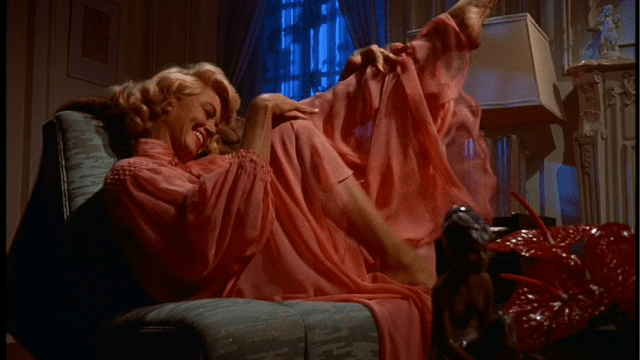
Meanwhile, Mitch is caught up in a love triangle (square..?); he loves Lucy, Lucy loves Kyle, Kyle’s psychopath sister Marylee (Malone) loves Mitch, and Kyle pretty much loves, but distrusts, all of them.
Marylee masks her love for Mitch with a string of unsuitable lovers
Like Sirk’s previous entries, Written on the Wind is a melodrama with lots of twists and turns, and you’re never sure whether or not it will have a happy ending. It’s visually beautiful and “soft,” and the costumes are gorgeous (and very symbolic). Despite Mitch and Lucy being the characters everything (and everyone) revolves around, the Hadley siblings are by far the most intriguing.
Their insecurities are understandable and explained, although they both go way overboard in their efforts to compensate for them – Kyle by spending money and drinking, and Marylee by being promiscuous and sabotaging Mitch and Lucy’s lives.
She is even sexual enough to kill her father. Quite an achievement.
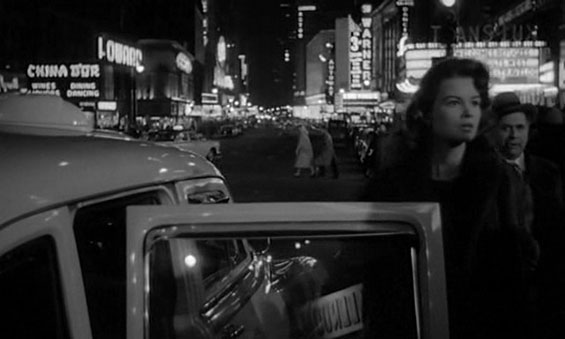
We loved the costumes, the calendar at the beginning, all the twists and turns, and the crazy Marylee (who we sort of felt sorry for…at first, at least). Also, the scene in the beginning with Lucy and Kyle in the taxi is oddly poignant in these times of sexual harassment allegations. It’s clear that Lucy is on her guard, and that this is not a situation she’s unfamiliar with… Which says a lot, we think.
Must have been one hell of a conversation in the plane to go from this to marriage…
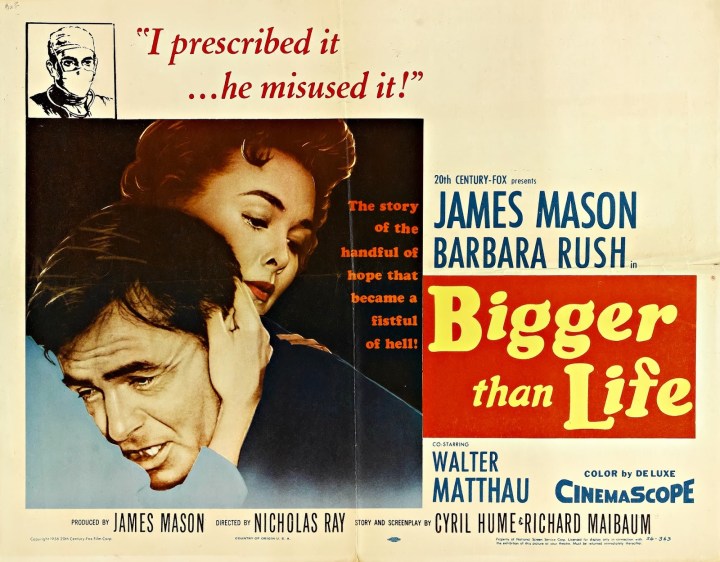
School’s out for Easter. What a dream! Though not for teacher Ed Avery (Mason), who suffers stomach pains and is on his way to his second job as a cab dispatcher. Despite his clear discomfort and his rush to get to his second, secret, job, he takes the time to give a student a break and to play matchmaker for a couple of colleagues. An all round good guy!
After a dinner party, Ed collapses and his wife Lou (Rush) and BFF Wally (Matthau) get him to the hospital. The doctors run a series of tests, including a very cool and quite possibly cancer-inducing X-Ray with barium, and are discouraged by what they find. Without treatment, Ed has less than a year to live.
A life span further reduced by the liberal helpings of barium and x-radiation
The only treatment found to be somewhat effective is the newly discovered (possibly?) hormone cortisone, but it can have serious side-effects. After weeks of experimenting, a proper dosage is found, and Ed is sent back home with a few weeks’ supply of cortisone pills.
Ed’s medication gives him a new appreciation for fancy clothes and shopping sprees. There’s a chance we may have too much cortisone in our systems…
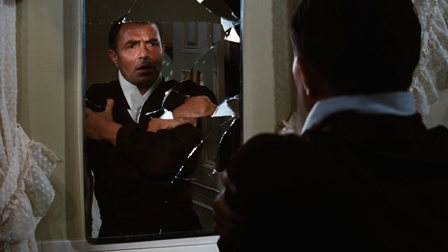
In time, Lou starts noticing some changes in her husband’s personality. He is more adventurous and spontaneous, but less sensible and responsible. He is energetic and manic with terrible mood swings and occasional tremors.
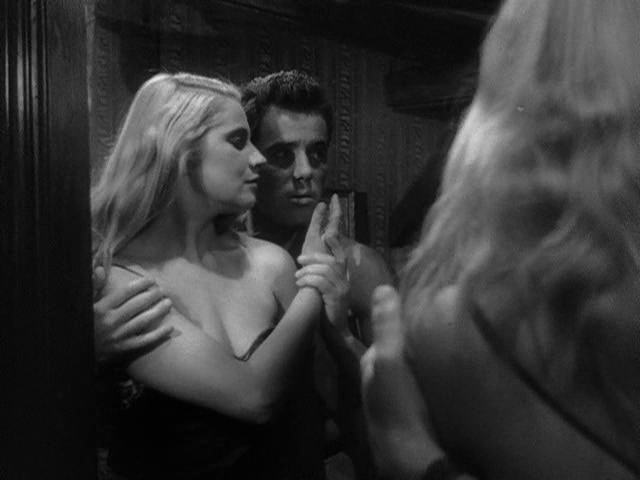
There’s always a possibility he is possessed, according to the mirror
As Ed’s solution is to up his cortisone intake, his new personality traits develop into full blown delusions of grandeur, complete with a new tyrannical approach to family life.
Even his shadow gets in on the action, looming threateningly over his young son Richie
Bigger Than Life is very dramatic, and Ed’s development throughout the film goes from one extreme to the next. We loved the X-Ray/barium scene, the dramatic crescendo of the ending, the shadows and the general craziness. It may not be a film we’ll rewatch over and over again, but it is definitely worth watching once.
What we learned: Teachers owe it to themselves to be sick on school days – not during vacation. Word! Also, stick to the prescribed dosage.
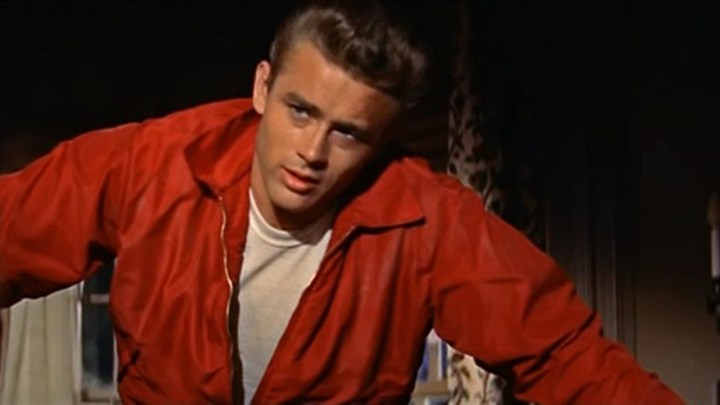
Jim Stark (Dean) is a troubled teenager with anger issues, a bit of a drinking problem, and an aversion to being called a chicken. He starts his new life in a new town by being thrown in the drunk tank and then getting into trouble with the local “tough guys.”
He does make one friend, but that guy’s no good in a fight
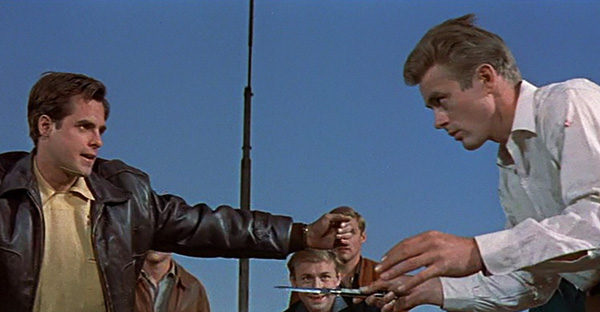
After trying to hit on Judy (Wood), and failing miserably, he tries to ingratiate himself with her gang by cracking jokes during a class field trip to a planetarium, but they do not find him amusing. In fact, they find him so unamusing that they vandalize his car and threaten his life after school.
Look, we hate people who talk during movies and lectures as much as the next person, but we do feel like this is overreacting a tad…
Jim, insecure in his masculinity, is infuriated when he’s called a chicken, and he agrees to meet the gang’s leader for a “Chickie run” that evening. Which goes about as well as you’d expect.
He does get to smooch up a bit with Judy though, so it’s not all bad
Bad things happen, people gang up on our hero, his parents give bad advice, and the kindly police officer he bonded with in the beginning is unavailable, so Jim is at a loss. He teams up with Judy and his only other friend Plato (Mineo) and they hide in an abandoned mansion in the outskirts of town.
We’re impressed with Judy’s ability to cope with her boyfriend’s death by getting it on with his main rival. However, it might be an upgrade…
Believe it or not, this was actually our first time watching this film despite its status as a classic. We’re glad we finally got around to it though – it was beautiful, dramatic and moving, and James Dean was just filled with charisma and raw energy.
The characters are damaged and flawed, but sympathetic. We initially really disliked Judy (we’re a bit over the “good-but-misunderstood-girl-with-daddy-issues-and-a-crappy-boyfriend”-thing), but she actually managed to grow on us, and her motivation was understandable. Jim is basically a good guy with crappy if well-meaning parents and his own daddy-issues, but he does have a good heart.
Plato is by far the saddest character. Always on his own, with the housekeeper his only parental figure, he comes to see Jim as a father and role model as much as a friend. Wait – another person with daddy-issues? We’re beginning to see a pattern here…
We’re slightly ashamed we haven’t seen Rebel Without a Cause until now, because we get what all the fuss (or fuzz?) is about. If you’re as behind on the times as us, we recommend you delay it no longer. It’s definitely worth the watch, and it does not seem outdated at all; even if the methods of kids’ rebellions might have changed a bit with the times, their causes are still present.
What we learned: Listen to your kids. And take responsibility for them.
The tiny town of Black Rock is amazed to see the train actually stop for the first time in four years. Even more puzzled, and suspicious, are they to find a stranger getting off in search of a hotel room and a cab to take him to Adobe Flats.
“I vote we just kill him now and get it over with. There’s no way we can share our one female resident with yet another man.”
The stranger, John J. Macreedy (Tracy), is met with hostility from all sides, mainly led by Reno Smith (Ryan) who everyone seems to be afraid of. The hostility increases when Macreedy reveals he is looking for a Japanese-American farmer named Komoko, and he is served a story of Komoko being relocated in the wake of Pearl Harbor.
Pictured: tension. And not the homoerotic cowboy movie kind.
As Macreedy is trapped in the town for the night and all lines of communication with the outside world are sabotaged by local followers of Smith, vet/undertaker Doc (Brennan) is the only one willing to help him. Doc reveals that Komoko is dead, although the details of his death are still unknown to our hero.
Hint: there’s racism and bigotry at work. Thank God the world is not plagued by those kinds of outdated ideas anymore!
Smith and his croonies, most notably Coley and Hector (Borgnine and Lee, respectively), no longer operate under any pretense of innocence, and the chances of Macreedy surviving the night grow smaller and smaller.
It doesn’t help that our hero is a one-armed man trying to fight a pissed off Ernest Borgnine
Bad Day at Black Rock is an exciting and tense murder-mystery-western with a crime at the centre of the plot which is strangely (and sadly) relevant to our own times and political climate. Macreedy is a stoic badass, yet you’re never sure things will go his way or who he can trust. The men in this one-woman-town must make some tough choices and decide whether or not to make up for the mistakes that were made four years ago.
It’s hard to see how anything at all could happen in a town this small, let alone something horrible
There’s nothing not to love about this film. It’s shot in Eastman Color and Cinemascope, and beautifully so. There are car chases, shoot-outs, bar fights, Dames (well – just the one dame, actually), murder, mystery, and mayhem, and we loved everything about it. Loved it!
What we learned: This is a local town for local people. There’s nothing for you here! Alternatively, they don’t take kindly to strangers round these there parts.
Cary Scott (Wyman) is a youngish widow (typecast much?) with two grown children in college. While her hoity-toity society friends want her to remarry within their social circle, Cary has her eye on gardener and nurseryman Ron Kirby (Hudson).
Luckily for Cary, her feelings are reciprocated, and the unlikely couple start dating. Ron introduces her to his kind and laid-back friends and shows her a whole new way of life – one where material possessions and status do not matter. It’s an appealing thought for a woman trapped within a boring and unfulfilling existence with bitchy women and horn-dog men.
“But how can I possibly love someone of lower social standing? He’d better be some sort of Disney prince or something!”
As their relationship becomes gradually more serious, the couple meets with prejudice from Cary’s friends and children. Will they overcome these obstacles? Will love triumph over small-mindedness and social constructs?
Will Cary be able to downgrade to these awful living conditions and this horrible living room view? Only time will tell.
It’s only our second Sirk film, but already we’re seeing a pattern (apart from the obvious one of casting the same actors); at the root of everything there is a philosophy. In Magnificent Obsession the idea was that it is one’s duty to help those less fortunate. In All that Heaven Allows, one’s duty is to oneself – to live the way one wants to and not how society expects you to live, and to make choices for oneself and not always put others first.
The philosophy could also be that rich men are judgmental, entitled, rapey douchebags. We’re not quite ready to rule that interpretation out yet.
It’s an engaging and fun watch, beautifully shot, and in glorious technicolor. Romantic dramas aren’t really our favourite genre of films, but Sirk does them wonderfully, and we’re enjoying getting to know this director. Great lazy Sunday viewing (although we technically watched it on a Monday. But Monday before work started, so Monday-for-Sunday).
Bob Merrick (Hudson) is a spoiled rich brat whose life is all about indulging his narcissistic personality. After throwing a tantrum when his advisors try to suggest that the weather isn’t really suited for speed racing on the lake, he gets himself into a completely avoidable and potentially fatal accident.
“That bitch lake had better obey my financial power!”
On their way to save him, the police pick up a resuscitator from a neighbour with a heart condition. As it is put to use saving the life of the self-centered playboy, the good doctor to whom it belongs succumbs to a heart attack.
“My husband died from a heart condition while indirectly helping a man with no heart? How very symbolic of him!”
When Merrick learns what happened, he tries to apologise to the doctor’s widow, Helen Phillips (Wyman) who naturally does not want to hear from the man who cost her husband his life. Merrick, the Phillips family’s jinx, then causes Helen to lose her sight in an accident. You’d think he’d learn to stay away by now, but he keeps pursuing her, taking advantage of her blindness to take on an assumed identity. At least the Phillips’ misfortune(s) bring about a change in Merrick, sending him down a very different path than the one on which he had started.
“This Bobby sounds like a real piece of work! Good thing I, ehm, Robby, am completely different from this rich bastard!”
Despite its clear religious undertones and somewhat melodramatic style, we really enjoyed Magnificent Obsession. It is beautiful and sad with some unconventional (albeit at times almost farcical) twists and turns.
We want all their clothes. Especially Jane Wyman’s.
It’s always nice to watch the redemption of self-obsessed characters, and this one delivers. We loved Nancy (Moorehead) and the little girl Judy (Nugent), and we LOVED the costumes in glorious technicolor! We liked this more than we thought we would, although we realise that it’s one of those films you have to be in the right mood for. Luckily, we were, and we’re looking forward to more Sirk to come.
Ed Wood is commonly known as the worst director of all time, which may or may not be true (there must be someone worse out there, although it’s possible they’ve never released anything major), due in large part to the cult classic Plan 9 From Outer Space (1959). Slightly less well known, though still fairly (in)famous, and (hopefully) slightly more autobiographical is Glen or Glenda from 1953.
Despite his infamy, Ed Wood threw the best and most surreal parties!
Transvestite Patrick/Patricia has committed suicide, and the investigator, Inspector Warren (Talbot) wants to learn more about their motive. He talks to Dr Alton (Farrell) who tells him two stories about different forms of gender identity, starting with the story of Glen/Glenda (Wood).
Some men have different reasons for admiring lingerie in shop windows…
Glen is a fairly normal heterosexual man who is engaged to marry Barbara (Fuller), and who likes to dress in women’s clothing and to feel like a woman. He describes it as a sort of split personality and he cannot quite make up his mind whether he wants to continue doing this or whether he wants to stop. He also has a hard time deciding how to tell his fiancée about his alter ego. This is the most clearly autobiographical narrative in the film, since the director himself went through a similar process (as we’ll see in Tim Burton’s Ed Wood when we reach 1994).
He feels like it’s sinful and wrong too, poor guy/girl
Dr Alton also tells Warren the story of pseudohermaphrodite Alan, who after a long period of confusion, goes through a sex change to transition to female. In between these two narratives, Bela Lugosi pops up in a lab straight out of a Frankenstein film and talks about human nature while doing experiments that have nothing whatsoever to do with the rest of the film. There’s also a (drug-fueled?) dream sequence heavy with symbolism (we think).
An old Universal horror? A Hammer film, perhaps? Nope, it’s a docudrama about gender identity
A film as indecisive about its nature as its eponymous character, Glen or Glenda cannot seem to make its mind up about in which genre it wants to belong. The scenes with Bela Lugosi fall firmly into the horror realm, while other parts of the film fluctuate between documentary, drama, romance, pantomime, silent movie, and symbolism heavy art feature. It is a very interesting film to watch though, and its cult status is understandable. The artistic merits of the film do not, however, quite match the level of the progressive and important subject matter, and it’s a strange experience watching it. Well worth it though!
Kanji Watanabe (Shimura) is a small cog in the great wheel of Japanese bureaucracy. He’s been feeling a bit under the weather and goes to see his doctor. After a less than encouraging meeting with another patient in the hospital waiting room, Watanabe’s doctor tells him the exact lies his fellow patient warned him of, and he realises he only has a short time left on this earth.
Like any doomed man, he tries to drown his sorrows
With a death sentence hanging over his head, ungrateful children plotting to take his money, an unfulfilling job, a dead wife, a wasted life, and no tools to connect with his son or express his emotions, Watanabe stops going to work and starts drinking. He spends a night out with a novelist he meets, but drinking and partying does little to lift his spirits.
His cheerful demeanor does wonders for all those he meets though
After his first experiment fails, he starts to spend time with a former underling from work – the young and vivacious Toyo (Odagiri). He asks her to teach him how to enjoy life – he wants his last few months to have meaning, but he doesn’t know how to make that happen – and she tells him that her new job making toys is bringing her joy. This gives Watanabe an idea – to help a group of lobbying parents clean up a cesspool in their neighbourhood and make a playground. Finally, the bureaucrat makes things happen.
Ikiru is beautiful and haunting, and we loved it (despite its lack of samurai). It’s a long feature, but it flies by, and one cannot help but be drawn in by the intriguing actors and the very human plot. Watanabe has to get a death sentence in order to start living, and unfortunately this is true for so many people. In a society where people’s worth is determined by their ability to adapt to and contribute to the system, Watanabe manages to use the system to form his legacy. However, he needs the push of his impending death in order to start doing something with his position.
An intriguing, beautiful and heart breaking drama and an interesting view into post-war Japanese bureaucracy and society, this is one of those films everyone should watch at some point in their lives. Not as famous (at least in Norway) as many of Kurosawa’s other films, we’re glad it was added to the list, otherwise it probably would have flown under our radar and we’re glad we watched it. It actually made us feel something in our cold, dead hearts.
What we learned: Live while you can, love your work and make a difference.
After a bath, Susan Gilvray (Keyes) sees someone leering through her bathroom window and calls the police who basically chalk it up to hysterical women who should know better than to get undressed in their own homes.
She should know better than to go near windows while her husband is a work
One of the police officers, Webb Garwood (Heflin) seems to understand perfectly why a peeping Tom would like to spy on Susan, and he swings by at the end of his shift to check up on her. They discover that they are from the same town and start hanging out together when her radio personality husband is at work, which eventually leads to an affair.
Because, in this world, “no” apparently means “yes”.
After a while of cheating on her husband (who we get the impression is more than a little bit controlling), Susan loses her nerve and after some back-and-forths the couple split up. However, Webb, who early on stumbled across Susan’s husband’s life insurance papers, hatches a cunning plan.
He decides to get rid of the troublesome rival, get the girl and make a profit in the process. It all goes according to plan, but then another little hiccup appears in the shape of an unplanned pregnancy which could expose them both.
Luckily, this town is coming like a ghost town and provides a good place to hide
The Prowler wasn’t at all what we expected. We were prepared for a lot more stalker action and less murderous-psychopath-lover action, but we were far from disappointed. Instead of the basically good man corrupted by the femme fatale we often see in Film Noir, this is the story of a basically good girl who is corrupted by a man (Un Homme Fatal..?) and who must suffer the consequences.
Him taking the position of her stalker probably should have been her first clue…
Susan’s fatal flaw is probably her terrible taste in men. Between her controlling husband who locks up everything in his house, including his wife, makes her stay up and listen to his late night radio show and signs off with a slightly ominous “I’ll be seeing you, Susan,” and her new beau who’s a murdering psychopath, she never really stood a chance. Add to the mix the fact that Webb is a master manipulator and Susan is incredibly naïve and easily manipulated, and you have a recipe for disaster.
She should have walked away the minute he sat down in her house as if he owned the place
Though not what we expected, we loved The Prowler and we don’t regret the fact that we ended up having to purchase a second, Region A Blu-Ray player in order to watch it (that’s what you get for not checking region codes properly when buying stuff online). At least now we’re no longer limited to buying Region B discs. We’ll pretend it was all part of our master plan all along.
What we learned: Don’t marry your dead husband’s killer.