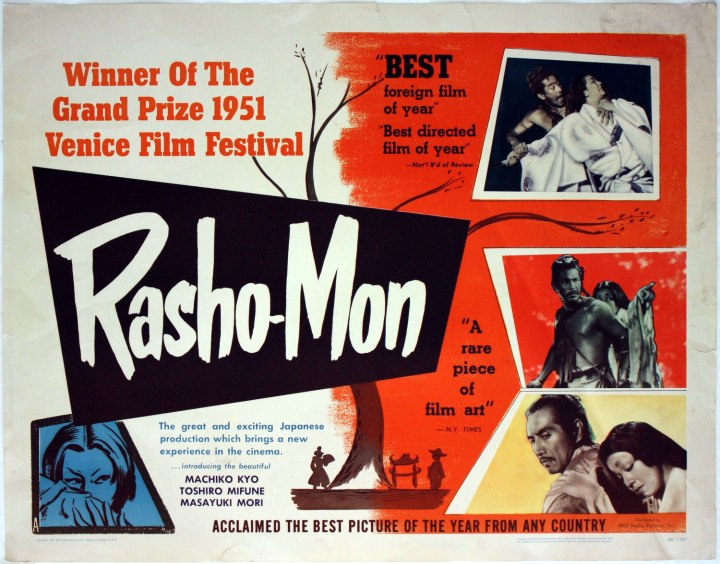
We’ve reached the oeuvre of Akira Kurosawa, and we kick it off with the classic Rashômon, which has been on our to-watch list for years, but somehow we never got around to seeing it. However, when the local cinema put it on earlier this year, we took the opportunity to watch it on the big screen and we did not regret it.
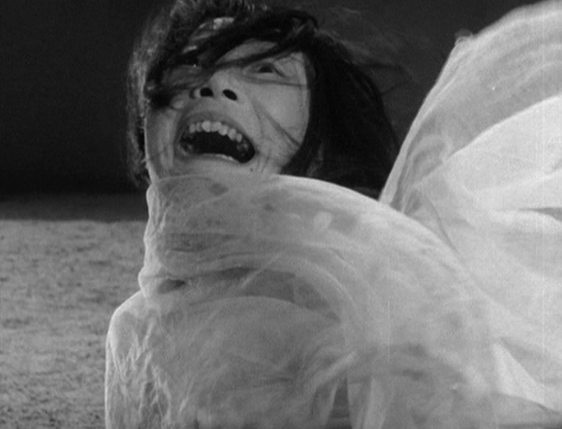
A cinema screen is the only way to get the full impact of this face
Three men, a woodcutter (Shimura), a priest (Chiaki), and a “commoner” (Ueda) seek shelter from the rain under an old, decrepit gateway of sorts. They are all involved to an extent in the death of a samurai (Mori) who was killed in the woods a few days prior to the rainstorm. The audience is then given various accounts of what happened.
The style and level of expertise of the fighters vary with the different accounts
Different witnesses/”persons of interest” tell their version of events but they all have something to hide or a reputation to uphold, so their testimonies are less than credible. Still, we get versions from a bandit who takes credit for the crime (Mifune), the samurai’s wife (Kyō) whose character probably changes the most in the different accounts, the woodcutter, and the samurai himself through a medium. What really happened? ‘Tis a conundrum.
Innocent, exploited victim or unscrupulous femme fatale? Or perhaps just a woman doing what she needs to do to stay alive? You decide!
It’s an amazing and compelling film and we’re very happy to have had the opportunity to watch it in the cinema (however, as we were in a dark room with other people we couldn’t take notes as we usually do, being the nerds that we are). We’re looking forward to more Kurosawa – both the ones we’ve watched before and those which are new to us.
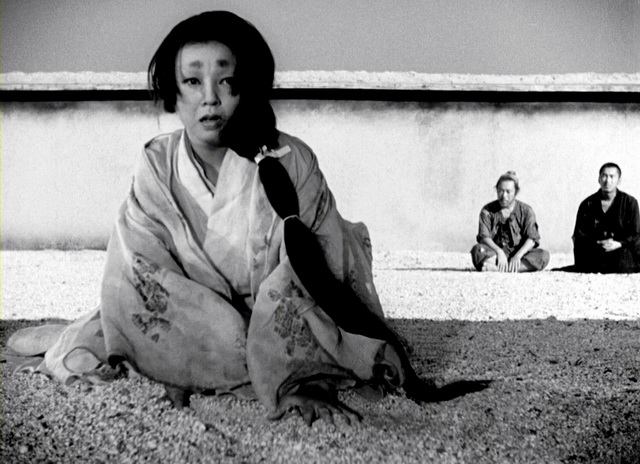
We think a lot of modern Japanese horror films owe a lot to the creepy, creepy medium. She was seriously unsettling…
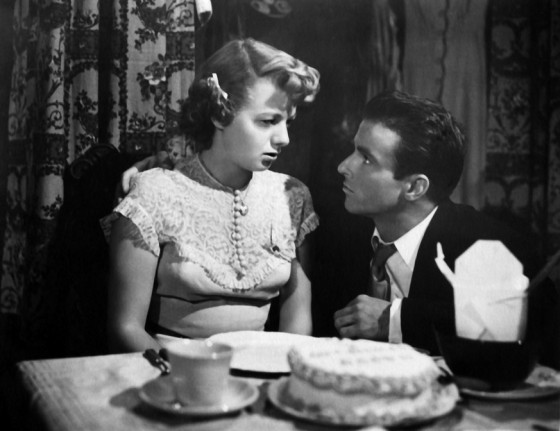
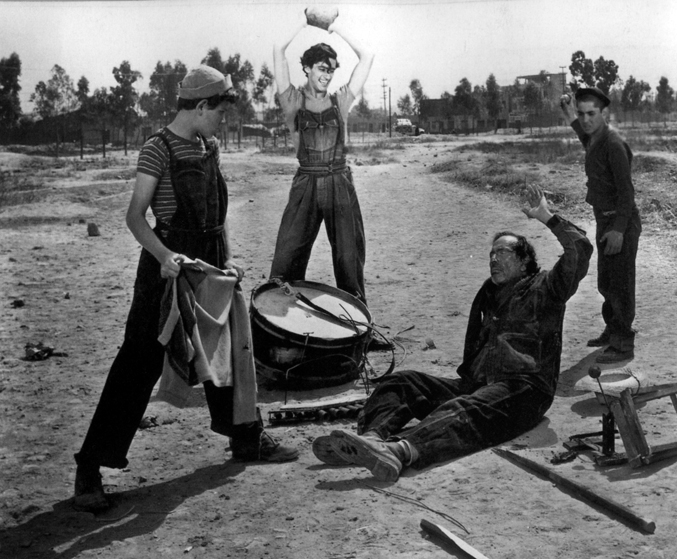
Pop the champagne! We’ve reached number 100! And what an uplifting and optimistic film with which to celebrate. Perfect for a night of champagne and revelry, Buñuel’s Los Olvidados follows the depressing lives of a group of children (of various levels of dental hygiene) in the streets of Mexico through minor and major crimes.
Look! They’re celebrating with us! Happy, happy happy times. Nothing bad will ever happen. La di da di da.
El Jaibo (Cobo), recently escaped from prison, comes back to his old neighbourhood to take up his rightful place as leader of the local children, who he rallies into helping his criminal path by attempting to rob a blind street musician. Brave. Meanwhile, Ojitos (Ramírez) has been left in the streets by his father who seemingly has no plans of returning to pick up his son. The abandoned child is taken care of by Pedro (Mejía) – a good boy who’s abused at home but wants a different life for himself.
The entire film is a laugh riot and not at all depressing as f**k…
Another one of the kids who wants something more from life is Julian, but when Jaibo finds out he has a job and is no longer interested in petty crime he goes into a rage and kills him. Pedro, who witnesses the murder, tries to turn his life around by getting a job, but Jaibo not only screws that up for him, he also literally screws Pedro’s bitch of a mum.
“How dare he aspire to the glamourous life of a blacksmith! I must ruin this for him.”
As a general rule, if one of the kids finds something worthwhile in their lives, Jaibo is there to tear it down. As many other criminals who recruit children, he has no prospects or ambition of his own and therefore wants to drag everyone down to his level to feel like less of a loser.
Los Olvidados is a sad and depressing insight into lives of poverty with a very Un Chien Andalou-dream sequence (which we loved) and frustratingly little hope in the end. If we thought Ladri di biciclette was depressing, it has nothing on this. At least in De Sica’s film there was a loving family and some semblance of hope in the depression – Buñuel’s depiction is pretty much devoid of hope.
We can’t even get into all the shit this little girl goes through
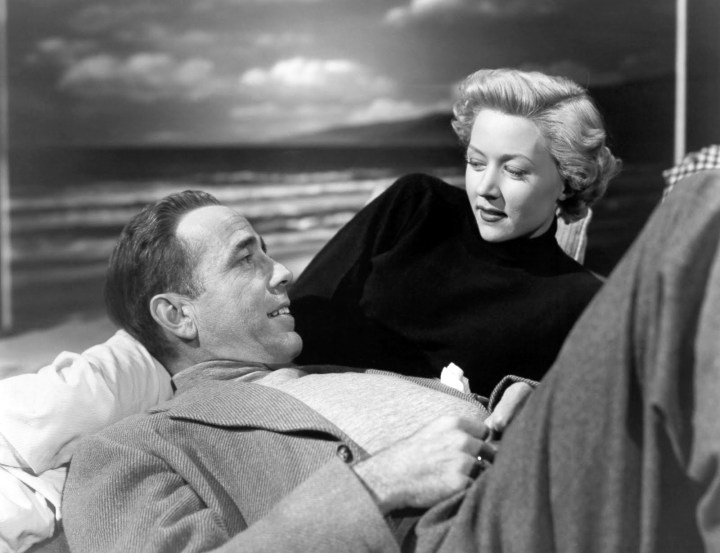
Dix Steele (Bogart) is a successful screen writer whose career is in a bit of a slump. He is about to adapt a novel into a screenplay, and as he cannot be bothered reading the source material, he invites the adorable Mildred (Stewart) home to tell him the story. She cancels her date and goes home with him, and at the end of the night he gives her money for a taxi and sends her on her way.
Dix is too busy creeping on his neighbour to pay attention to the girl in his apartment
When Mildred turns up dead the next day, Dix becomes the prime suspect; he was the last one to see her alive, he has a violent temper and also a somewhat unsettling fascination with murder. In addition, he doesn’t really seem too bothered by the whole affair, which is always a red flag for law enforcement (we have learned through movies). However, his neighbour Laurel Gray (Grahame) provides an alibi as she witnessed Mildred leaving the writer’s apartment, and the police let him go.
Seems the whole creeping-on-the-neighbour-thing went both ways
The two start a relationship (which is kind of a bad idea since she’s basically the only thing standing between him and a lengthy prison sentence) and quickly start spending all of their time together with Laurel working as Dix’s secretary/assistant. While their relationship seems to be mostly good, Laurel is gradually exposed to her boyfriend’s explosive temper and, as in Suspicion, starts doubting his innocence and her own safety.
We won’t reveal too much of what transpires, but In a Lonely Place is a captivating Noir thriller and we never tire of watching Humphrey Bogart being super cool and somewhat menacing, though here also strangely vulnerable. Gloria Grahame is also excellent and holds her own with her iconic co-star.
In between the tension and doubt there are also sweet and romantic moments
It’s an excellent film with a compelling (though ultimately fairly unimportant) murder mystery and a very intriguing relationship. The characters are flawed and deeply human, and while their choices may not always be good, they are understandable.
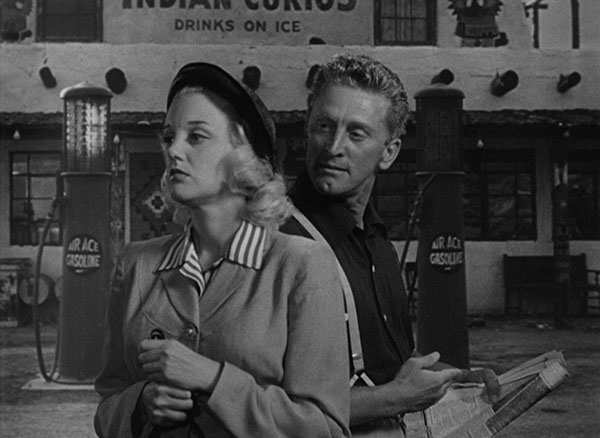
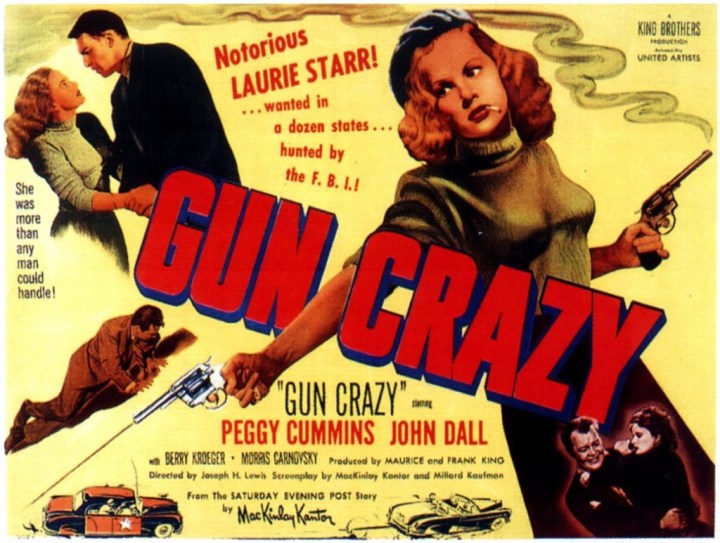
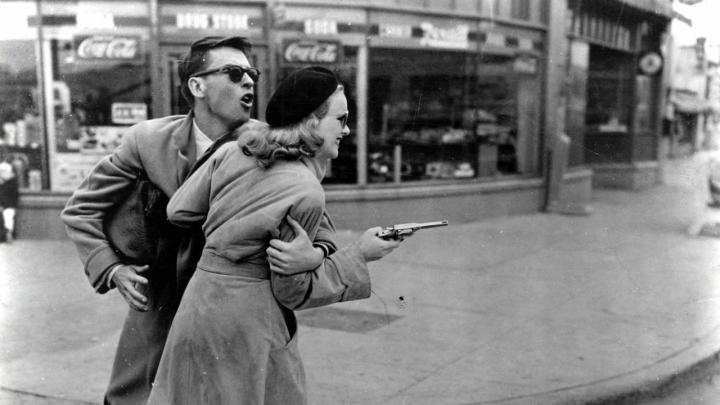
Barton Tare (Dall) has been obsessed with guns (although incapable of killing anything) ever since childhood, when he was arrested for trying to steal one and sent to reform school. As an adult, shooting is his only real skill, and after seeing the alluring Annie Laurie Starr (Cummings) show off her marksmanship in a travelling circus, he joins them as a sharp shooter and goes on the road.
We can’t really blame him for going. Anyone capable of pulling off this look is surely worth risking it all for.
After a short stint with the circus, the two are fired for falling in love while Laurie “belongs to” the circus owner. (Yup, we know…) The lovers go on the road, get married and spend their savings quicker than they probably planned. Laurie has an idea of how they can earn a living and, very much inspired by Bonnie Parker and Clyde Barrow, they go on a crime spree, robbing banks, shops and factories.
Some are more trigger happy than others. See “Deadly is the Female” – original (spoiler) title
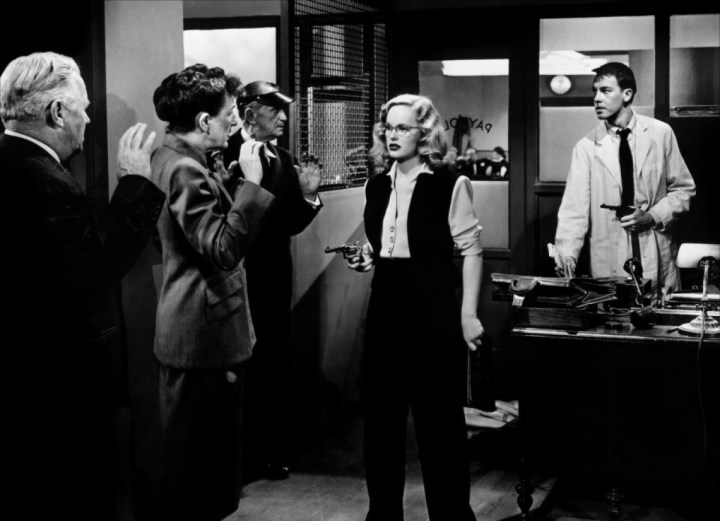
While Bart has a strict no-killing policy, Laurie isn’t as scrupulous. After a factory hold-up gone slightly awry, Bart discovers that Laurie killed two people in the robbery and he is less than pleased.
“Bitch had it coming though, criticizing my slacks!” – Laurie, probably
Despite their difference of opinion regarding the value of human life, Bart is unable to leave the woman he loves, and as the FBI gets involved in the manhunt for the robbers-turned-killers, they take increasingly desperate measures to escape the law.
Gun Crazy was amazing (despite the fact that it pretty much put all the blame for Bonnie and Clyde’s crimes on Bonnie). Laurie may be the Fatalest Femme we’ve encountered so far – not because she is necessarily the most devious one, but because Bart is probably the most “innocent” Noir (anti-)hero in many ways. Sure, he has an unhealthy obsession with guns and firepower, but at the same time he is almost boyishly naïve and truly seems to believe they’ll be able to conduct a series of robberies without hurting anyone. Or he’s just telling himself that, which is the more likely scenario.
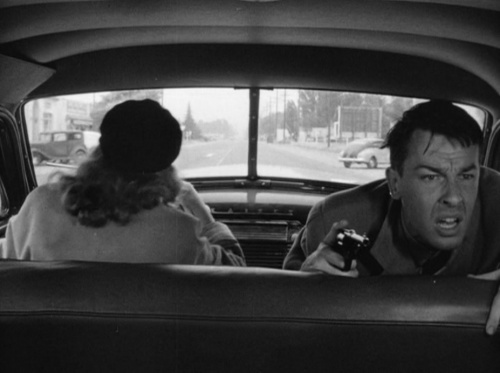
She wears the pants AND drives the car. And he won’t even shoot police officers for her…
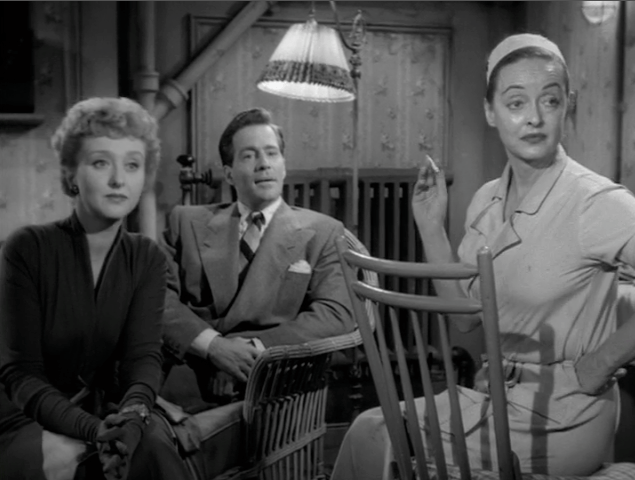
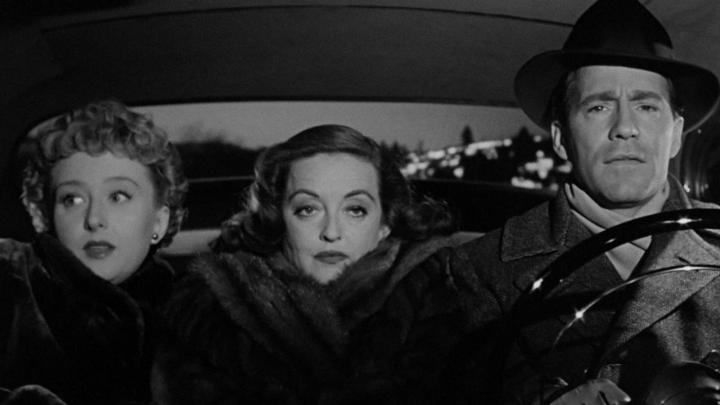
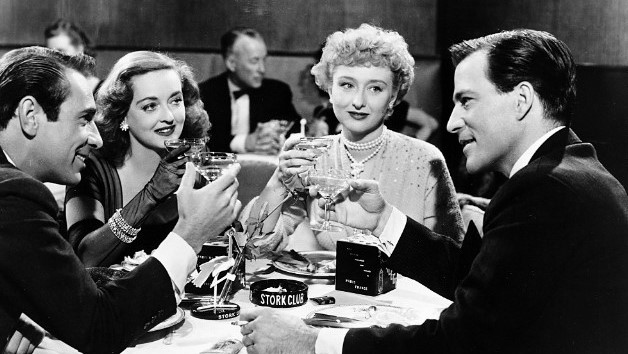
While the title states this is All About Eve, this classic is in reality all about Margo Channing (Davies), an aging theatre actress, and her circle of friends. The show starts with the eponymous Eve (Baxter) winning a prestigious theatre award with Margo in attendance, looking very much less than impressed. We then flash back to their first meeting and get to see what has unfolded up until this point and what brought them there.
“I’d like to thank all the people I’ve screwed over and used on my way here”
After her show one night, Margo’s friend Karen (Holm) invites a devoted fan backstage to meet her hero. The fan introduces herself as Eve and tells her tragic life story, charming both women in the process. Margo, sympathising with her visitor, offers her a home and a job as a personal assistant of sorts.
Leave it to Bette Davies to make even post-show clean-ups look glamorous
As Eve and Margo grow closer, Margo starts to see through Eve’s quiet, unassuming demeanor and realises that she is in fact an ambitious young actress who works on manipulating everyone around her to make it to the top. Coupled with Margo’s own insecurities about aging, this leads to some irrational (but fabulous!) behaviour on her part, as she struggles to convince those around her of Eve’s true nature.
Luckily for Margo, she has the most sarcastic eyes in human history and she makes them work for her!
With the exception of critic Addison DeWitt (Sanders), the men are generally bad at seeing through Eve, while the women catch on to her a lot quicker. In a way though, Eve is just manipulating a system made by men in which she has very little actual power. The ageism, especially towards women, in the entertainment industry comes across very clearly in this film and even the strong Margo eventually more or less gives up her career and marries her longtime boyfriend despite teasing her best friend about her life as a housewife.
No woman is truly happy until she has bagged herself a man [citation needed]
Despite being almost 70 years old, All About Eve never feels old or outdated. It’s a drama with elements of thriller and a lot of comedy, and the two hour run time flies by. As good, and as beautiful, as Baxter is, Bette Davies is easily the star of the film, and we absolutely loved her. A classic for a reason, this is one of those films which everyone should watch at least once. If this isn’t enough to peak your interest (if you haven’t already heard of the film, you philistine!), there’s also an early appearance from Marilyn Monroe. Should seal the deal, we think.
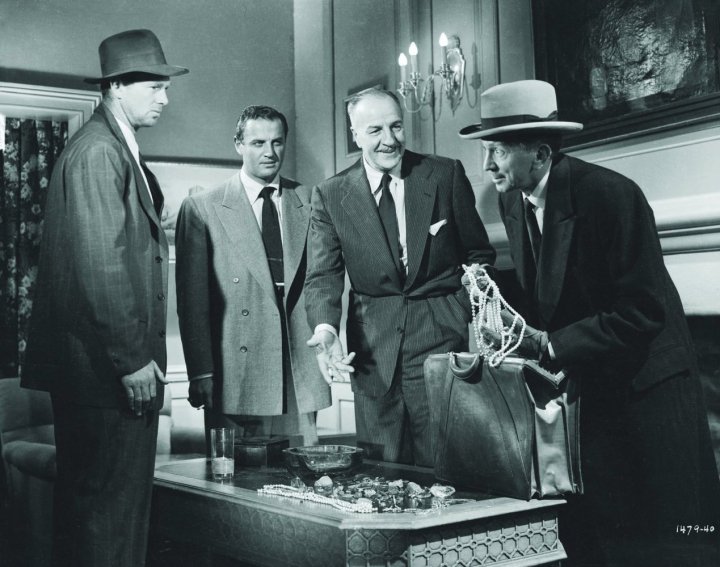
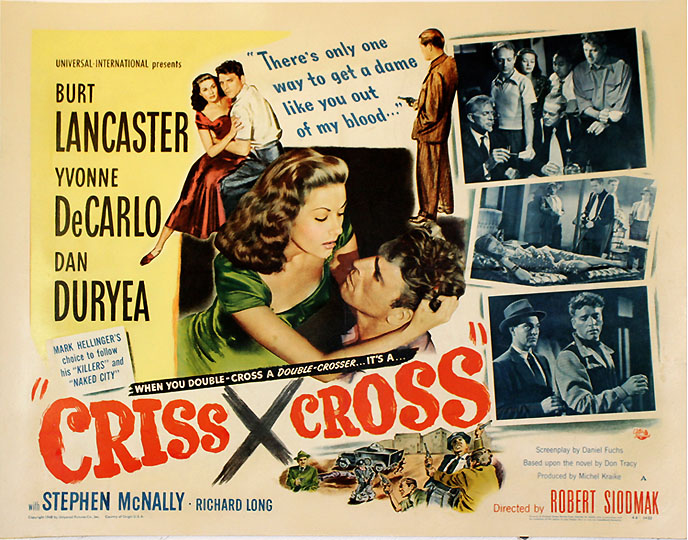
Steve Thompson (Lancaster) has returned to Los Angeles after a year’s absence, and he quickly reconnects with ex-wife Anna (De Carlo) – the main reason he left town a year earlier. While they seem to be ready to start their relationship again, Anna is also pursued by local gangster Slim Dundee (Duryea) and after a series of miscommunications with her ex-husband as well as pride on both their parts, she ends up marrying Dundee.
Her new marriage leads to a lot of sneaking around dark parking lots with her ex. That’s what you get for marrying money instead of…whatever it is Steve is to her. Passion perhaps?
When the lovers are caught in Steve’s house, he tries to cover up their affair by suggesting to Anna’s criminal husband that they join forces for a heist. As an armoured truck driver, Steve offers to be an inside man on a pay roll robbery as long as no one gets hurt in the process. What could possibly go wrong in this scenario?
Alarm bells should have rung when everyone else showed up at the party in variations of this outfit
Criss Cross explores a lot of the typical Noir tropes, such as the good guy whose fate is sealed through a mix of circumstances, bad decisions and, of course, the love for a Dame. In addition, there’s the usual: flashbacks, heists, double-crossings, chain-smoking, heavy drinking, gorgeous dresses, the protagonist’s voice-over, and a gradually darker and darker story line.
As pictured here, Criss Cross also features the typical Noir trope The Decorative Lampshade. Classic!
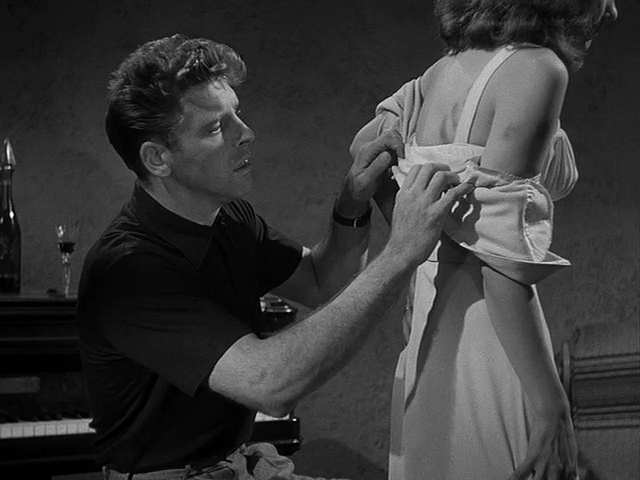
The Dame here is fairly innocent and nice compared to a few others we’ve encountered so far, although looks can be as deceiving as a Dame. Anna almost seems another victim – of men in her case, who treat her fairly crappily and might be to blame for her Dameyness (totally a word!), though some of the responsibility might lie with her (her alternative may have been to end up like the barfly in the Round Up). Her descent into victimization may be just a side effect of her learning that her new husband is not as easy to manipulate and control as her ex, but it may also be that Steve (and the audience) are given a glimpse into why she is who she is.
Bruises are an easy way to evoke sympathy in both exes and audiences (which does not mean the sympathy isn’t justified, by the way).
Likewise, Steve is not as much of an anti-hero as many other Noir characters – apart from his obsession with Anna (and his tendency to fight with her), he seems to be a fairly ordinary man with a normal family and a steady, average job.
Until he starts planning heists, that is. As far as we know, that’s not completely normal. Well, perhaps planning them is, but going through with them is another story!
All in all, we thought this was another wonderful and suspenseful Noir from Robert Siodmak, a master of the genre. Great movie – great rhumba music, courtesy of Esy Morales and his Rhumba Band. Good times!
What we learned: When you Double-Cross a Double-Crosser… It’s a Criss-Cross! Also, organizing a heist to cover up an affair may not be the best idea…
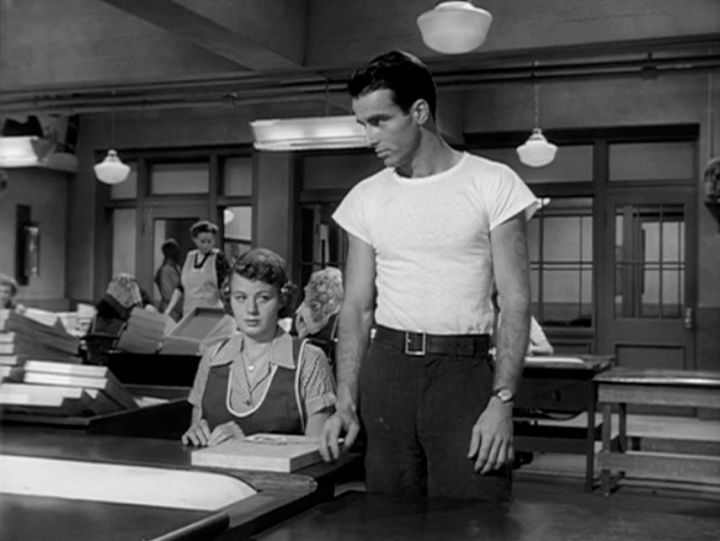
Leonora Eames (Bel Geddes) has one ambition in life: to go to Charm School so that she can be eligible to marry a rich, upper-class man. After saving up all her money to attend said school, she gets a job modelling clothes in a store which, through a series of (un)fortunate events leads to her meeting Smith Ohlrig (Ryan), the epitome of the rich bachelor.
As you can see, she is instantly comfortable in his company
Ohlrig marries his model more to prove he will than because of any true affection for her, and as soon as they are married, she starts to see his true nature. Rather than a wife, he treats her as property – he expects her to be at his beck and call at every hour of the day and even embarresses her in front of his friends and co-workers. To Leonora’s credit, she realises that no amount of money is worth this kind of treatment and she leaves her abusive husband.
As the spoiled man-child he is, Ohlrig’s reaction is to ignore everything not going his way and play his pinball machine instead.
Though not divorced, Leonora is now on her own and gets a job as a receptionist in a small doctor’s office, where she meets Dr Larry Quinada (Mason). For once, she is in the company of a man who expects more from her than being arm candy – she must give her all to her job and show that she can learn. After a somewhat rocky start, she realises that she is capable of more than being a charming wife
Unlike Ohlrig, Quinada is looking for a woman of substance, not flirty “charm girls”
However, despite the lack of love in their marriage, Ohlrig has no intentions of giving his estranged wife a divorce, and his treatment of her becomes more and more brutal throughout the film. In addition, Larry is unaware of her marital status as she is afraid to reveal her real identity to him. Will she be able to escape this mess?
And what’s going on here? Watch Caught to find out!
Caught is a suspenseful noir which we completely loved. While Leonora’s ambition at the start of the film is questionable, it seems as though this is something she has been told to do, more than something she wants deep down. She is reluctant to go to parties she’s invited to, and she is weary of the sort of men who invite random models to parties. Her readiness to leave her rich husband without a penny also speaks to her true nature. She’s sweet and likable although a bit irresolute and helpless in the beginning.
It’s a great watch with an interesting ending (which we won’t spoil) that may have been even more controversial to a 1940s audience than it is today. A very good, somewhat unusual noir with great performances – kind of like Citizen Kane from the wife’s perspective in a lot of ways. Although parts of Citizen Kane is also from the wives’ perspective so it’s not a perfect comparison… Suffice to say – we loved it!
What we learned: The only reason we haven’t married rich yet is because no one ever sent us to Charm School. Damn our equal opportunity, sisters-are-doing-it-for-themselves country! Also, money alone isn’t everything.
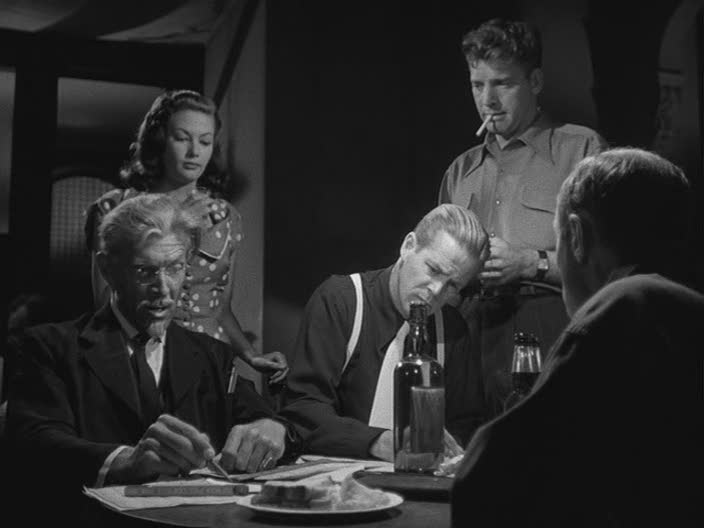
Fred C. Dobbs (Bogart) is down on his luck, roaming around Mexico without a penny to his name. After finally being paid by a scam artist he worked for (a beating proved necessary to get the money he was owed), he teams up with Bob Curtin (Holt) and old prospector Howard (Huston) to dig for gold in the Sierra Madre.
If you came to this film looking for a 1940s Brokeback Mountain you’ll be sorely disappointed. Despite the tension, the clothes stay on at all times.
They head up into the mountains and within a few minutes of run time (though several days for the characters) they strike it rich. Setting up their operation, Howard warns the newcomers about the effects of gold on a man, but Dobbs shrugs it off, stating that he will never be corrupted. He could not possibly be more wrong.
This perpetual scowl on his face is not the look of a man indifferent to the prospect of wealth
The three gold diggers stay in the mountains for the better part of a year, and the tension and distrust between them grow exponentially in that time. When a fourth man shows up intent on joining their operation, they unite for a short while in the face of a common enemy, but their comradery does not last once the threat is gone. With each of them, especially Dobbs, growing concerned with the intentions of the others, they are soon fighting for their lives against both the elements and each other.
The Treasure of the Sierra Madre (or, as our DVD cover says, El Tesoro de Sierra Madre – thank you, Amazon Marketplace) is the first Western on the list and we loved it. There are saloon fights, shoot outs, bandidos, treacherous nature and friends, Indians, and Federales, and it’s tense, dark and dirty. There’s a lot of foreshadowing going on, so from the start you can make fairly educated guesses as to what will happen, but that doesn’t take anything away from the viewing experience. It’s a great watch, and we do love it when Humphrey Bogart plays slightly more villainous characters.
Let’s just think back on the time before it all went wrong, shall we…
Victoria Page (Shearer) is a young, ambitious ballet dancer who, after a party, is invited by ballet impresario Boris Lermontov (Walbrook) to try out for his company. At the same time, young composer Julian Craster (Goring) gets a job with the same company coaching the orchestra. As Vicky rises to be the new prima ballerina (after the old one got married), Julian also rises through the ranks as a composer. The culmination of both their work is a new ballet, The Red Shoes, based on H. C. Andersen’s classic fairy tale. Julian composes while Vicky dances the lead.
While the others work, Lermontov does his very best impression of a creepy old man
The ballet is a great success, and its two rising stars fall in love, something Lermontov is none too happy about. He fires Julian, and Vicky, though torn, decides to go with her boyfriend. She marries him and he starts composing operas, also to great success. However, despite her meteoric rise to fame in Lermontov’s ballet, Vicky spends the following year out of work.
We strongly suspect Julian didn’t like other men’s hands this close to his wife’s hoo-ha..
Next season, Vicky goes back to Monte Carlo on holiday with her aristocratic aunt and runs into Lermontov again. He convinces her to dance The Red Shoes once more, but on the night of the performance, Julian comes and demands his wife choose between him and the ballet. Crazed (or possessed?) by this ultimatum, Vicky loses her mind and her control, just like the protagonist in Anderson’s fairy tale.
Ah – innocence ruined by the lure of passion. It’s like the fairy tale reflects the fate of the innocent ballerina…
It’s clear that Lermontov is supposed to be some sort of parallel to the shoe maker in the fairy tale, but honestly, he’s not the devil here. He encourages her ambition – an ambition that comes from her, not any outside force. Sure, his encouragement comes from mainly selfish reasons, and he may have some ulterior motive of his own, but at least he want her to follow her passion. Julian seems to think she should be content being the wife and muse of a talented composer, despite her own obvious talent which she is unable to develop once they leave the company. In our opinion, Julian is the bad guy here.
It doesn’t help our impression that he shows up for her performance wearing something very close to a Nazi outfit and goes straight for the boobs
This film is spectacular and definitely a new favourite of ours. It’s an intriguing story with great, often eccentric, characters (we particularly love the other members of the ballet company), gorgeous costumes and breathtaking dancing. The performance of The Red Shoes – a ballet within the film – is wonderful and somewhat reminiscent of the Berkeley musicals from the ’30s, beautifully incorporating cinematic effects with amazing dancing to tell the story.
We’re quite certain that the audience cannot be replaced by an ocean in a real live performance.
It seems to us that women’s ambition is a dangerous thing (in which case Lermontov is the devil), although we’re not sure for whom. Is it scary for the men who lose control over them, or for the (fragile) women who will crack under the pressure of trying to balance a traditional role (doting wife and house maker) with a professional career? Possibly both, but it seems like women tend to pay the price – especially in morality tales and fiction (let’s not even go into the sexual undertones of this film and, indeed, the fairy tale on which it’s based).
What we learned: A happy and full life should have room for love and ambition. To have to choose is unfair (especially when it’s one gender asking the other to choose while they themselves can have it all..). Also, things haven’t changed much for ballerinas in the last 7 decades, judging from the parallels between this film and Black Swan (2010).
A recent addition to the list, The Fallen Idol did not disappoint. French ambassador’s son Phillipe (Henrey) is left home alone with his good friend and idol butler Baines (Richardson) and his less pleasant wife (Dresdel) for a few days. Like his namesake (and also ambassador’s son?) in Venom (1981), Phillipe has a penchant for snakes which Mrs Baines is not particularly impressed with.
Mrs Baines quickly establishes herself as an antagonist by killing the boy’s snake, and it comes as no surprise then that her husband is having an affair (she may have killed his snake too, if you know what we mean). Phillipe comes across Baines and girlfriend Julie (Morgan) although he is too young to figure out what their relationship is and assumes that Julie is Baines’ niece.
Phillipe crashes their secret rendez-vous in a scene very reminiscent of Brief Encounter
After Mrs Baines denies her husband a divorce, the unhappy spouses each manipulate Phillipe to learn and/or hide secrets and the poor kid is caught in the middle of the sordid affairs of two grown people who should know better than to involve him. As their conflict escalates, so does the situation – Mrs Baines falls down the stairs and dies. Phillipe, having witnessed a fight immediately preceding the fall, runs away and right into the hands of a (very clever and kind) police officer.
The boy also runs into the arms of a sweet prostitute, but again is too young to truly appreciate the experience.
Police officers investigate the death of Mrs Baines, and Phillipe, trying to protect his friend, weaves a web of lies which does more damage than good, and the last half of the film is a tense investigative affair which we found almost unbearable. The relationship between Baines and Phillipe will most likely never be the same, and Phillipe’s innocence is also lost forever. And not because of the prostitute.
Because of the dead-wife-who-Baines-kinda-hated thing
The Fallen Idol is a great and tense drama, beautifully shot with a very dramatic score. Although we must admit, knowing that Mrs Baines would fall down the stairs (it says so right on the DVD cover), we spent the first half of the film betting on when it would happen. Every time she walked up or down the stairs, we were at the edge of our seats, waiting for her to die (you will not believe the amount of times that woman survives a trip up or down the stairs!). We loved it!
What we learned: A great many things. Do not involve children in your sordid marital drama. Admitting to an affair is better than a murder charge. Also, WTF is “Nosegay”? And where can we get some?