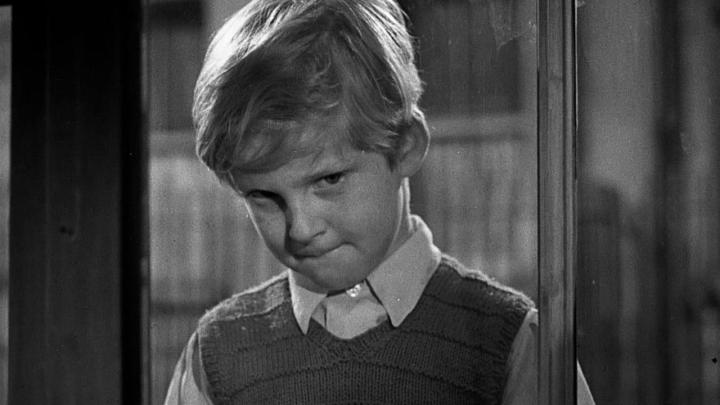
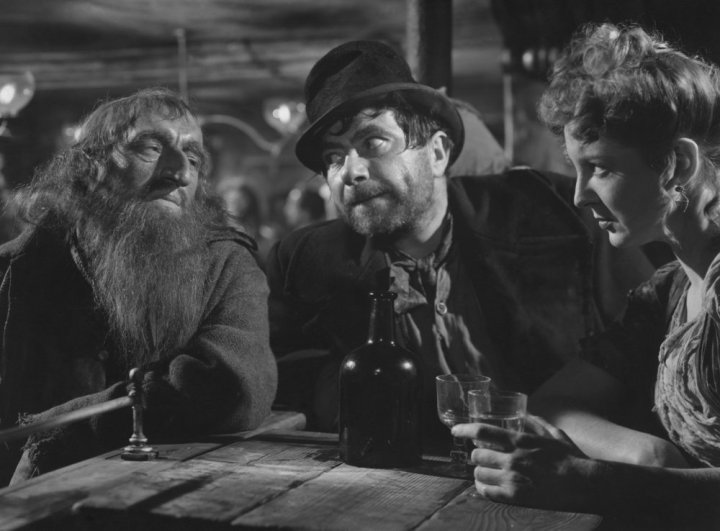
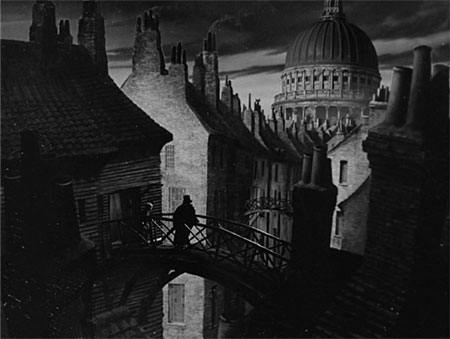
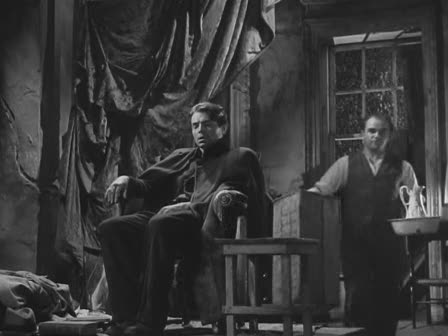
We assume (perhaps mistakenly, but still) that most people have some idea of the plot of Dickens’ 1838 novel Oliver Twist, and so we’ll keep our plot summary to a minimum. Suffice to say, Oliver Twist (Davies) is a poor orphan who is brought up in an abusive workhouse and who, through a series of unfortunate events, ends up alone on the streets of London. He takes up with a band of thieving boys, led by Fagin (Guinness), and the inexperienced Oliver is promptly arrested on his first outing.
Fagin cannot accept responsibility though – he did after all spend upwards of five minutes training the boy before sending him out with Dodger
Oliver is acquitted, falls ill, and ends up in the care of Mr Brownlow who takes him in as his own. But what is their connection? It turns out they are more connected than they originally assumed…
Or perhaps Oliver is just like us, took one look at that library and decided to stay forever
Meanwhile, Fagin and Bill Sikes (Newton), a brutal man who runs the show, are freaking out, worried that Oliver will blow their whole operation. They therefore kidnap him to keep him quiet, but Nancy (Walsh) feels bad for both Oliver and Brownlow and decides to snitch. How will this all end?
Ultimately, Nancy forgot that snitches get stitches…
From the ominous beginning – storm, thorns and torrential rain – to the suspenseful ending, David Lean’s Oliver Twist is a great watch. Lean’s version is a fairly faithful adaptation of the novel although, as with all adaptations, there are fewer details and some parts of the book are only alluded to, changed, or left out completely.
The film is beautiful and atmospheric with gorgeous sets, a great score, wonderful performances and (naturally) Dickensian characters (including the somewhat racially offensive Fagin). We recommend it both to lovers of the novel as well as those who cannot be bothered reading it but still want to pretend they have.
What we learned: The things some people will do for financial gain… Also, lynch mobs are terrifying, whether in the flesh as in 19th century London, or online as in now.
In post-war Rome, Antonio Ricci (Maggiorani) is experiencing the Poverty Catch-22: he is (finally) offered a good job, but the job requires a bicycle which he has pawned to provide for his family and cannot reclaim until his first paycheck. Which he won’t get without his bike. Luckily for Antonio he has a good wife, Maria (Carell), who sells their sheets to retrieve his bicycle. With his mode of transportation back, Antonio is set to start his new job, putting up posters of glamorous stars around the city.
The job also requires expert balancing skills… Biking around with this gear is seriously impressive!
As promising as the beginning is – the tale of a man who works his way out of poverty after someone gave a break – we just know that something terrible will happen. And of course, as the title implies, the bicycle is stolen. On Antonio’s first day, no less. He gives chase, but the thief’s cohorts distract him and send him down the wrong path. He reports the theft to the police, but they do not consider this case a priority. All Antonio can do to keep his job and make a living for himself and his family is to go look for the bike himself.
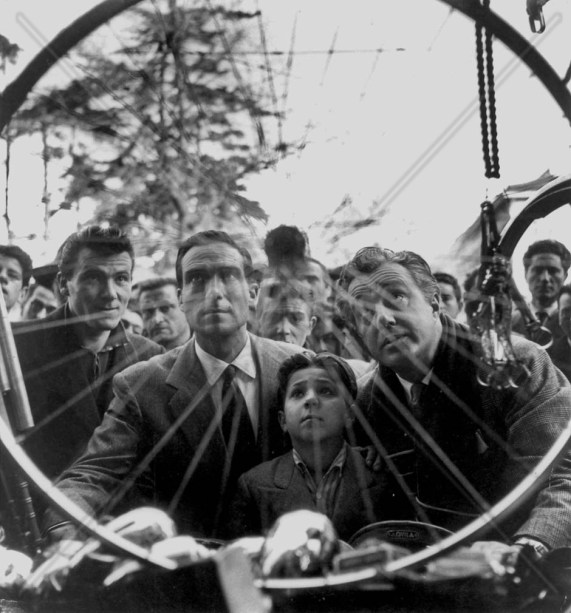
Finding a bike in a city of millions isn’t made easier by their decision to inspect every possible bike in detail
He takes his young son Bruno (Staiola) with him to a market to look for his stolen property, whole or in parts, and they spend the entire day roaming around Rome on their quest. The day puts a strain on Antonio’s relationship with his young son, especially as he, in his desperation, makes some bad choices and cannot live up to the heroic view Bruno has had of him up until now.
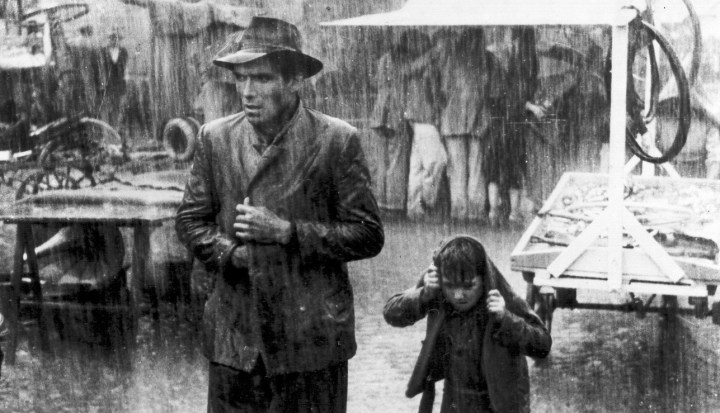
The weather does absolutely nothing to lighten the overall mood of the film
This was a rewatch for (one of) us and not a particularly happy one. Not because we didn’t like the film – it’s amazing, but it is also thoroughly depressing. Antonio and Bruno have a few good moments during their quest such as the restaurant scene (which made us kind of hungry, we must admit), but there is a mood of hopelessness and desperation throughout Bicycle Thieves (the plural noun in the title implies more than we’re prepared to reveal) which stays with you for a while.
However many mistakes Antonio makes though, his son stays by his side. Bless.
Antonio is not a bad man, but he is not really a particularly good one either. He is human and desperate and he acts as such. Which is understandable. The film is an interesting (and beautiful) insight into post-war Italy and the effects poverty has on people. While it is sadder and more depressing than anything we’d willingly expose ourselves to (we prefer to live on fluffy clouds), it is not by far the worst one from De Sica in terms of sob factor. Seriously, if anyone tries to make us watch Umberto D. (1952) again, we might have to resort to violence. That shit is brutal.
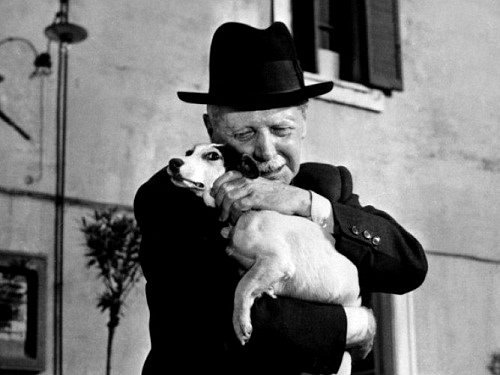
We mean it. If you care at all about dogs or old people (and you should! Both!), De Sica’s Umberto D will mess you up.
Jacques Tourneur goes down a different route than in Cat People and I Walked with a Zombie with this film noir, but it still works.
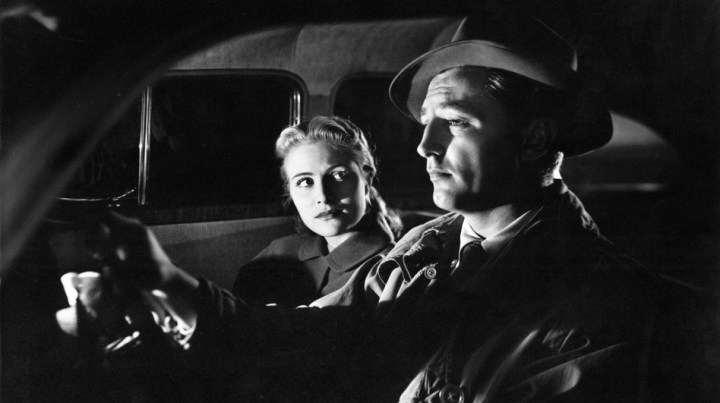
Jeff Bailey (Mitchum) runs a gas station in a small California town, is moderately successful at it (he has at least one employee) and is dating a sweet girl, Ann (Huston). However, he has a past and there are those who won’t let him forget it. One day, Joe (Valentine) saunters into town to drag Jeff back into the world he left behind – a world of criminals and Private Dicks. And, of course, Dames.
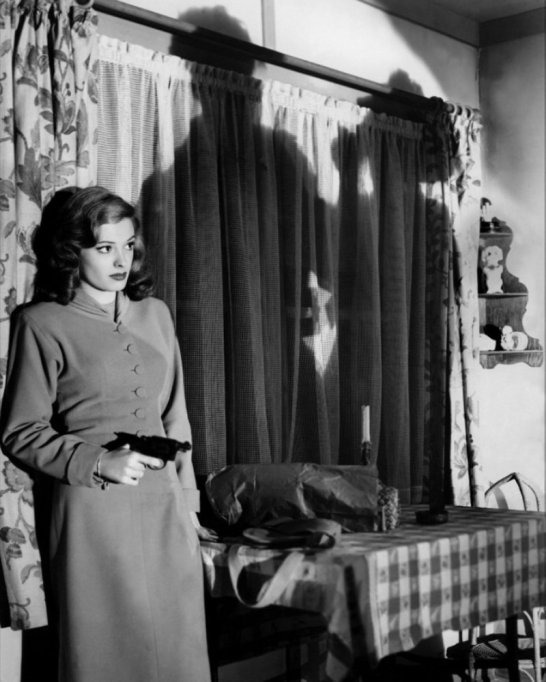
As we have established before, there are good girls (pictured above) and then there are Dames
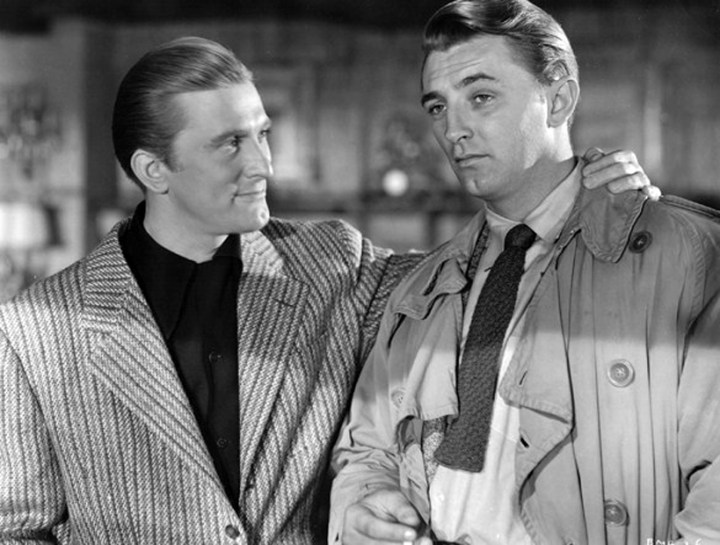
Jeff spills the beans to his girlfriend and tells her all about a romance he had back in his private detective days with a certified Dame, Kathie Moffat (Greer). He was hired by her ex boyfriend/stalker/victim Whit Sterling (Douglas) to track her down after she had shot him and run away with $40 000 of his hard earned and totally legitimate money. Jeff follows Kathie’s trail to Acapulco and strikes up a conversation with her, which turns into a whirlwind romance. He lies to Whit and takes Kathie with him to San Francisco to start a new life. Which doesn’t exactly go as planned.
Turns out you can take the Dame away from Danger but you cannot take Danger away from the Dame
This could have been the end of the story, but Joe’s appearance means Jeff’s past is about to catch up with him. Kathie has gone back to Whit and Jeff has no choice but to do one last job for him. A job which includes murder, frame-ups, tax evasion and even more double-crossing dames.
As we mentioned, this is quite the departure from the previous Tourneurs on the list, but there’s still something distinctly Tourneur about it. We’re just not film scholarly enough to point out exactly what that is… Suffice to say, we enjoyed Out of the Past (almost) as much as his earlier ventures into horror (“almost” because horror is our lifeblood). It is exciting and fun with the most duplicitous of Dames, but there’s also love and romance, heartbreak and sorrow. Extremely enjoyable!
What we learned: Drinks in Acapulco are too cheap. They keep leaving half empty (half full?) glasses in bars!
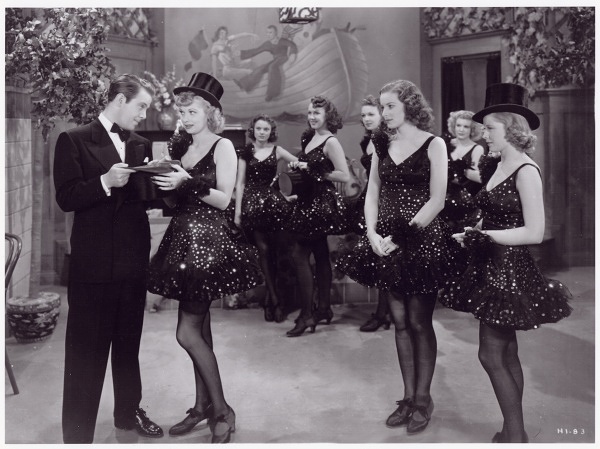
We’re going back in time to catch up on a recent addition to the list, and what a great addition! Judy O’Brian (O’Hara) is an ambitious young club dancer with ballet dreams. However, when she goes to a meeting with Steve Adams (Bellamy) to audition for the American Ballet Company, she sees the professional dancers and is intimidated by their (very impressive) skills. Thus, she runs out before seeing Adams.
Adams leaves his office at the same time and tries out his smooth umbrella game on Judy, but is brutally rebuffed. She goes back to the apartment she shares with a fellow dancer and they are visited by Bubbles, aka Tiger Lily White, (Ball) – a former dancer in their troupe who has made a name for herself in Burlesque. She is looking for more girls and hires Judy as a stooge – she is to dance ballet during breaks in Bubbles’ set to rile up the men who have not paid to see art.
These people paid good money for a striptease and she doesn’t even have the decency to wear a short tutu!
As if Judy’s life isn’t complicated enough, she also starts dating Jimmy Harris (Hayward) – a rich drunkard who is still in love with his ex-wife. When Bubbles finds out she goes after Jimmy herself, and the humiliation of her job, Bubbles’ insensitivity and her crushed ballet dreams culminate to enrage the so far kind and sensitive Judy.
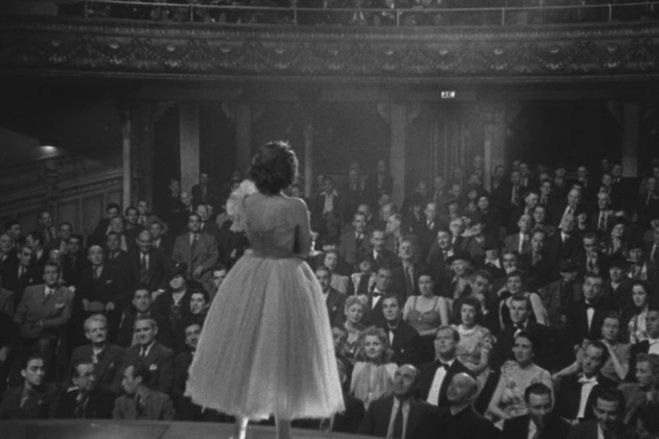
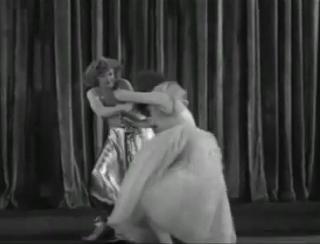
The audience finally gets their money’s worth when a cat fight ensues
After an amazing speech to the leering audience, Judy gets into it with Bubbles who, after initially playing the outraged victim, reconciles with her fellow dancer and with herself. As for Judy, she has another encounter with Adams and things are definitely looking up.
Dance, Girl, Dance was a great addition to the list. It has strong female characters and great dance scenes – two things we absolutely love. The fact that this is the first film with a female director comes across as well (although there are of course male directors who can write and direct women – we’re not trying to be sexist here). The issues addressed in the film are interesting coming from a female perspective, and Dorothy Arzner handles the lives of dancing girls in the ’40s with a slightly different take than Busby Berkeley. Great dance movie – great movie!
What we learned: is it worth sacrificing one’s dignity for fame and money? Also, a double feature night of Dance, Girl, Dance and Split (2016) leads to strange dreams of James McAvoy as a ballet dancer…
P.S. Confused about numbering? Check out this handy disclaimer!
In an unnamed Northern Irish city (our money’s on Belfast), Johnny McQueen (Mason), recently escaped from prison and hidden ever since, is planning a robbery/heist with his cohorts to raise funds for their (also unnamed) organisation. Despite not having been outside for years, Johnny is set on carrying out the plan himself, even when one of his mates offers to go in his place. However, during the heist, he suffers some sort of existential crisis (or perhaps agoraphobia) and things go wrong. Johnny shoots a man and is himself injured, and has to go on the lam.
Is this some Omenesque foreshadowing? Stay tuned to find out!
The now injured Johnny first hides in an air raid shelter and after Dennis (Beatty) helps him escape his hiding place he roams the city looking for safety and help with his injuries, meeting all sorts of interesting and colourful characters along the way.
With the authorities hot on his heels, the people he meets are sympathetic but afraid to help. Most of them give him a drink and send him on his way, scared to get involved but not willing to turn him in and collect the reward. Meanwhile, his girlfriend Kathleen (Ryan) is also looking for him and enlists the help of Father Tom (Fay) to save her love.
As the backdrop of all this drama, we see the local kids hero worshipping and celebrating him, in many ways turning him into some sort of Messiah figure. Unfortunately, we all know what happened to Jesus, so this is not necessarily a good sign. Johnny spirals, deteriorating both physically and mentally, and he has to try to come to terms with what he has done and what will happen.
The snow keeps falling heavier and heavier which, again, we find somewhat ominous
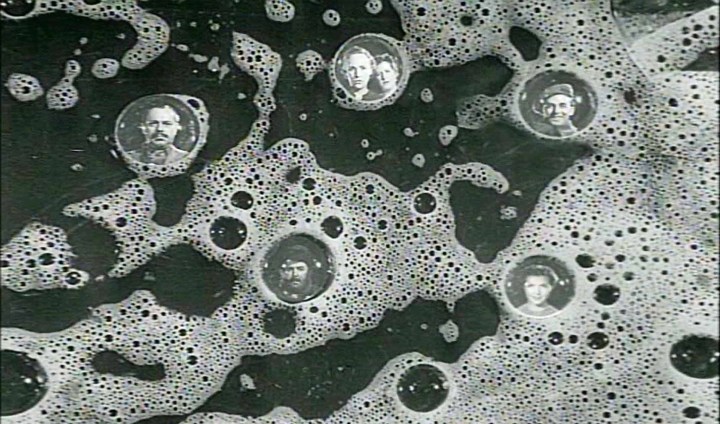
Odd Man Out is a lot more slowly paced than the other Noirs we’ve watched lately, which was a nice departure. We loved the performances, the beautiful sets (the ravages of “conflict” are evident in the decrepit buildings), the lighting, the score, and particularly the visions in the beer foam and the moving portraits. It’s a long and slow watch, so you have to be in the right mood, but it is definitely worth it.
Pro tip: once you start seeing this in your spilled beer, it’s time to go home
Edmund Goulding’s Nightmare Alley brings us back to the carny world of Freaks, complete with a Geek (not the computer kind though; more the rip-the-heads-off-of-chickens-with-his-teeth kind). It’s a world we’ve missed and we were very happy to be back.
The Geek is ever present though never shown on screen. Our filthy, sensationalist minds were only slightly miffed.
Zeena, Mentalist Princess (Blondell), is mentoring Stan (Power), an ambitious young carnival performer. Stan learns of a secret code which Zeena and her now alcoholic husband Pete (Keith) used to “tell fortunes” back in their Vaudeville days, and he is set on learning it. However, Pete will have none of it and forbids his wife from teaching it to Stan or anyone else.
“If only something could befall this desperate alcoholic..!”
One dark night, there is a fatal (if accidental?) mix-up of bottles, and Pete has drunk his last drop. Unable to perform alone, Zeena teaches Stan the code and the two of them resurrect her old clairvoyant act. That is, until Stan is caught fraternizing with fellow performer Molly (Gray) and the lovers are forced to marry, leave the carnival and set up on their own.
With his new wife, Stan starts performing in hotels – a step up from the traveling carnival circuit and with a slightly more powerful and respectable clientele. As his audience and his reputation grow, he strikes up a (probably platonic) relationship with a consulting psychologist, Lilith Ritter (Walker), who treats many of the city’s elite. When he learns that she records her sessions, he teams up with her to use her clients’ personal information to gain their trust and their money.
He underestimated how fatale this femme really was…
Stan becomes the victim of his own hubris and ambition. No matter how many of the women (and Tarot cards) in his life try to warn him that he is crossing the line he keeps pushing, making himself out to be almost a Messiah figure, and in the end something’s got to give. The story comes full circle – we start and end in a traveling carnival where people make their own fate. Nightmare Alley is in many ways an Ikaros-tale, and it’s an intriguing and hypnotic watch. We absolutely loved it!
Also, Joan Blondell, who we loved in the BusbyBerkeleymusicals, got even better with age!
Brighton. A cesspool of crime, run by gangsters and desperation. On top of the ladder following the death of old kingpin Kite: Pinkie Brown (Attenborough), a young but ruthless man. As newly appointed leader it is his duty to avenge the death of his former boss, and he blames reporter Fred Hale. So he disposes of him.
Fred wasn’t the only victim. Those glasses had once offended his mother so were also promptly disposed of.
While there are no witnesses to the actual disposing (which by the way was an excellent scene), Ida Arnold (Baddeley) who had spent most of the day with Fred, gets suspicious and starts her own investigation. At the same time, Pinkie’s associate Spicer (Watson) royally messes up while trying to establish an alibi for the gangsters, and accidentally leaves behind a potential witness – 17 year old waitress Rose (Marsh).
Luckily, Rose is a mature, intelligent woman, not easily manipulated or an easy victim, and she brings the gangsters down. Just kidding!
To stop Rose talking, Pinkie starts dating her, and while he may very well be the worst, broodiest date ever, she is an inexperienced, naïve Catholic girl and she falls for him. Silly child.
She even tends to his battle wounds, that sweet summer child
Their (insanely wrong) romance blossoms, but that is about the only thing going right in Pinkie’s life. Ida continues her investigation and stumbles across Rose who accidentally reveals a crucial piece of information. Meanwhile, Pinkie’s business is under threat from Colleoni, a rival “businessman,” which puts another cog in his wheels.
Later, his rival also puts a scar on his face and fear in his eyes
As his story progresses, Pinkie gets more desperate and more violent and it all builds towards an inevitably bleak ending, particularly as he introduces some Romeo and Juliet-type scenario to his new, doting wife. We’re not entirely sure she paid attention in English class, or perhaps she is still so young she thought it all romantic.
We’ve heard the end referred to as fairly “happy”, but we cannot help but think Rose would be better off knowing the truth about her marriage as it would at least leave her with a chance to move on. As it stands, she may be lost forever.
Brighton Rock is suspenseful to the point of being stressful, and it’s a very good watch. The performances in the film are great, and we really enjoyed it. Definitely worth watching. We will leave you with a picture featuring Ida and Dallow (Hartnell – aka The Doctor), as we have not managed to squeeze them in anywhere else.
We threw in a couple of police officers for good measure. Enjoy!
What we learned: if a shady character indirectly sort of threatens your life, don’t marry him.
Sister Clodagh (Kerr) is tasked with starting a convent high up in the Himalayas. To aid in her quest, she is offered four companions; Briony the Strong (Furse), Philippa the Gardener (Robson), Blanche (aka Honey) the Sweet (Laird), and Ruth the Difficult (Byron). Together, they travel to the great unknown to start a school and a hospital for the locals.
Luckily for them, nothing ever goes wrong when a group of people are stranded in a remote, albeit beautiful, location
They quickly establish a school where they teach children about guns, and a hospital where they treat people who are sick, but not too sick. With the help of government agent Mr Dean (Farrar) and the local General (which is apparently a code name for royalty), who pays locals to visit the convent, the nuns flourish, at least for a while. They also take in a young local girl, Kanchi (Simmons), who has been hitting hard on Mr Dean with no luck.
It’s hard to be the only eligible bachelor in the area. He needs help controlling the urges of the women crossing his path.
When the Young General (Sabu – an actual Indian) comes to learn, the sisters are sceptical about admitting a man into their midst, but they eventually let him join their lessons, which Kanchi is thrilled about.
As the film progresses, all the nuns experience changes. Sister Philippa has a crisis of faith and ends up planting flowers instead of the vegetables she’s supposed to be growing for the convent. Sister Clodagh keeps having flashbacks to her life prior to life as a nun, reliving her past relationship back in Ireland with a man she thought she would marry. Sisters Blanche and Briony have to make some tough choices in regards to a sick infant, one which has consequences for all the nuns. However, sister Ruth’s break from reality is the most intense and sinister, which makes the last 20 minutes of the film play more like a horror film than the melodrama of the first hour.
This is what happens when you question your choice of celibacy
Ruth falls in love (or lust) with Mr Dean, and she becomes insanely jealous of Clodagh as she suspects (rightly or not) that the Sister Superior feels the same way. While the nuns blame the clear air and the water of their new home for their new emotions, it is quite possible that the convent itself might be partly to blame. We learn early on that the palace used to be a House of Women – a house for concubines and wives of the royals, and it seems the women go mad with lust and desire, in some form or another, in this building.
We enjoyed this film a lot. We have to admit that for the first 50 minutes we were not entirely sure what the point was – why was this film made? Beautiful as it was, it didn’t seem to be going clearly in any one direction. However, everything comes together in the last half. It is a strange and bizarre film, but we loved it nonetheless. Ruth’s transformation is wonderfully creepy and the endless drumming towards the end of the film are very reminiscent of I Walked with a Zombie, which adds to the feeling of horror of the last half hour. If you’re up for something weird and unusual, you should check out Black Narcissus. It’s quite the experience.
Belle (Day), the beautiful young daughter of a merchant, is being Cinderella’d by her rooty tooty snooty sisters after their family’s fortune was lost at sea. As her father gets word of one of his ships having reached port safely, he travels to the city to regain some of his fortune, only to find it has all been seized in payment of his debts. Returning home through a scary forest in a storm, he seeks shelter in a castle which seems abandoned yet has a marvelous feast set out for him.
There’s nothing at all sinister or creepy about the place
He spends the night in the castle and, when leaving the next morning, picks a rose for his daughter as that was her only request for a present. Big mistake. A frightful Beast (Marais) sets upon him and tells him he must die for this offence. The merchant manages to make a deal to go home home to see his family if he promises to return promptly or send a family member in his place. Belle, being the good daughter, offers to go to the castle instead of her ailing father.
The pretty dresses and jewellry sort of make up for the creepy living statues and ornaments of her new home.
Instead of finding a primitive beast ready to devour her, Belle meets a gentlemanly one who proclaims her mistress of the castle and himself her humble servant. She stays with him for months, and though every night she refuses his marriage proposal, they develop a friendship and companionship which is quite mutual, despite him looking like he’s always on the verge of reciting Shakespearean soliloquies. Case in point:
We’d like to think his tendency to lurk behind her is more a kindness so that she won’t have to look at him, rather than something sinister. Despite the neverending marriage proposals.
After a while, Belle finds out that her father is grievously ill and asks to go home to see him. The Beast agrees on the condition that she returns one week later, and gives her a magic mirror to see him, his glove which will return her to the castle whenever she’d like and, for some reason, the key to his fortune.
“I’m sure there’s no way anyone would abuse that power”
Of course, Belle’s cunty sisters, her idiot brother and his friend Gaston, uh, we mean, Avenant (also played by Marais), persuade her to stay on a bit longer, steal her key and decide to go kill the Beast and steal his fortune. However, Belle sees the Beast half dead from grief in her magic mirror and uses the magic glove to return to him at the same time her brother and Avenant arrive to dispose of him. There are declarations of love, the Beast transforms to his true princely form and all live happily ever after. Except for the intruders, one of whom is himself transformed (to take the Beast’s place as guardian of the castle? Of the afterlife? Of purgatory? Who knows?), but that’s their own fault.
“Them bitches had it coming, trying to interfere with our strange and possibly Stockholm syndrome-induced romance!”
Cocteau’s version is a very faithful adaptation of the traditional French fairy tale despite him, naturally, having taken some artistic licenses. Visually, this film is wonderful with amazing details, especially in the enchanted castle which is like Barbie’s Gothic Dream House – creepy but luxurious. The disembodied arms which act like servants and the half-living statues that adorn the halls and rooms are fantastic (in all senses of the word) and add an extra layer of surrealism and magic to the film. The costumes are extravagant, if not necessarily always flattering, and the beast is superbly made up.
The food even looks appealing in black and white, which is impressive in itself
If your only cinematic experience of Beauty and the Beast is the 1991 Disney version, we really recommend this one as well, as it is a very different perspective on the same story.
What we learned: women must learn to look beyond physical appearance, but the same is not necessary for men. Also, don’t trust your relatives – them bitches be greedy!
As Peter Carter (Niven) is plunging towards certain death in a shot up plane May 1945, his final moments are shared with radio operator June (Hunter) and the two, as people are wont to do in these intense situations, fall in love. He ejects from the burning aircraft without a parachute and is surprised to find himself alive on shore some moments later. Surely, the fall should have killed him?
How much imagery of nudity, flutes and goats do you need to convince yourself you’ve reached hell?
Turns out, it should have. Up on the celestial plane, the clerics are confused about the lateness of his arrival until they find that his Conductor, a very camp Frenchman (Goring), lost the pilot in the fog and thus neglected to collect his soul.
“Bonjour! Je suis le campest Frenchman you’ll ever meet. Bon bon, mon petit fromage!”
Unfortunately for the clerics of the afterlife, in the few hours of “extra” life Peter got, he met and fell in love with June which greatly complicates things. As he is not at fault here, is it fair to take him away just as he has found the love of his life? Since it was their mix up that caused this to happen, the celestial beings grant Peter a trial with his life at stake.
Celestial trials have the most impressive courtrooms
Meanwhile, in our own world, June has enlisted the help of a doctor friend of hers, Dr Reeves (Livesey, of Colonel Blimp-fame), as her new love is suffering headaches and possible hallucinations after jumping from a plane without a parachute… Naturally, the medical professional diagnoses Peter with head trauma and recommends surgery, to coincide with the patient’s heavenly trial.
This was a beautiful and engaging film which we completely loved. The relationship between Peter and June is lovely, although a bit hasty. She’s either very wonderful or very naïve to stick by him when he starts talking crazy after they’ve known each other for all of a day. The trial becomes very political, and much of the criticism against England from the USA could have been modern criticism against the US, which is very interesting to observe (especially given the newly instated president..). It’s like both countries have a history of proclaiming themselves above others and trying to impose their rules on other nations…
The sets are beautiful and impressive, especially on the other plane.
Such as the stairway, or escalator, to heaven, for instance
In a way, this film is like an opposite Wizard of Oz, as our world is in glorious technicolor while the other world is in drab black and white. Then again, our world is supposed to be the desirable one so it makes sense. A Matter of Life and Death has humour, excitement, adventure, romance, political undertones, history lessons, camp Frenchmen and gorgeous shoes! What’s not to love?