Starring: Paul Newman, Robert Redford, Katharine Ross, Strother Martin, Cloris Leachman, George Furth
Year: 1969
Runtime: 1h 50min
Remember our ongoing series of discovering we enjoy westerns a lot more than we thought we did? Here’s another entry! To be fair, this one we knew we liked – we’ve seen it several times before, and we’re pretty sure our dad had it recorded from TV when we were growing up. It’s been about 20 years since our last rewatch though, so we were pleasantly surprised by how good it actually is!
In fact, we were blown away! Hah! We’ll see ourselves out…
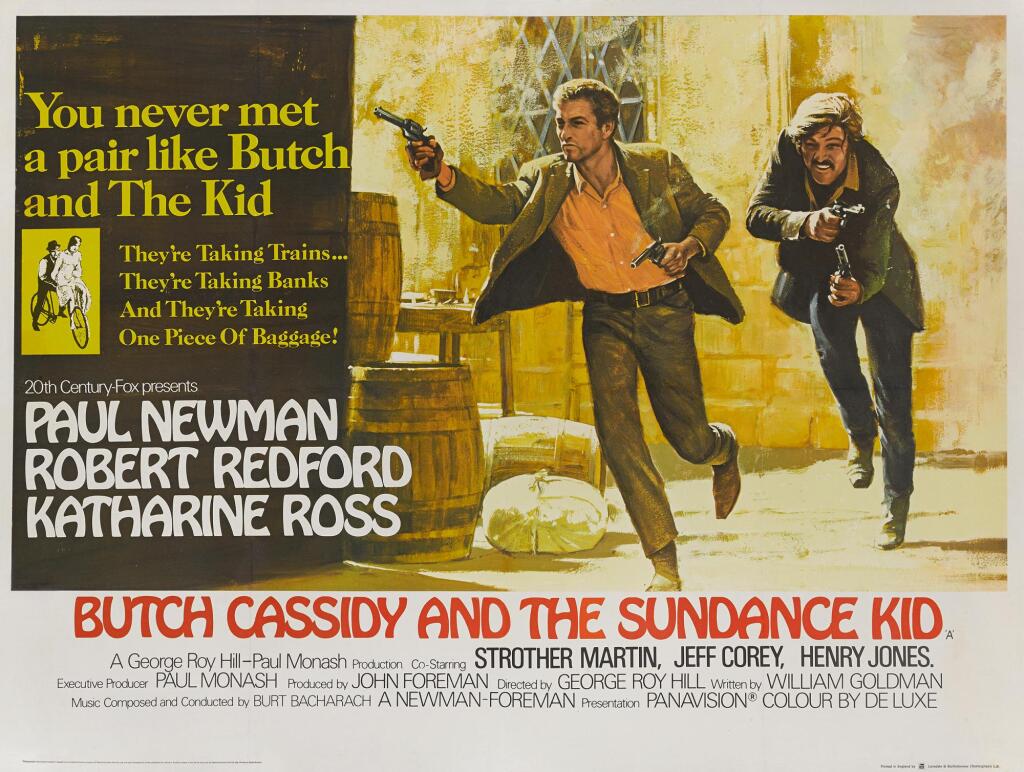
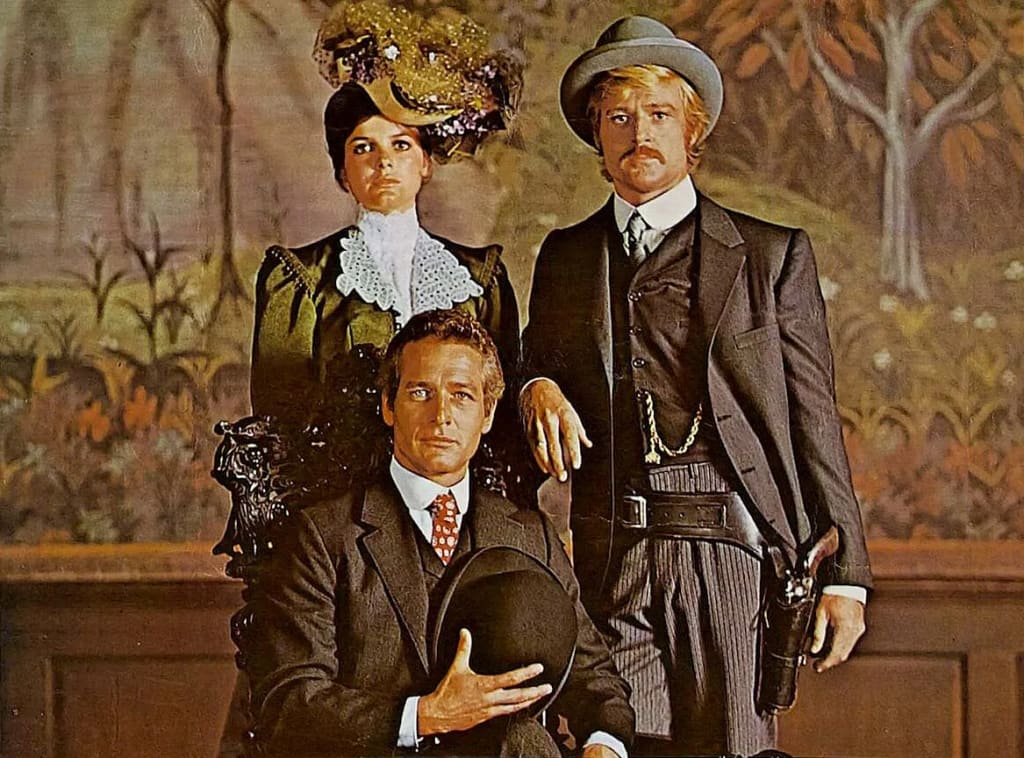
Butch Cassidy (Newman) is the leader of the infamous Hole in the Wall-gang, a group of outlaws who rob things. Trains, banks, you name it! His position as leader is supported by his bff, sharpshooter Sundance Kid (Redford), made evident when another gang member tries to usurp control.
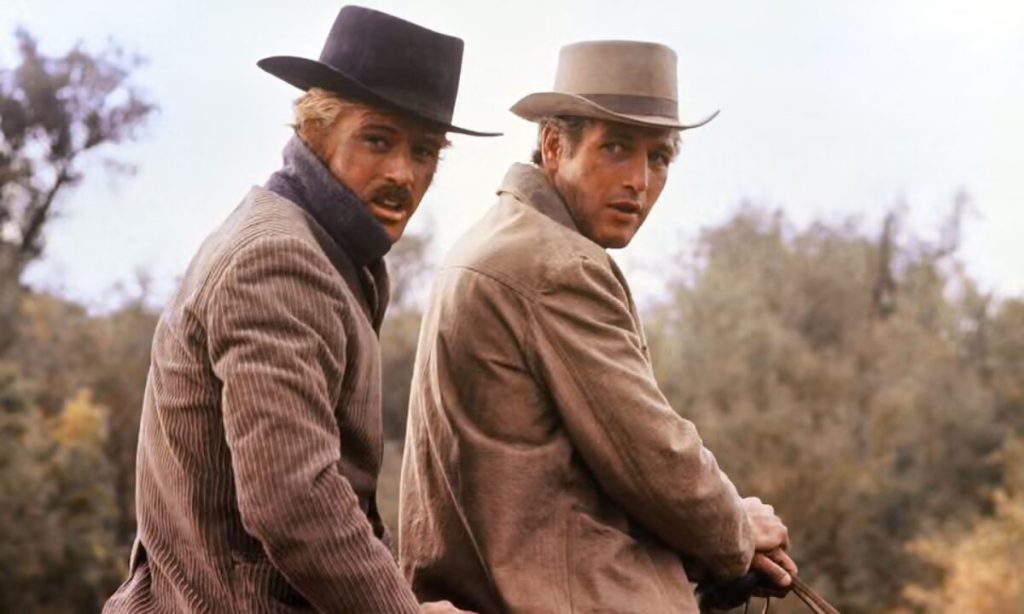
Cowboys who ride together, chide together! Or something…
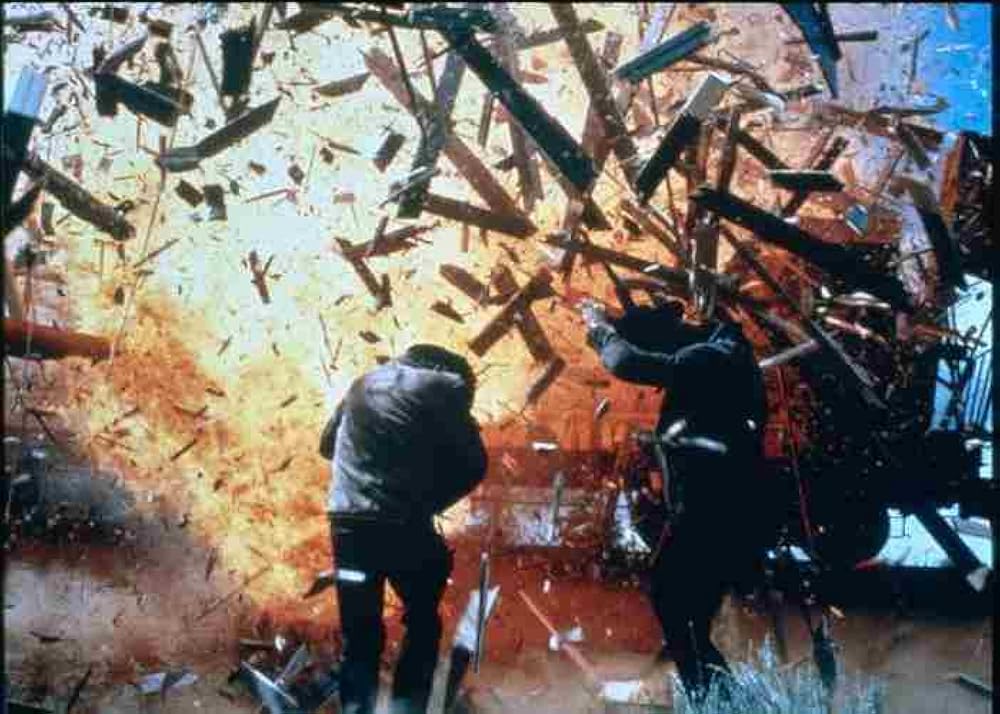
After a successful (and very polite) train robbery (shoutout to our man Woodcock!), the pair get reckless and decide to go for a second one. With way too much dynamite (another shoutout to our man Woodcock!). However, by this point the authorities and E. H. Harriman of the Pacific Railroad have had enough and hired an elite group of trackers and hunters to ambush and kill the gang. So Butch and Kid must go on the run – they pick up Kid’s girlfriend Etta Place (Ross), and decide to go to Bolivia. Pretty much on a whim.
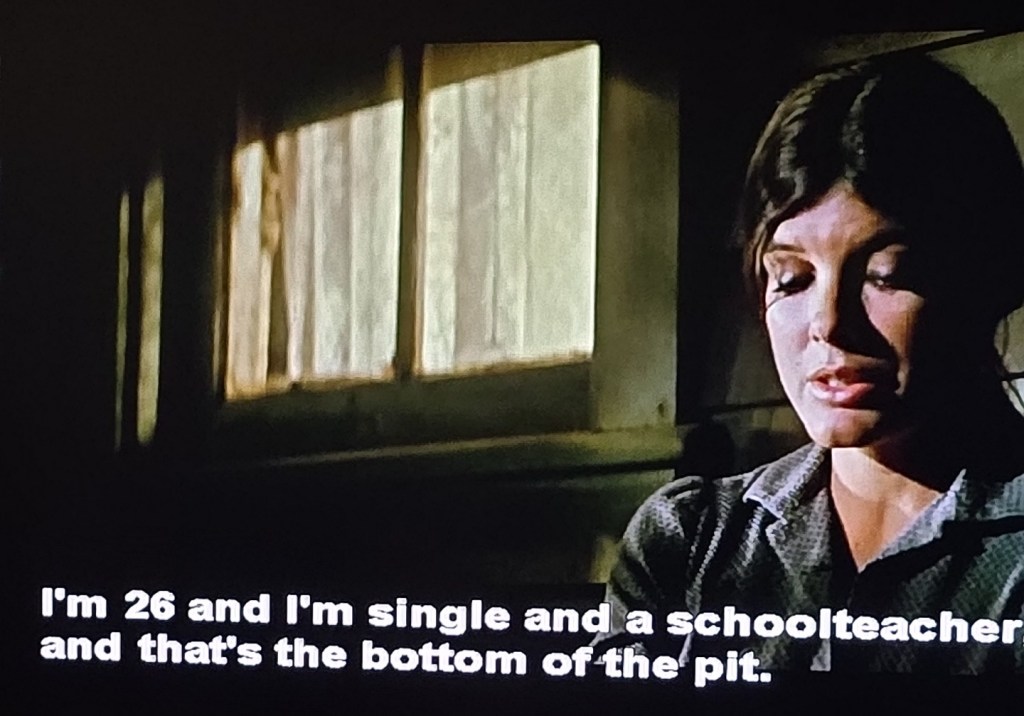
Etta’s reasoning for joining them. I have never felt more personally attacked by a movie character in my entire life…
Butch Cassidy and the Sundance Kid is fantastic! We love the relationship and banter between the two leads, the myriad of entertaining side characters, the projection opening, the use of sepia, the montages, the soundtrack, the bicycle salesman, how Etta’s hats kept growing, Butch’s committment to giving sex workers orgasms, and Woodcock. The movie is very funny, very charming, and filled with excitement and adventure. It is easy to root for the outlaws despite them being criminals – in addition to their charm they are mostly nice, polite and non-violent in their interactions with their victims.
Her hat has not yet even reached its final form
We are left with some questions though: 1: How do you ride DOWN to La Paz? 2: Where is the line between a couple plus one of their best friends, and a throuple? And how (un)healthy is it to be kind of indifferent to which person in a friend group you actually date? (This miiiight go for all three of them) 3: Who are those guys?
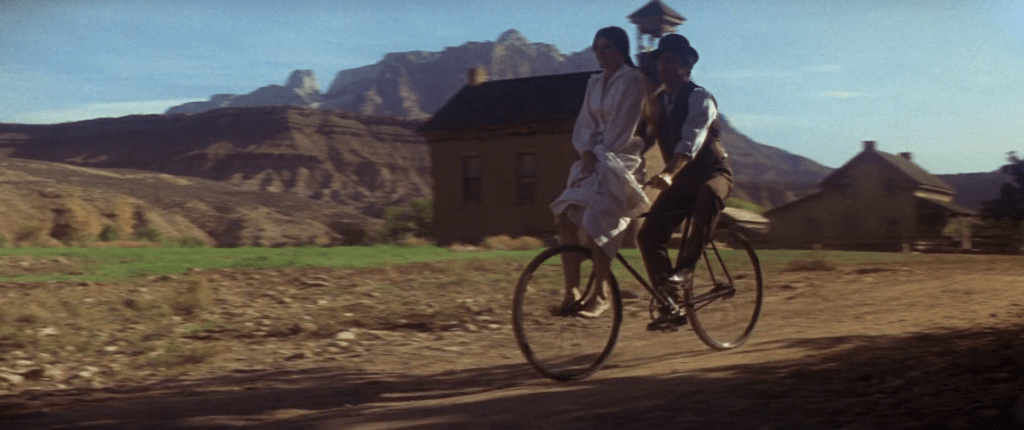
And why leave the bicycle behind?
What we learned: Swimming lessons save lives! As do Spanish lessons. So always bring a teacher along when you go on adventures.
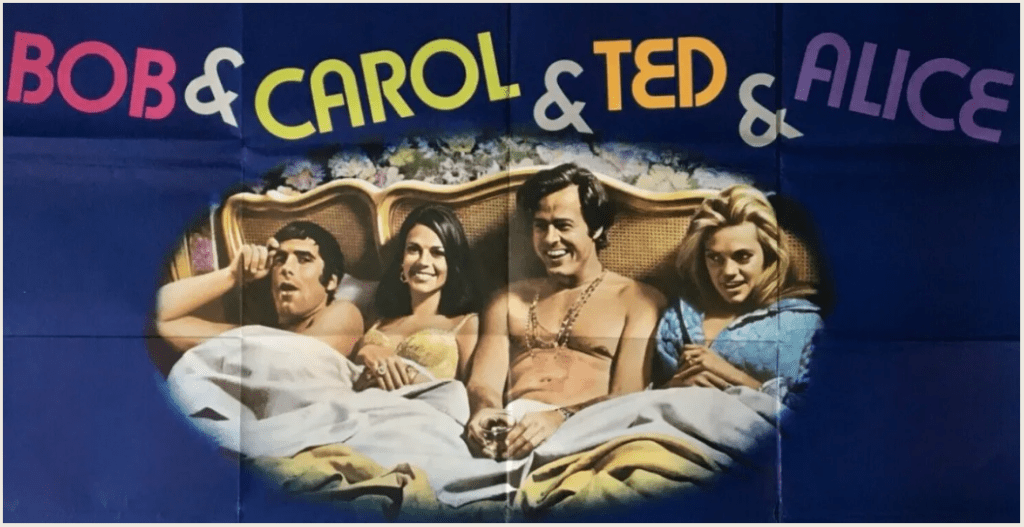
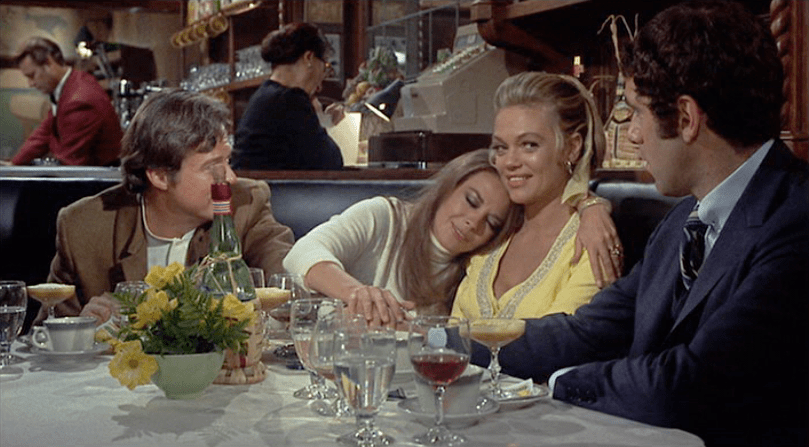
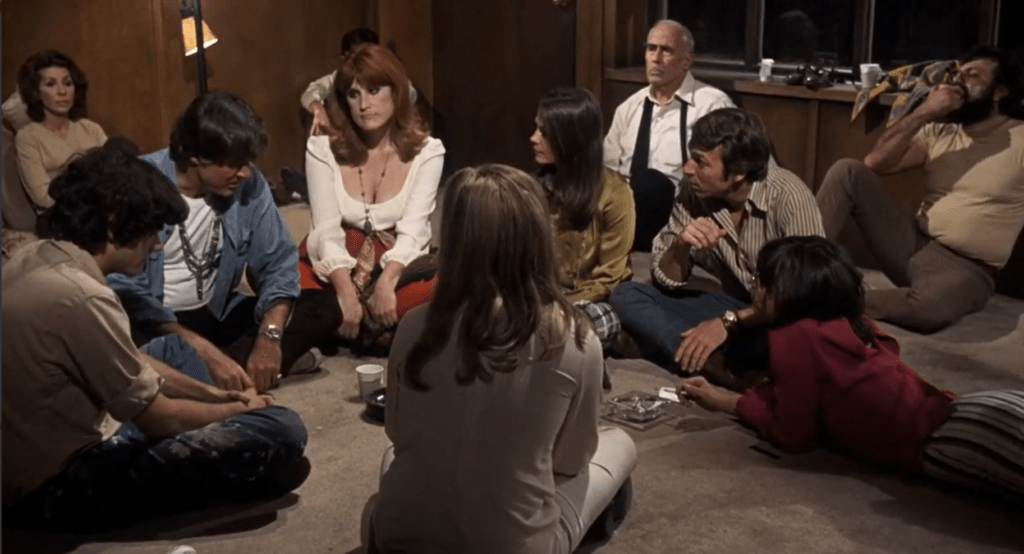
Bob and Carol, a cool, trendy couple, visit “The Institute” – part couple’s retreat, part wellness camp, part New Age cult and part nudist camp. In short, everything you could nightmare of and more. They’re there in order for Bob to do research for a documentary he is planning, but they are caught up in the teachings of the place and are converted into the cult of full emotional honesty and openness. Hijinks ensue.
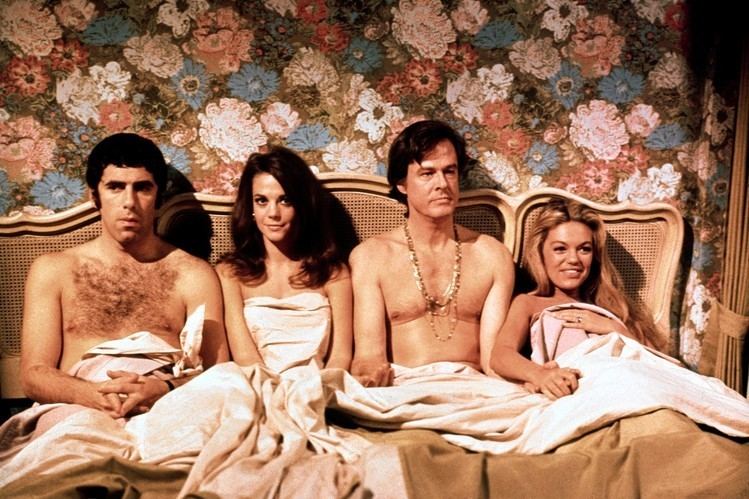
Hijinks include, but are not limited to, one of the most awkward attempts at an orgy ever captured on film. And quite possibly the most accurate one.
After their weekend of group hugs, feelings, close-ups and a desperate search for better orgasms (shout out to our girl Myrna!), they return to their lives with a new outlook on relationships and life in general. Which, in the tradition of newly converted cult members everywhere, they waste no time trying to impart on their (more cynical) friends Ted and Alice.
In this scene, we are Ted. Ted is us.
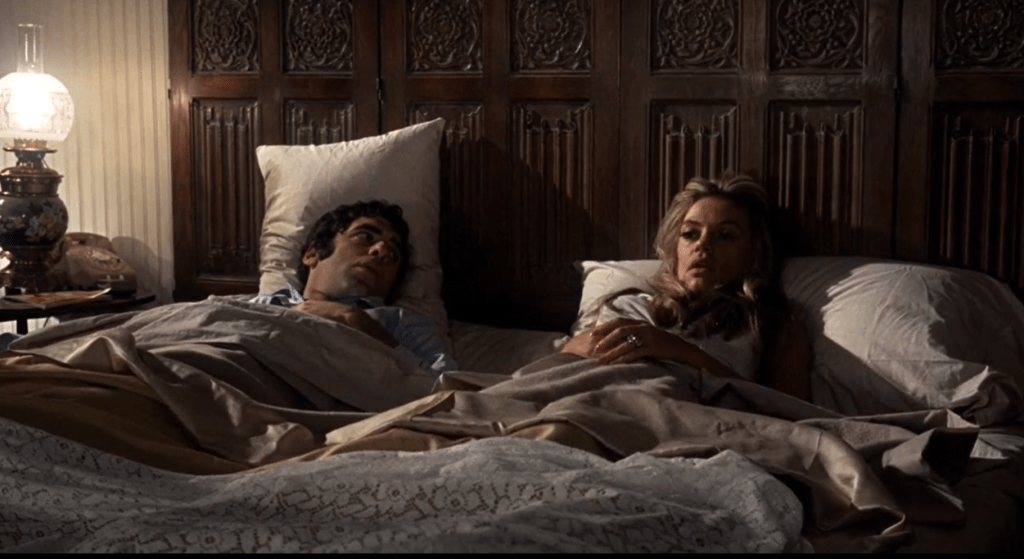
Then, Bob has an affair. In the spirit of their new openness he tells his wife, but her reaction is not what he expected. Carol is thrilled! She wants to know details, she commends him for being open and sharing, and she thinks it’s just the best thing ever! Which upsets Bob who then turns things around trying to make himself the victim here…
We’re right there with you, Carol…
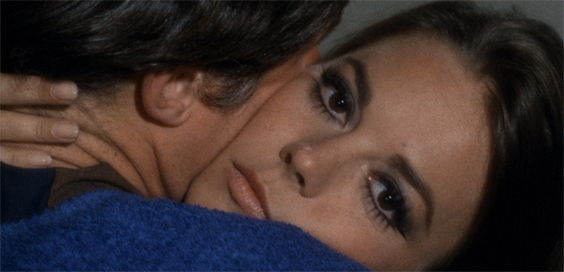
When they share the news with Ted and Alice, the latter has trouble reconciling her idea of Bob and her friends’ marriage with this information. She becomes very upset – but don’t worry. Ted is there to console her! By trying to coerce her into sex even after she’s said no about 17 times… What a gem…
We are no longer Ted. Ted is no longer us.
We continue to follow the two couples as they explore adultery, boundries, constructed moralities, orgies and friendships, and it’s an entertaining and fun watch. Silly, a little bit sexy, frustrating at times, but overall quite enjoyable. The female characters save the movie – Carol and Alice are interesting, compelling and quite sympathetic. Bob and Ted are… a bit dull. Ted is mostly just an ass, frankly. At least Bob actually evolves and becomes a better person as the story progresses, which is nice to see.
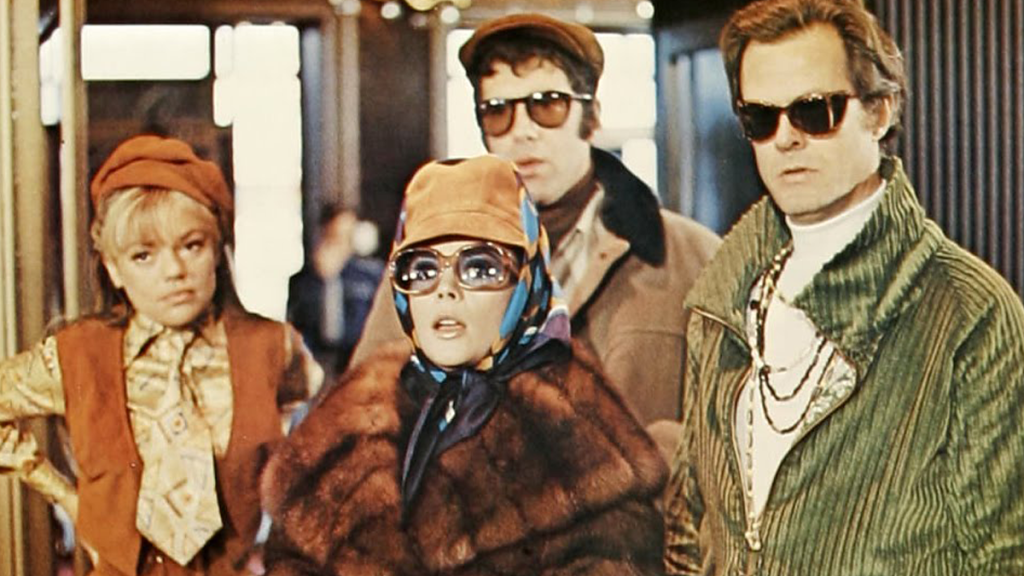
Another highlight: the fashion! Fifty shades of Earth.
We loved Myrna at the retreat (the whole retreat, really), the awkward orgy attempt, and the creepy shrink (well, hated really, not loved. But at least he sparked a feeling which is all one can ask for in this world). Overall we had a great time with this. It is interesting to see marital rape, gender inequality, societal mores and double standards all dealt with in what is basically a sex comedy. A rather sophisticated, clever and enjoyable one at that.
Our only objection is that we wanted MORE MYRNA!
What we learned: The gazpacho was astonishing!
MVP: Myrna. We love you and your lack of orgasms.
Next time: Butch Cassidy and the Sundance Kid (1969)
Starring: Lino Ventura, Paul Meurisse, Jean-Pierre Cassel, Simone Signoret, Claude Mann, Paul Crauchet, Christian Barbier, Serge Reggiani
Year: 1969
Runtime: 2h 25min
Hey! Do you want to watch a World War II movie but you’re kind of over the big action features where good always triumphs over evil and the heroes invariably make it out of the most intricate scrapes and gruelling situations practically unscathed? Well, look no further than Army of Shadows/L’armée des ombres.
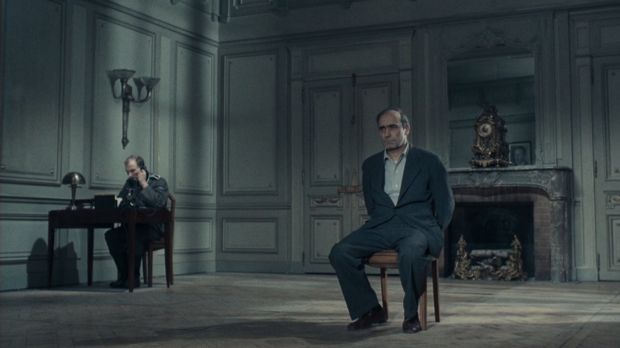
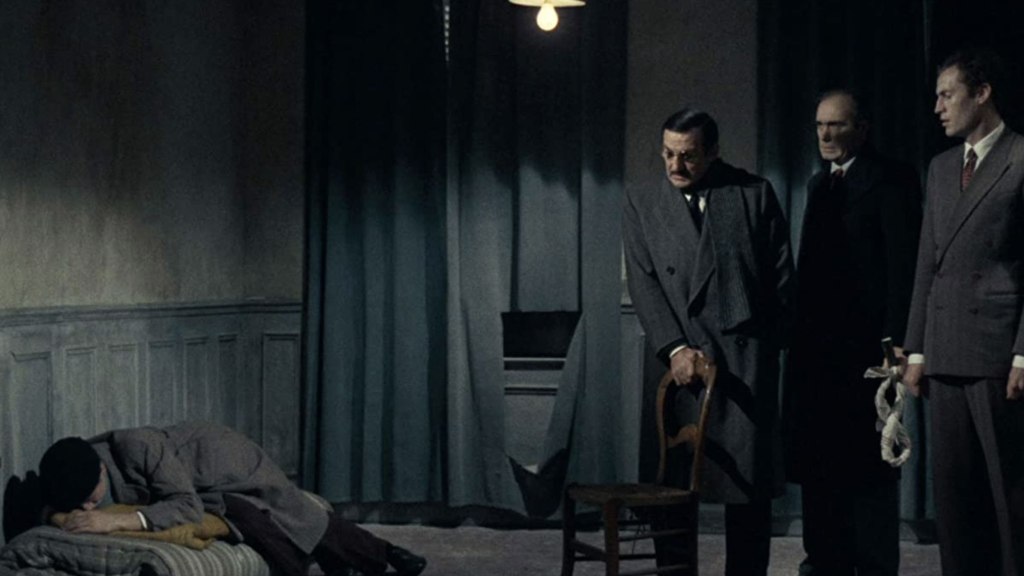
Being tied to a chair while watching is optional. The creepy stenographer in the corner is, unfortunately, not. He’ll simply appear in the room as the opening credits roll. It was quite unsettling.
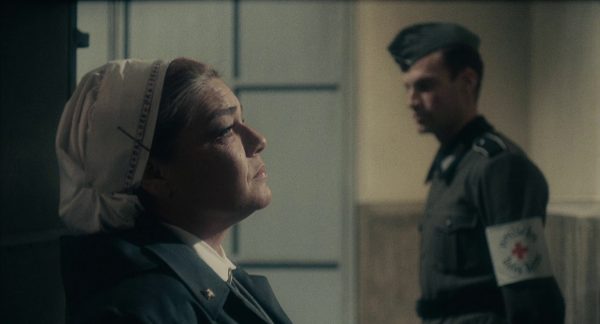
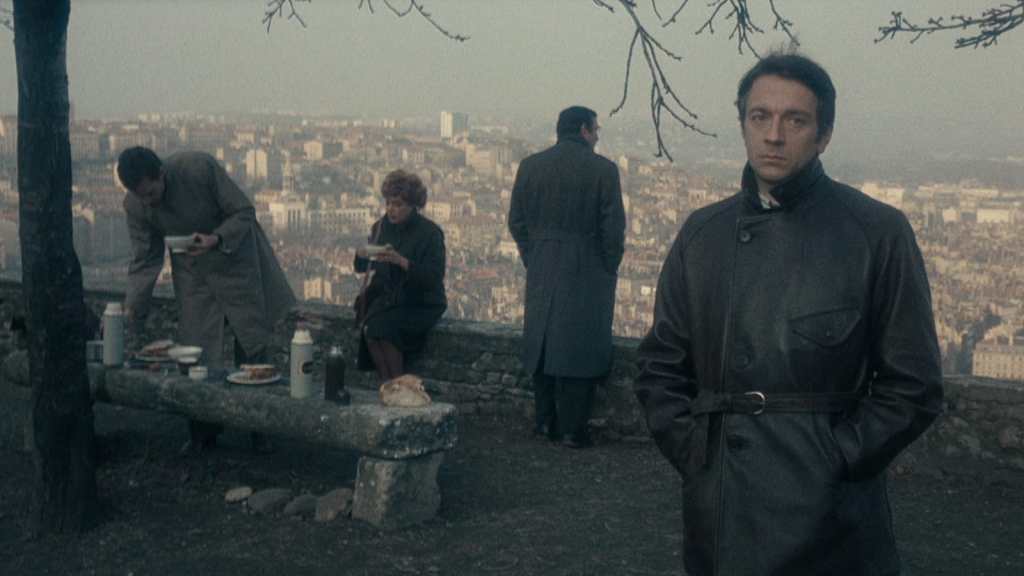
In this movie, we follow various members of the French Resistance during the German occupation. Philippe Gerbier (Ventura) is arrested by the Gestapo after a betrayal. He manages to flee, and enacts his (quite practical and dispassionate) vengeance on the person who gave him up. Among his fellow Resistance buddies we find “Le Bison” (Barbier), “Le Masque” (Mann), “Ze Big Boss” (Meurisse), and… Mathilde (Signoret).
She might be Mathilde to you, but to us she will always be The Mistress of Disguise.
Other members lacking exciting code names include Jean François (Cassel) and the unfortunate Félix (Crauchet). Their missions are unglamorous and unromantic, and their actions seem motivated by a sense of what needs to be done rather than any ambition of glory or acclaim. And indeed, without giving too many spoilers, many of them will die in obscurity under false names with few or no one knowing what they did or what they sacrificed for the greater good (The Greater Gooood..).
We’re just kidding. They all lived long, happy lives, and after the war frequently met for picnics. And to stare into the nothingness while trapped in the echo of the horrors that they lived through years ago and still relive in the dark of night… But mostly picnics.
Like we said, if you’re looking for a Nazi-ass-kicking action film à la Where Eagles Dare, The Dirty Dozen, or The Great Escape, this is not it. Army of Shadows has more in common with a spy drama than any of those, but not in any James Bondesque way. Despite its occasional action scene, it’s rather quiet and slow, but it packs an emotional punch.
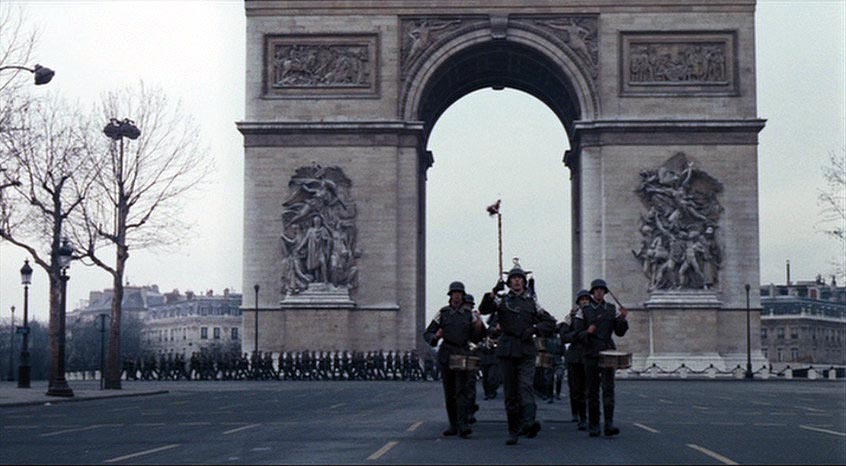
The chilling opening scene reminded us of Pretty Poison, where instead of a high school drill team marching during the opening credits (quite sinister in itself), there are Germans troops marching through the Arc de Triomphe (arguably a bit more sinister). The early execution scene sets the tone for the film – there’s no joy, nor any strong feelings of hatred or lust for vengeance here, just regret and somber, unavoidable reasoning.
Honestly, we’d never before encountered the problem of what do you do when your safe house/execution place gets new neighbours and you can no longer shoot your victim due to the noise. It poses quite the conundrum. We’re glad to now have a frame of reference for when we’ll inevitably find ourselves in a similar situation.
The pace is slow, and there’s very little music/score, which adds to the sense of realism in contrast to the focus on action and heroism we’re used to seeing in movies set during World War II. Even Gerbier’s escape from the clutches of the Gestapo in the beginning is rather mundane – and probably a lot more realistic than more elaborate depictions of similar events in other movies. Not that this movie is devoid of action or heroism – there’s quite a lot, but it is often less flashy. The acts of heroism are even occasionally close to pointless (we’re looking at you, Jean François. Heroic though your actions were, one could argue that they were ultimately unproductive).
That being said, any mode of resistance is important, and empathy is never wrong. Let’s all agree that we don’t want a repeat of this scenario.
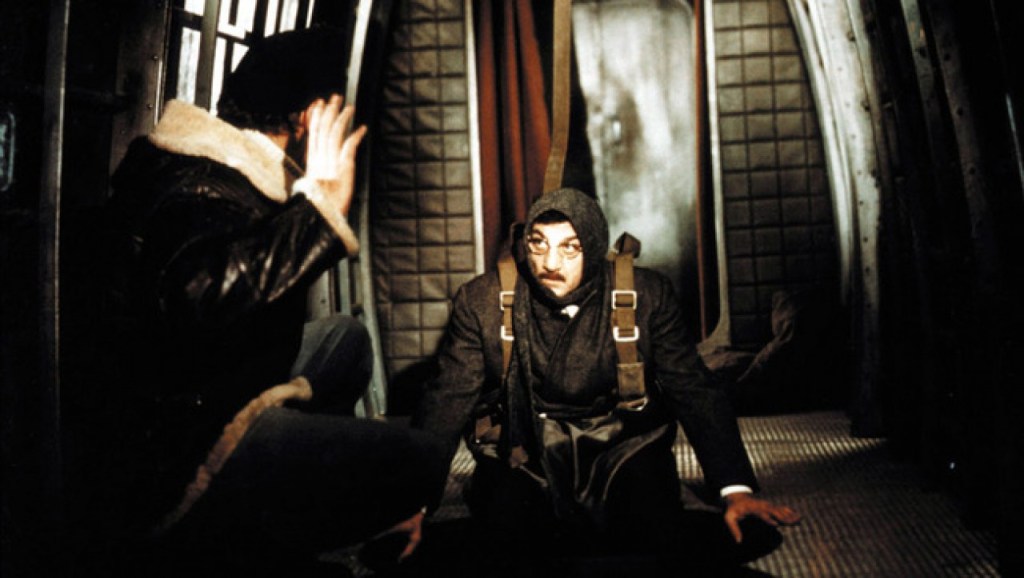
We loved Mathilde, the Brits in the loft, and the dispatcher on Gerbier’s flight back from London. Not to mention the oh so subtle ways we were told the characters had arrived in the UK – the Big Ben, red telephone boxes, and the British flag over the Houses of Parliament were all very vague hints that only the most discerning viewer would be able to pick up on. We also loved the clearly ’60s hair and make-up sported by several of the ladies (clear influences by the style of the time of production in historical films and shows are always fascinating to see). Overall, Army of Shadows was another movie we probably wouldn’t have picked up if it hadn’t been on the list, but one we very much enjoyed and that we’ve thought about frequently since we watched it.
It’s not all bleak. For instance, the flight scene was hilarious!
What we learned: Resist! But also, sacrifices must be made when opposing a fascist regime…
MVP: Mathilde! We will hear no arguments! (And, sure, Gerbier as well, of course. Not to mention La Résistance. Everyone who fights back against oppression, really.)
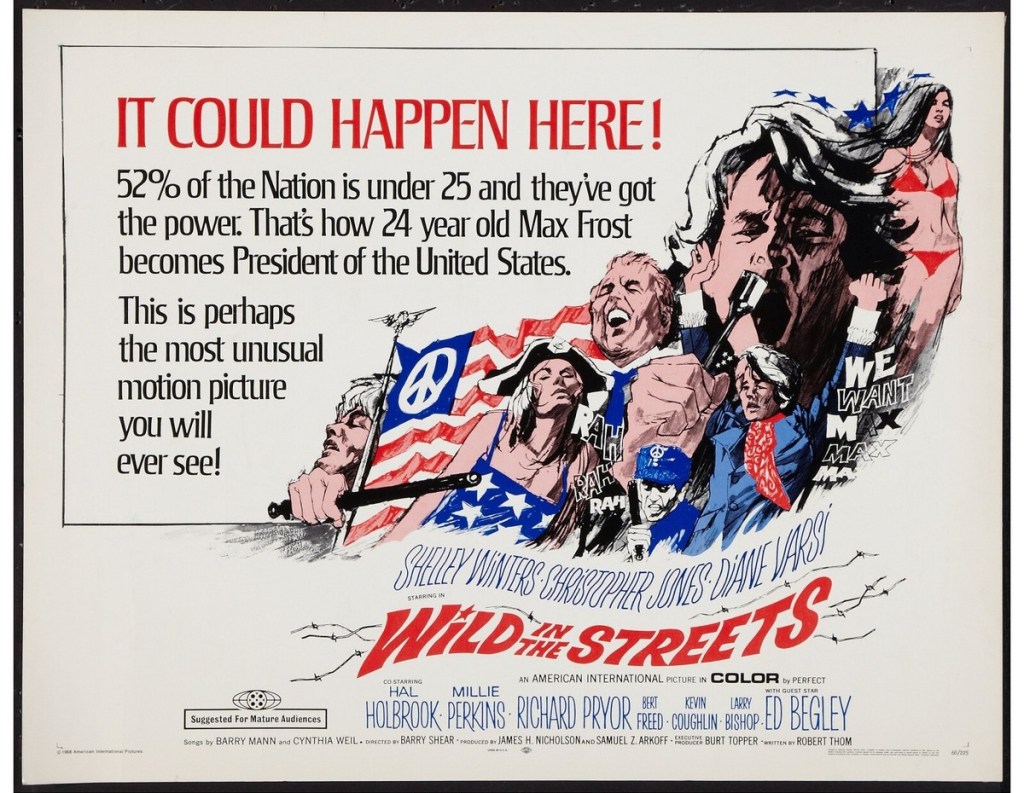
Starring: Christopher Jones, Shelley Winters, Diane Varsi, Hal Holbrook, Richard Pryor, Millie Perkins, Ed Begley
Year: 1968
Runtime: 1h 37min
Happy New Year, everyone! Sorry for the lack of activity, but we’ve been very busy and important people, travelling the world everywhere from Cambodia to Kirkenes on the Norwegian/Russian border (alright – only those two places, but still. Very important!) with little time to watch movies or write about them. Now we’re back and we bring you 2026’s first review, Wild in the Streets (1968).
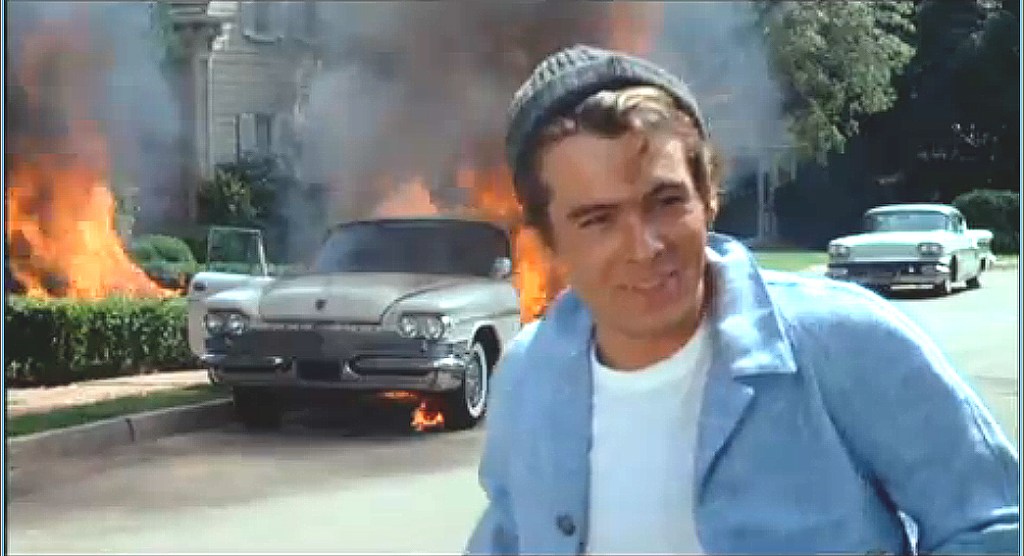
Like our protagonist Max, we walked away from a past on fire (in our case, 2025) with high hopes for the future. Unlike Max, our future (2026) immediately became a much larger dumpster fire than the past had ever even aspired to be.
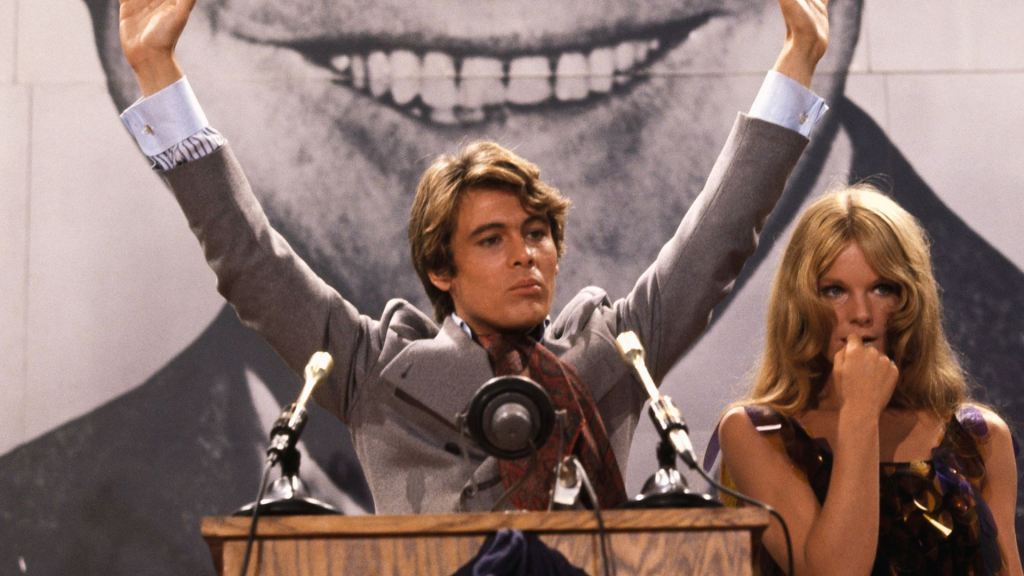
Remember Privilege? Well, Wild in the Streets is its slightly sillier American cousin. Max Flatow (Jones) grows up with an overbearing mother, a volatile family life, and some psychopathic tendencies. He runs away and reinvents himself as Max Frost – an incredibly accomplished pop star surrounded by other precocious young people ranging in age from 14 to 25.
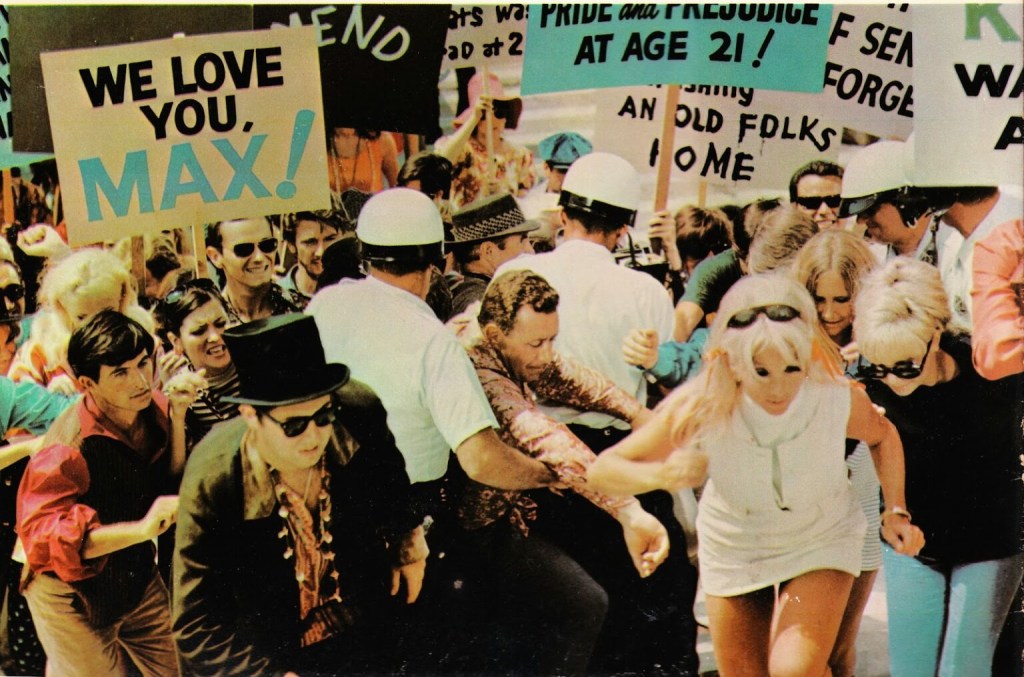
He also amasses a huge amount of crazed fans
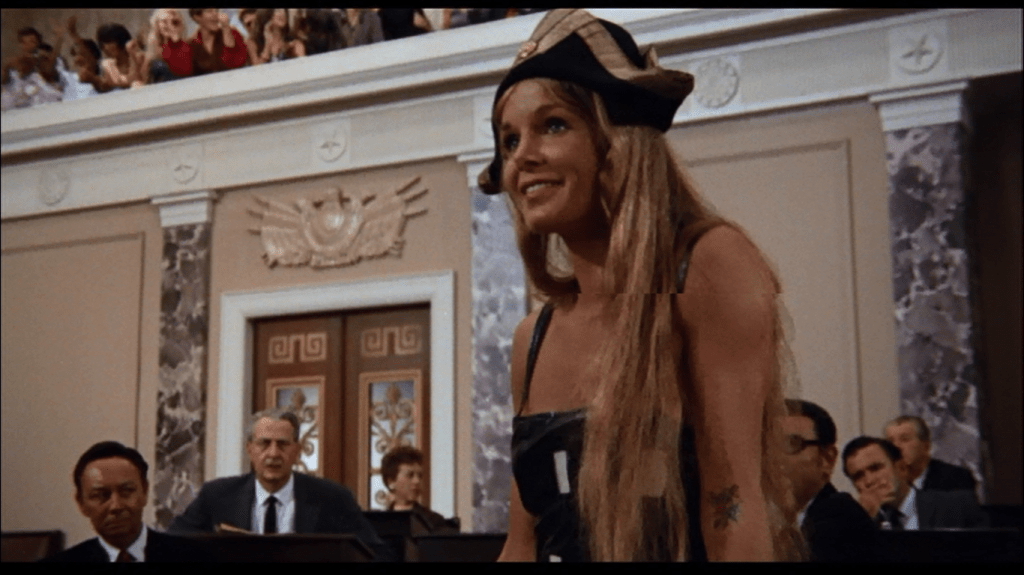
Max is approached by Congressman Johnny Fergus (Halbrook) who is running for Senate and who wants to lower the voting age to 18. His sons are huge fans of Max, and Fergus sees him as a way of getting support from the younger generation. However, the politician gets more than he bargained for when Max and his vast following become more and more involved in the politics of it all. First, they insist on further lowering the voting age – not to 18 but 15. They then manage to get Max’s girlfriend Sally LeRoy (Varsi), a former child star with a strong penchant for acid and an equally strong aversion to clothes, voted into the Senate to really change things up. And change things they do…
She is mostly naked, but whenever Sally does deign to put on clothes, her fashion sense is impeccable!
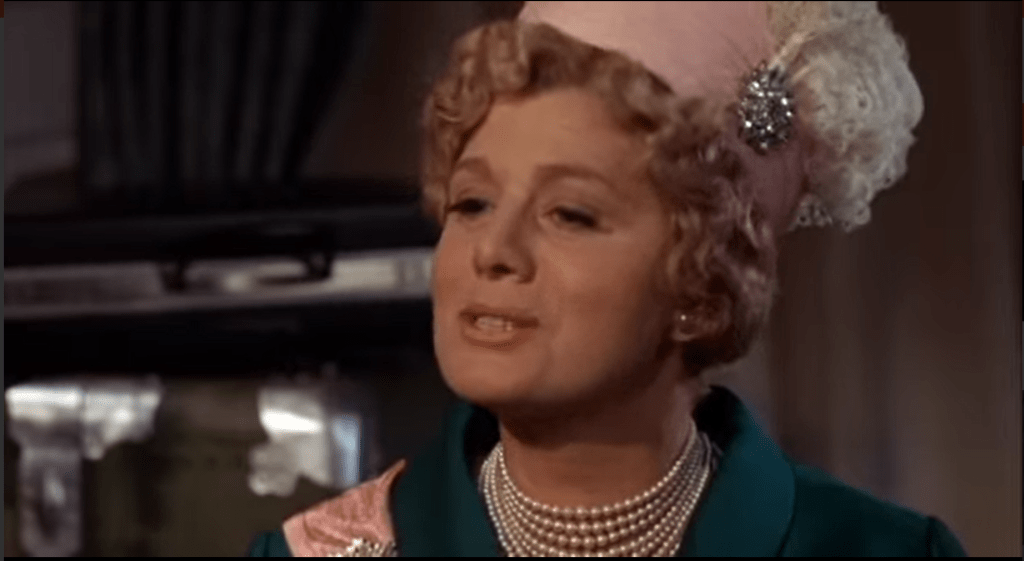
Parallel to all this, Max’s estranged mother Daphne (Winters) does her best to capitalize on her son’s success while desperately clinging to her own fading youth. She also completely steals the show! And possibly commits vehicular manslaughter (which somehow never comes back to bite anyone in the ass. We were expecting Chekhov’s Dead Child™, but we never hear of the incident again).
Her journey of reinvention to fit whatever narrative she perceives at any given time is a joy to behold
We quite enjoyed this, although when it comes to the idea of abusing pop cultural icons for political power, we personally think Privilege was a better executed version. However, we loved the swinging ’60s vibe, Max’s truly horrible hairstyle (you need to see it from the back!), Sally LeRoy’s fashion sense (less is truly more), the crazy mama Daphne, and the fact that no one really came off well in this. It was a wild ride indeed! Still, as over the top as the story arch and the portrayal of the political process were, the plot was still not as silly as electing a failed business man and reality TV star as president. But somehow less dangerous.
Sure, perhaps ageism can be a bad as racism and fascism, but this fictional USA is definitely not as sinister as its real, current counterpart.
Now, as ancient over-forties (Sister the Youngest had her 40th birthday in December! Happy birthday!), we were naturally sceptical to the idea of anyone over 35 being considered obsolete and put out to pasture. On the other hand, if someone allowed us to retire at 30 and then put us in a commune with free drugs from the age of 35, we might not be entirely opposed to the idea… Although we suspect we’d be over it pretty quickly. Expecially as the compound was full of other people. Which Hell truly is made up of.
What we learned: The power of rock compels you. Dealing in absolutes is rarely productive. And again – stop blindly worshipping people!
MVP: Max’s mom! Shelley Winters, you absolute legend.
Starring: Richard Burton, Clint Eastwood, Mary Ure, Patrick Wymark, Michael Hordern, Donald Houston, Peter Barkworth, William Squire, Robert Beatty, Brook Williams, Derren Nesbitt, Ingrid Pitt
Year: 1968
Runtime: 2h 38min
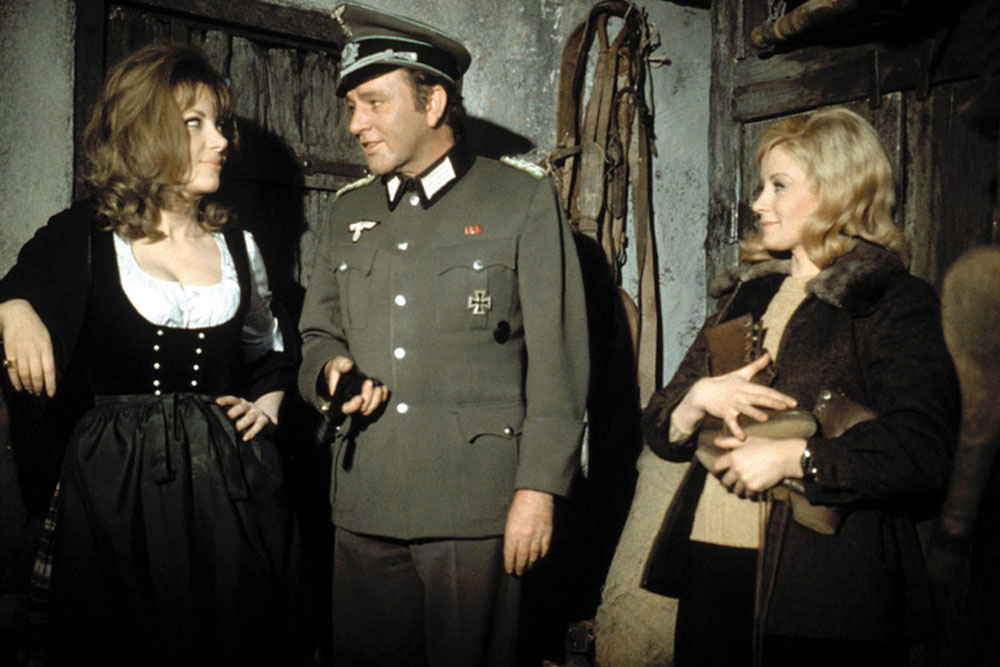
High in the Bavarian mountains, an American Brigadier General is being held by the Nazis as a POW. A team of British MI6 agents is formed and tasked with rescuing him before he spills important secrets. Led by Major Smith (Burton), they are joined by (smoldering) American Army Ranger Schaffer (Eastwood) and dropped off in the mountains from midair disguised as German soldiers.
“Ok, boys! Let’s practice. Repeat after me: ‘Hallo. Guten morgen. Bitte. Danke. Ich heiße. Auf wiedersehen. Ich möchte ein Bier. Tschüss.’ You got that? Great! Then I think we’re all ready. This should go smoothly.”
Now, you may think that this will be a straight forward let’s-break-into-the-castle-and-get-our-guy-and-go-home-again-lads kind of a story. But you would be mistaken. There are traitors and secrets and twists and turns galore! Double and triple crossings. Spies and lovers and friendships. And explosions. So. Many. Explosions.
Impressively, they managed to throw in a couple of competent and bad ass female characters as well. We approve.
Because of the many twists and turns, we don’t want to spoil anything by giving away too much of the plot. We’ll just urge you to watch this, because it is amazing. We have mentioned that we have been very pleasantly surprised by the westerns we’ve watched for the list, and the samegoesfora lot of the warmovies (those are six different links, btw. Don’t say we never do anything for you). This is not the first genre we’re instinctly drawn to (even though we grew up with a father who watched a lot of war movies and who also read the books they were based on), but we find ourselves enjoying them immensely.
Then again, any movie with an action sequence set on a cable car is bound to be a winner.
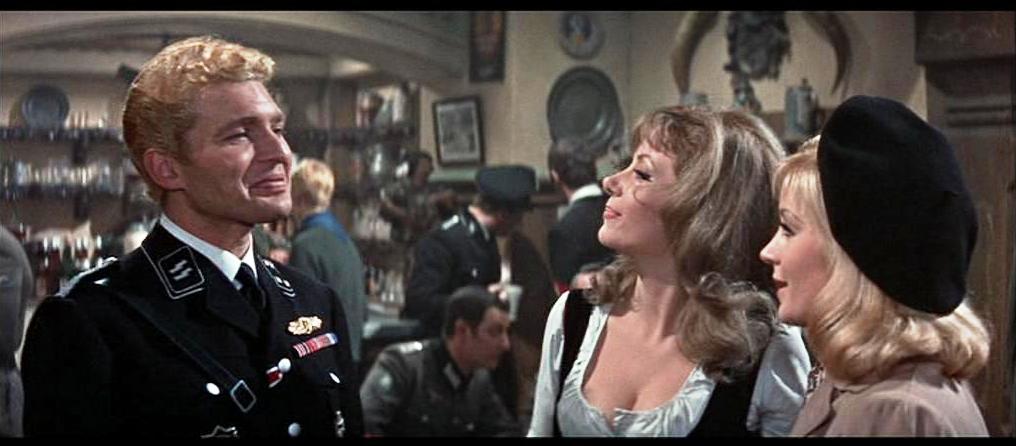
Where Eagles Dare is fun, exciting, entertaining and intricate, and also extremely stressful. It also features the most Gestapo guy that ever Gestapoed (Gestapod? Gestaped..?).
He’s giving 98% Gestapo with just a touch of Nigel from Top Secret (1984)
Both Burton and Eastwood are fantastic, as are the rest of the cast, but one could argue that the real star of the movie is Explosions™. Everything explodes. Did you know that German cars in the 1940s had built in explosives that went off randomly if they bumped into something? Or if they went down a steep hill? Or if the tyres stopped touching the ground for two seconds? Or if someone looked at it funny? We didn’t either until we watched Where Eagles Dare. Why they made them like that, we don’t know. Then again, we question a lot of choices made in Germany around that time, so this might have followed some inexplicable logic understood only by fascists.
Believe it or not, this is just a normal German car that was caught in a mild gust of wind. Our leading theory is that the cars were actually built by political prisoners who did what they could to defeat the third reich. Well done!
In addition to the frequently exploding cars, our heroes have brought enough dynamite to take down all of Bavaria, and they are not afraid to use it. There’s not a situation they face that can’t be improved with an explosion or two.
Although sometimes they use guns, just to mix it up a bit. It’s important not to become complacent.
We loved the actors, the characters, the many twists and turns, the balls-to-the-walls action, the gorgeous matte paintings, the sets, the stunts, the clearly ’60s hair and make-up, the cable car and all the burning cars. Not to mention the fact that Clint Eastwood, who looks about as American as it is possible to look, tries to pass for a German soldier. Now, it’s hard to pinpoint exactly what an “American” is supposed to look like, but he is it. You could look at that man completely out of any context, and 99% of people would go “Hey, look at that American guy!” (Then, most of them would add “He’s ridiculously handsome!” Especially if he smoldered at them.)
Pictured: obviously NOT a German
What we learned: Old timey movie kisses look incredibly uncomfortable. Also, Clint Eastwood is smolder incarnate.
Starring: Steve McQueen, Faye Dunaway, Paul Burke, Jack Weston, Nora Marlowe
Year: 1968
Runtime: 1h 42min
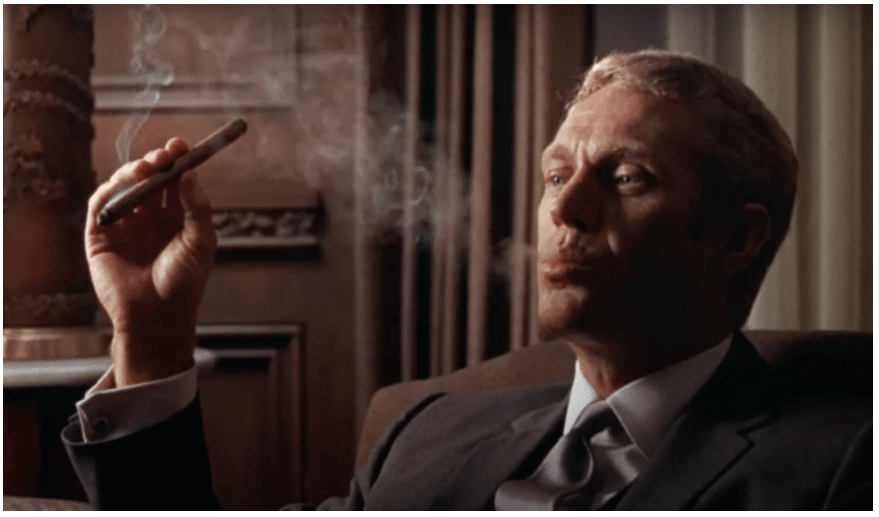
A heist is going down. And what a heist! There are several people in play, lots of phone booth coordination, heaps of money at stake, and a criminal mastermind at the reins. This mastermind is Thomas Crown (McQueen) – a rich business man stealing money basically for the hell of it, or out of boredom. Or to prove to himself that he is as smart as he thinks he is. But is he..?
Steve McQueen? More like Smuggy McSmugface, amirite? HAH! We’ll see ourselves out…
The heist goes off fairly smoothly, with only one shot fired and no casualties. It leaves behind many frustrated men in suits, but sadly very few leads. Then, someone makes the excellent decision of bringing in insurance detective/glamourous super sleuth Vicki Anderson (Dunaway) to assist in the investigation. She gets to work and quickly narrows their suspects down to a certain Thomas Crown based on… well, we’re not quite sure. A hunch? A vibe? Wanting to bone him? The logic is not entirely sound, but at least it turns out to be 100% correct.
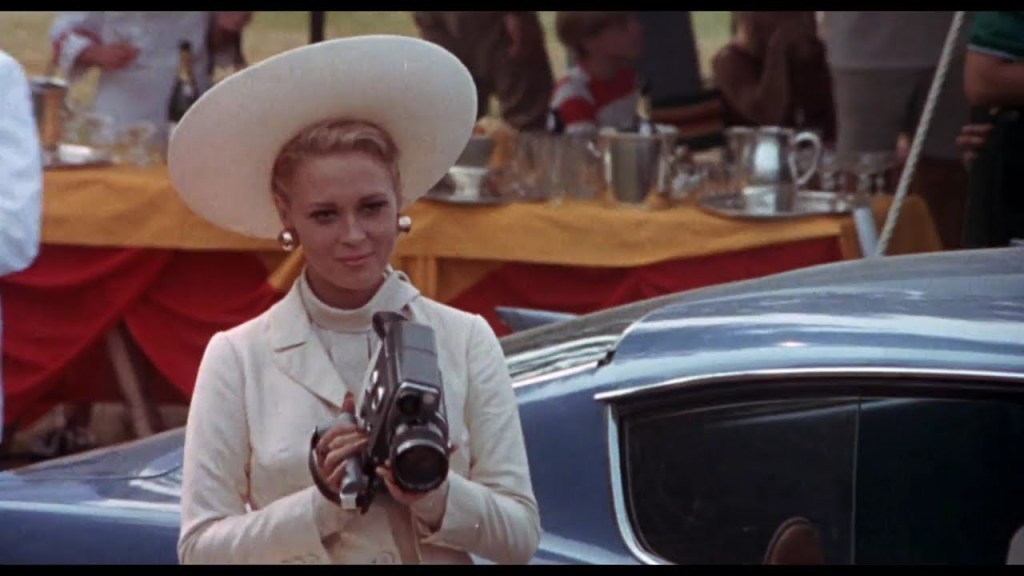
She then goes to work to catch her man. Her surveillance method of “bring a beast of a camera and then make eye contact with the target the entire time” is about as subtle as a freight train to the face
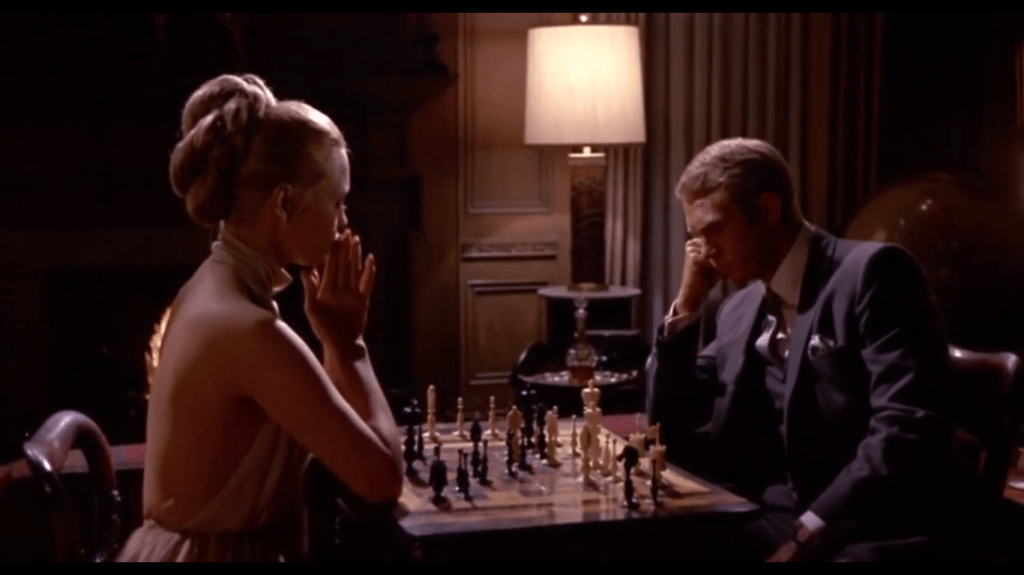
The only problem now is that they do not have any evidence to tie him to the crime. Luckily Vicki, passionately dedicated to her job, is willing to start a whole relationship with this man to prove her suspicion true. So their cat and mouse-/spy vs. spy-game begins.
They literally play chess about things
This was a bit uneven for us – there were things we absolutely loved about The Thomas Crown Affair, and things we’re more unsure of. We loved Faye Dunaway, and Steve McQueen is always charismatic af. However, once their relationship began, the film sort of lost some of its nerve and tension. Don’t get us wrong – there were some great scenes between them, and we loved Vicki throughout the entire film. Especially her sense of self: “I know who I am. Don’t put your labels on me.”
And what she is is an icon. An icon with an impressive and extensive hat collection.
I suppose we just didn’t quite buy into her falling for a bored little rich man who robbed a bank just for the hell of it. Now, if he was a suave art thief or something, we’d be all for it! Stealing art or artefacts in the style of Pierre Despereaux is cool (in fiction we mean, nice police people. We would never promote criminal activity in real life). Stealing money when you’re already rich is just… tacky. The film also felt as though they skipped some very important steps in the narrative, particularly how the investigators figured out how the heist was orchestrated and how they ended up with Thomas Crown as a suspect.
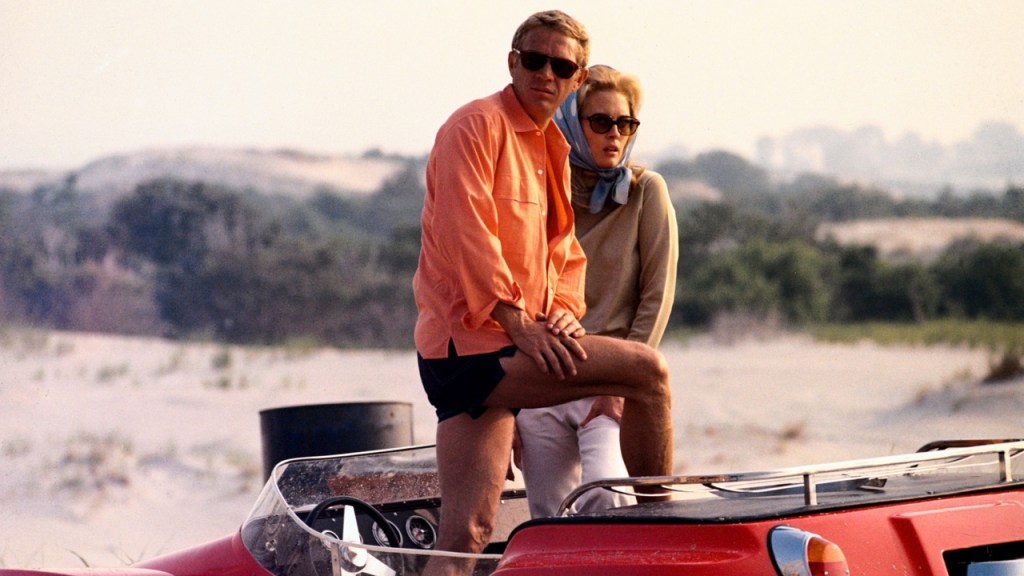
Was it the short shorts? It was probably the short shorts. We suspect everything could be traced back to the short shorts…
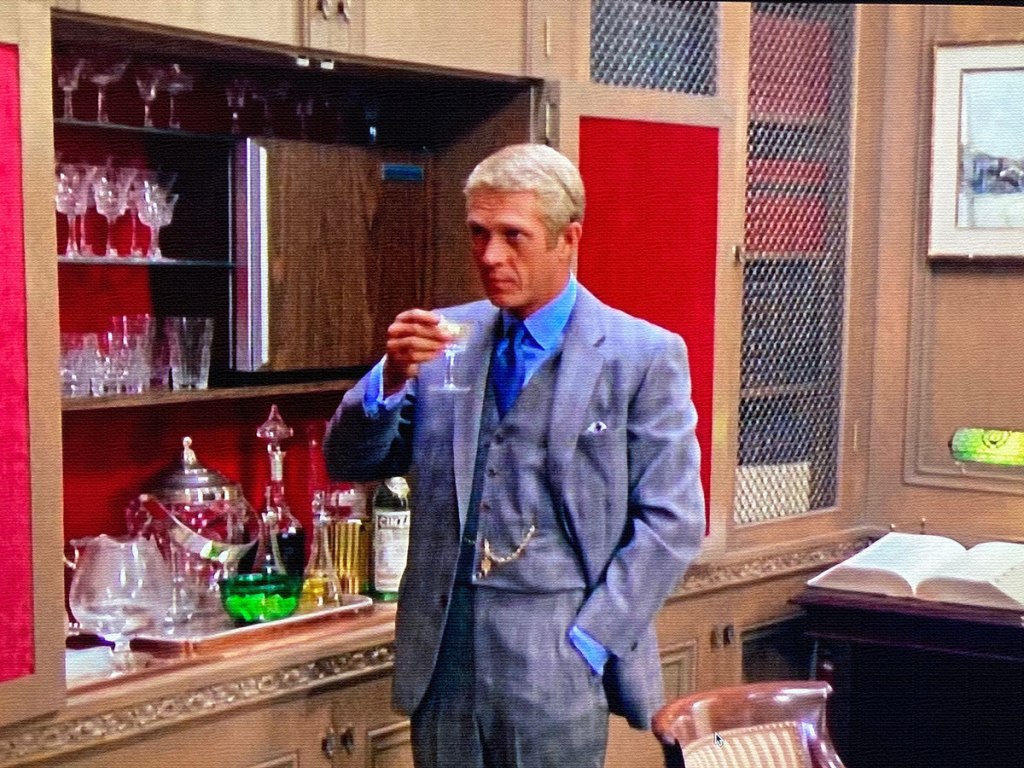
Still, we loved the stylish and cool heist in the beginning, the split screen which we also saw in The Boston Strangler (so hot in the ’60s), the built in wall bar with the fridge (we want one! Each!), Vicki Anderson – insurance sleuth extraordinaire, and the ending. There was something very satisfying about how they both stayed true to who they were in the end. Overall, we thought the first half was better than the last, but we had a very good time with this.
This! This is what we want in life! It even has a built in fridge! Swanky man optional.
What we learned: It must be so hard to be rich and bored…
MVP: Marcie! For the vibes. And also the aran sweaters.
Starring: Burt Lancaster, Janet Landgard, Janice Rule, Marge Champion, Joan Rivers, Nancy Cushman, House Jameson, Tony Bickley
Year: 1968
Runtime: 1h 35min
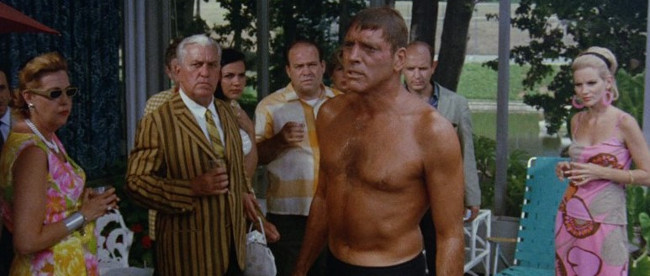
Welcome to the surreal world of The Swimmer. You’re in for quite a ride… Ned Merrill (Lancaster) is running around in his bathing suit in a gorgeous woodland, as people do. He drops by some old friends’ backyard and goes for a swim in their pool. The friends are hungover from the night before, and have not seen Ned for aaaaages. But they love him, and he’s such a great guy. While reminiscing with them, Ned has the brilliant idea to swim all the way home, by way of his neighbours’ pools which form a “river” the entire way. Off he goes!
But not without a drink in his hand. He’s not an animal.
As he makes his wet way towards his house he meets several old friends and acquaintances, but the vibe changes discernibly as he gets closer and closer to home. In the beginning, all the people he meets are old friends who clearly see him as a good guy, although they all get a bit weird whenever his wife or daughters are brought up. But as he gets closer to home, the people he encounters are increasingly hostile and keep hinting more and more to something that clearly has gone wrong in Ned’s life. Our “hero” also goes super sleazy with Julie (Landgard), a young girl who used to babysit for his kids. Things get gradually darker and weirder until he finally reaches “home.”
It starts off so innocently. Even bringing along his very young former babysitter seems wholesome at first. Until it’s not…
We had no idea what we were getting ourselves into, but we were hooked from the start. We loved how our view of Ned changed throughout the movie – from seeming to be a nice enough man (and just a little bit inappropriate with all the women he knew) in the beginning, to a creepy, cheating, horrible narcissist at the end.
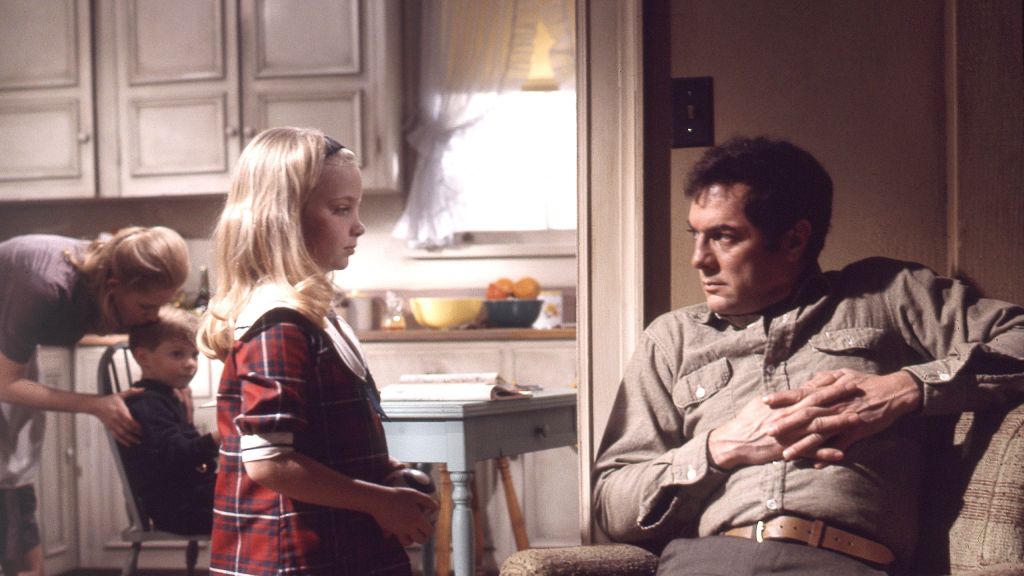
This scene with his former mistress is the best depiction we’ve seen of a man completely unravelling when he finds out a woman has faked her orgasms. Actual quote: “You loved it. You loved it. We both loved it. YOU LOVED IT!” And she’s just there like “Sure, Jan.”
The Swimmer kept us questioning throughout, and we came up with about 271 theories on what was actually going on. What happened to his daughters? His wife? Is this a sort of “life flashing before his eyes” scenario? Are we in purgatory? Is he senile? Is this a portrayal of his gradual corruption and entitlement throughout his life told through a swimming pool voyage? ‘Twas a mystery wrapped in an enigma. In the end, things start coming together and some questions are answered, but we’re still not 100% sure what exactly we just watched. That being said, we loved it (actually loved it. It wasn’t just a man telling us we did).
Another bit of unravelling: at the first pools people find him quirky and charming for going around in his swim trunks at a clothed event. As he progresses, not so much…
Among our favourite things were the ’60s parties he kept crashing (such a vibe!), the Hallorans, the way we liked Ned less and less as we went along, his increasingly fragile ego and psyche, and the many mysteries hidden in the plot. Also, the beautiful scenery added to the film’s dreamlike quality which, granted, gradually descended into a nightmare. Watch it!
Preferably through a closed, rusted fence with an anguished look on your face as you gradually realise the reality of your existence and slowly descend into madness and despair. It’s what we did.
What we learned: Dude! No means NO!!!
MVP: The pools. Or, possibly, the narrative technique. Or Ned’s fragile male ego.
Starring: Jean-Louis Trintignant, Klaus Kinski, Vonetta McGee, Frank Wolff, Luigi Pistilli, Mario Brega, Marisa Merlini, Carlo D’Angelo
Year: 1968
Runtime: 1h 45min
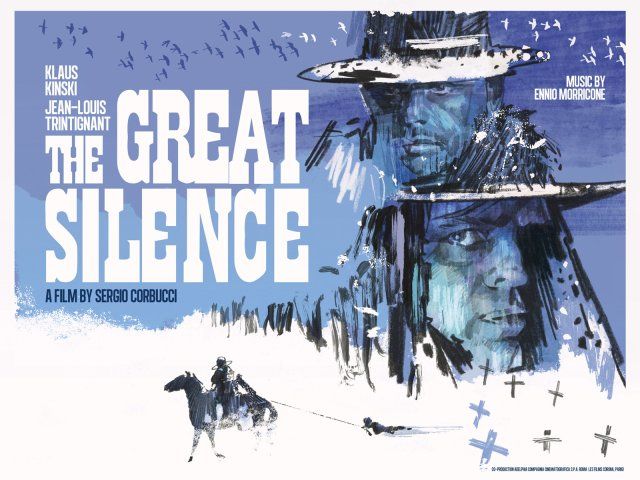
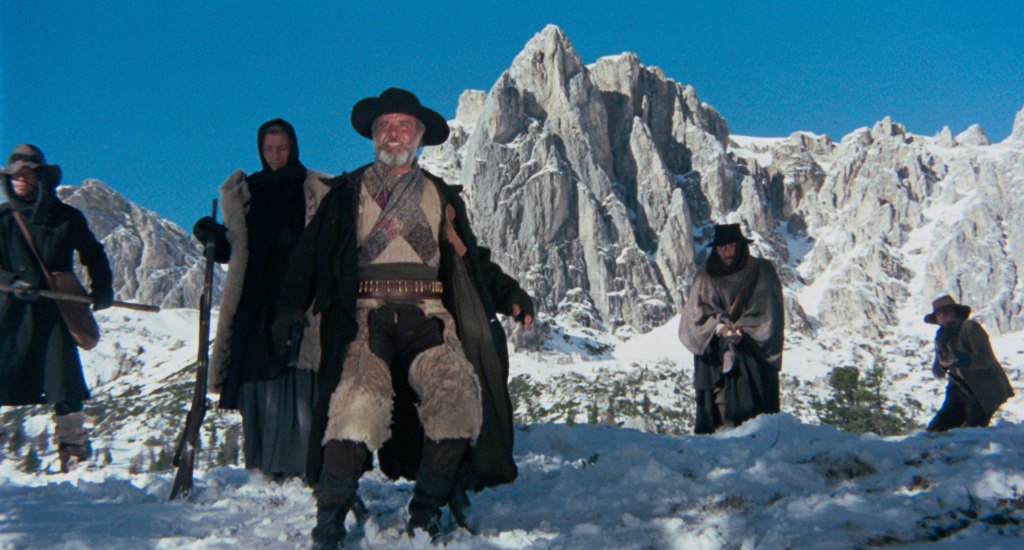
Snow. Horse, Rider. Norway? (Probably not, but looks like our landscape.) Crows. Shootout. Blood. Death. So starts The Great Silence. The eponymous Silence (Trintignant) is a mute gunman who makes bounty hunters tremble with fear. This (un)lucky Luke draws faster than his own shadow (well, at least faster than anyone else’s shadow), and his method is simple: be an annoying bitch until the other person gets fed up and draws their gun, and then kill them before they can pull the trigger. Thus, he only acts in self-defense and is completely within his rights to kill.
Way to hack the system, Silenzio!
The society in which Silence/Silenzio (we’ve heard it both ways) operates is run by corrupt politicians, greedy business owners and ruthless bounty hunters who prey on the little people. The worst one is Pollicut (Pistilli) – a banker and Justice of the Peace who uses his seemingly infinite (but very local) power to be a cunt to everyone and kill the guys who own things he covets, or who he simply doesn’t like. Of which there are many.
He wants their land, their houses and often their wives. And he will literally cut children’s throats in order to get what he wants. Among his many sins, that sorry excuse for a “beard” also ranks in the top three…
As a result of Pollicut’s greed and corruption, as well as problems caused by a severe blizzard, the people of Snow Hill are having a really bad time of it, and many are forced to turn to crime in order to feed their families. Pollicut uses these circumstances to make them outlaws and to place prices on their heads in order to take over their property. This attracts bounty hunters, chief among them being “Loco” (Kinski). He is, as the name suggests, utterly Loco. And racist. And a psychopath. And just an all ’round bad guy.
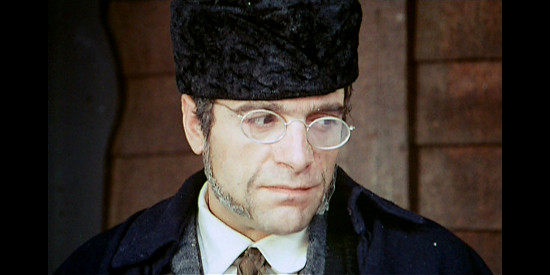
But his headgear game is on point
The women of this ravaged community, mainly newly widowed Pauline (McGee), hire Silence to defend them and help/avenge their sons/fathers/husbands, most of whom are either already dead or LARPing Robin Hood and his Merry Men in the woods surrounding Snow Hill.
In fact, let us talk about the name “Snow Hill.” Who came up with that name? Is it also called that in summer? Is this place perpetually snowy? In which case, why would anyone settle there? (OK, we realise that this is probably a bit rich coming from a couple of Norwegians. Nevertheless, we feel these questions are justified. The public needs to know!)
Enter player five, newly appointed sheriff Gideon Burnett (Wolff). From the start, he seems a decent enough guy, which is a rarity in this town. His mission is to restore order in Snow Hill before the governor declares amnesty on the merry men of the forest (and by “merry,” we mean “miserable” and “starving”). He is basically the only character in this entire movie who both operates within the law and does the right thing. Will his and Silenzio’s efforts be enough to save the town?
Look at this jovial face and icy ‘stache! Clearly one of the good guys.
We are enjoying the westerns a lot more than we thought we would when we started this project. We grew up watching some of them as our dad was a western fan, but it was never really “our” genre. However, each one we’ve watched so far has been incredibly engaging, and there’s so much interesting social commentary within them. For us, The Great Silence ranks as one of the best ones so far.
🎵 The hills are aliiiiive… With the sound of outlaaaaws 🎶
First off, we loved the women in this. From the bereaved mother who first asks for Silenzio’s help, via Pauline, to Regina (Merlini), they are bad ass, capable and vengeful – exactly how we like our female characters. We also loved sheriff Burnett, Silence’s method of being a little bitch until people try to kill you, the costumes, the snow, and the portrayal of people dealing with corruption and greed. As in a lot of westerns, on the surface it’s very easy to tell the bad guys from the good guys – there are no doubts about who we’re supposed to root for. But at the same time, the bad guys’ actions are “all according to the law,” which poses some interesting philosophical quandaries about laws and morality, and makes this a movie which is frighteningly topical and current…
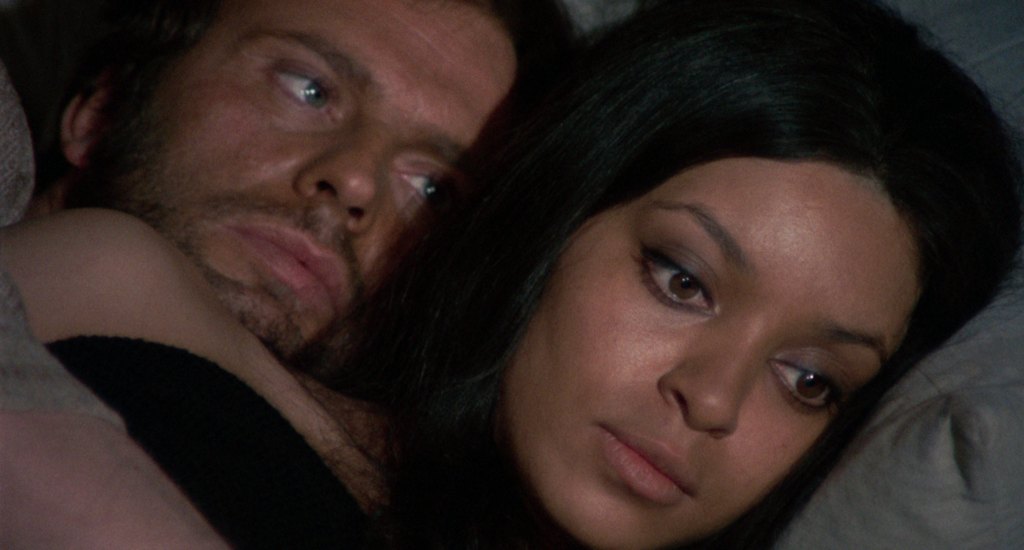
They also managed to throw in a bit of (interracial) romance, so we’re pretty sure everyone can find something they enjoy in this film. Well, good people can, at least.
By the way, without spoiling the ending too much (we hope… You can wait to read the rest of this until you’ve seen the film if you want absolutely no hint of a spoiler), if you have the DVD/Blu-Ray version of this movie, we recommend you also watch the alternate ending which you can find as a bonus. It is the most ridiculously over-the-top happy denoument we’ve ever seen, and we got the strong feeling that this was filmed as a sort of mutinous “fuck you” to people who thought the original finale was too bleak…
Side note: we felt really bad for all the horses forced to struggle through the snow throughout. That looked like really hard work.
What we learned: The law is not always right. There is no such thing as an ethical billionaire. And sometimes the bad guys win…
MVP: Whoever made all those shawls. Or Klaus Kinski. Also, shoutout to our boy Ennio Morricone!
Starring: Tony Curtis, Henry Fonda, George Kennedy, Mike Kellin, Hurd Hatfield, Carolyn Conwell, William Marshall
Year: 1968
Runtime: 1h 56min
From 1962 to 1964, Boston was terrorized by a serial killer who raped and murdered women, dubbed “the Boston Strangler”. Albert DeSalvo confessed to the crimes in 1965 and only three years later The Boston Strangler was released, detailing the crimes and the investigation. While this could have been a sensationalized and exploitative movie trying ot cash in on horrific events, it luckily comes across as a respectful and very accurate portrayal of a horrible case of serial murder.
It’s still gruesome – don’t get us wrong. Just not overly salacious.
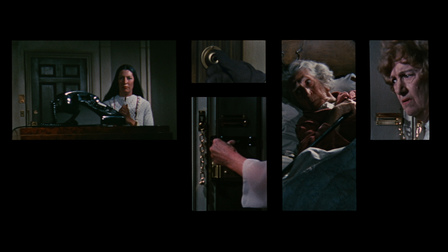
Right from the start, this drew us in. We loved the different angles/framing/multiple images (whatever we should call it – if you’ve seen the film you understand what we mean) used throughout the film. The first part of the movie depicts the investigation, and we really enjoyed having the focus on the investigators rather than the culprit – let’s highlight the heroes, not the monsters! We appreciated that the sexual violence suffered by the victims was only implied rather than explicitly shown. Fleischer manages to convey the horrific nature of the crimes without sexualizing the scenes, which is something more filmmakers should attempt at times…
This is what we mean by the whole different angles/framing/multiple image-thingy we mentioned. No idea what it’s called, but we loved it!
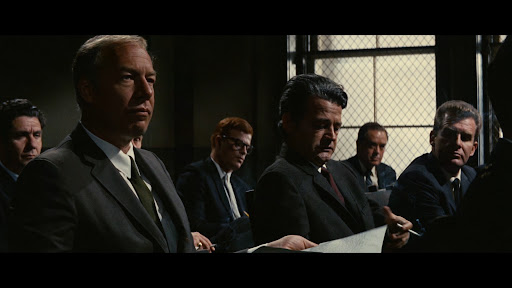
The main investigator, Phil DiNatale, is played by George Kennedy, which we have to admit took some getting used to. We found ourselves waiting for lieutenant Frank Drebin to come along and (hilariously) solve the crime… Instead, he is joined by John Bottomly (Fonda), the newly appointed head of the Strangler task force. It’s always beautiful to see when different branches of law inforcement manage to coordinate their efforts and come together to solve a case.
One might even say they formed some sort of… Police Squad! …we’ll see ourselves out.
And effort was definitely made! We loved seeing a bunch of creeps being arrested and/or interrogated for doing creepy stuff. Now, we don’t mean to kink shame – you do you, boo – but once you make your kinks someone else’s problem without their consent, you deserve to be made (at least) as uncomfortable as the ones you drag into your sexual fantasies.
Although questioning a man for murder simply for owning the collected works of the Marquis de Sade might be overstepping a bit… Who doesn’t have that on their bookshelf?
Eventually, the POV switches from the investigation to the killer himself. We are brought along as DeSalvo (Curtis) tricks his way into women’s apartments where he sexually assaults and strangles them. But we also get to see his family life, as he was married and had young children at home. Finally, the last part of the movie is focused on his confession and his mental state.
His seemingly normal and happy family life somehow makes the crimes even more unsettling… (Also, side note, his wife looks like Liv Ullmann… Well, Carolyn Conwell, the actress, did at least.)
There’s so much here we loved. Visually, it’s very stylish and cool, and we feel it tells the story without exploiting the victims too much. The Boston Strangler has no score and the silence works really well. It’s also extremely quotable, and we enjoyed the critique of the inherent violence in U.S. society. The pacing is a bit uneven, and the last act felt a bit long and is less engaging than the first part. Still, the final reenactment by DeSalvo/Curtis is very chilling and an unnerving end to an excellent movie.
Turns out making him take a long hard look in the mirror actually had the desired effect. Have we tried this in other interrogations..? Like, really tried it? Has this solution been staring us in the (mirror image of our) face all this time?
Ok, we know this is dodgy, but we love serial killer stories… What can we say – we’re white women, it’s our culture. So we know quite a lot about this case, and as far as we can remember The Boston Strangler is a very accurate depiction of events. There has been a lot of speculation about DeSalvo’s guilt though. Part of his confession contains details that he would be unlikely to know unless he was there, but other in other parts he gets very basic things wrong. However, a few years ago DNA evidence proved his involvement in at least one of the rapes and murders, so he was certainly not entirely innocent. The question remains though – was he the only strangler? Or were there several killers stalking the women of Boston? We may never know for certain.
We only know that thirteen women between the ages of 19 and 85 were sexually assaulted and brutally murdered, possibly by the same perpetrator…
What we learned: As fascinating as we admittedly find them, serial killers are pretty much pathetic in real life…
MVP: Probably Edward W. Brooke (Marshall). Assembling a task force is never wrong. Shoutout to DiNatale and Bottomly as well though!
Director: Federico Fellini, Louis Malle, Roger Vadim
Starring: Jane Fonda, Brigitte Bardot, Alain Delon, Terence Stamp, Peter Fonda
Year: 1968
Runtime: 2h 1min
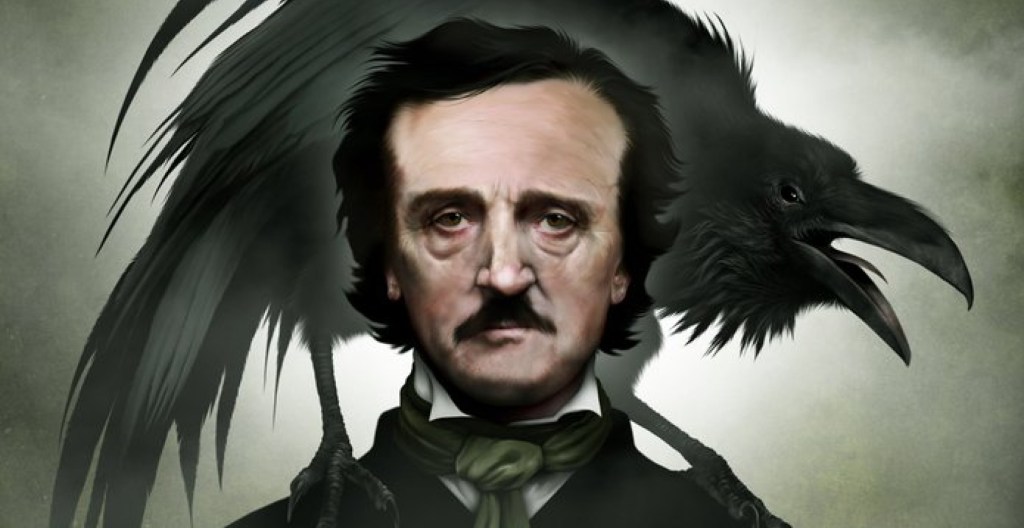
Spooctober continues (we expand it into November as well. And occasionally December. Not to mention January! There’s nothing scarier than a blank slate and new opportunities, after all…), and coincidentally there are quite a few fitting films coming up on the list. Such timing! In Spirits of the Dead, three directors have each made a short film based on the works of our child- and adulthood hero Edgar Allan Poe. Artistic liberties have been taken, but in each entry Poe’s spirit is present. And he is in fact dead. So the (English) title checks.
We like to think his spirit still roams wild on Hampstead Heath. Close to the meat.
Director Roger Vadim is behind the first segment, “Metzengerstein.” Here, cruel, oversexed countess Frédérique de Metzengerstein (Fonda) falls for her cousin/enemy/rival/neighbour Wilhelm Berlifitzing (also Fonda, but this time Peter), burns down his stables when he rejects her, then grows obsessed with a horse that appears out of nowhere just as Wilhelm accidentally dies in the fire. Well, technically the horse seems to appear out of a tapestry. Either way, clearly a supernatural horse. It does not end well for her.
There’s a joke in here somewhere about stallions and getting wet, but we’re better than that.
The second adaptation, Louis Malle’s “William Wilson,” follows the titular character (Delon) as he is confronted by kindness and positive qualities, things he himself does not possess in the slightest. As he goes around bullying and torturing school mates, trying to start a serial killer career by dissecting a random (and still alive) woman he picked up from the street (with a willing audience of equally psychotic medical students, it seems? WTF, guys???), and cheating at cards (ok, this one sounds relatively mild compared to the others, but he does it in order to strip and whip a woman (Bardot) in front of yet ANOTHER audience of men before offering her up for them to rape. So the cheating really was just a means to an end), he is repeatedly thwarted by a doppelganger (or the Jekyll to his Hyde, if you will). And Wilson is pretty darned indignant about it! It does not end well for him.
We see you, guys in the background who just stand by. You’re all equally culpable.
The final, and in our opinion best, entry is Fellini’s “Toby Dammit,” based on the story “Never Bet the Devil Your Head.” Now, while it might be the segment that diverges the most from the story on which it is based (it is also the only one where they did not keep the title or the historical setting), it is also the most successful (in our opinion). Toby (Stamp) is a messed up, alcoholic actor visiting Italy to star in a Catholic western and drive a Ferrari, who keeps seeing the devil everywhere. This devil is in the form of a little girl with a ball as opposed to Poe’s old man with just a girly hairstyle (actual quote: “his hair was parted in front like a girl’s”). Toby’s behaviour becomes increasingly unhinged as he falls deeper into the bottle as well as his own visions, climaxing in a wild Ferrari ride. It does not end well for him.
“Dress for the job you want, not the one you have,” they say. “Dress like a sickly Byronic vampire and reap the consequences,” we say.
Poe’s original story “Never Bet the Devil Your Head” is a hilariously passive aggressive response to his critics who accused him (and/or his tales) of lacking morals. So he wrote the most blatantly moral tale he could come up with. It is definitely worth reading if you have not – the tone is hilarious. However, it may not be the easiest story to make into an interesting film, so Fellini’s decision to basically keep only the ending and a slightly morally dubious protagonist is an understandable one. And as stated, this entry was our favourite, despite us being Poe-purists at heart.
“Those who dream by day are cognizant of many things which escape those who dream only by night” What a legend!
While the three shorts have varying degrees of connection with the source material, they have all definitely tried to sex it up quite a bit. Poe wasn’t really known for his spicy content – he was more about the implied incest and necrophelia than explicit sexual stuff. So, much more pure. In Vadim’s “Metzengerstein,” the young count Frederic has become sexy Frédérique, and the old neighbour Berlifitzing has become young, alluring, and a cousin to boot. So at least Poe’s incest motif has been honoured, we guess. William Wilson, while always an unlikable character has, in Malle’s version, become a sexual sadist in addition to your ordinary, run-of-the-mill everyday sadist from the short story.
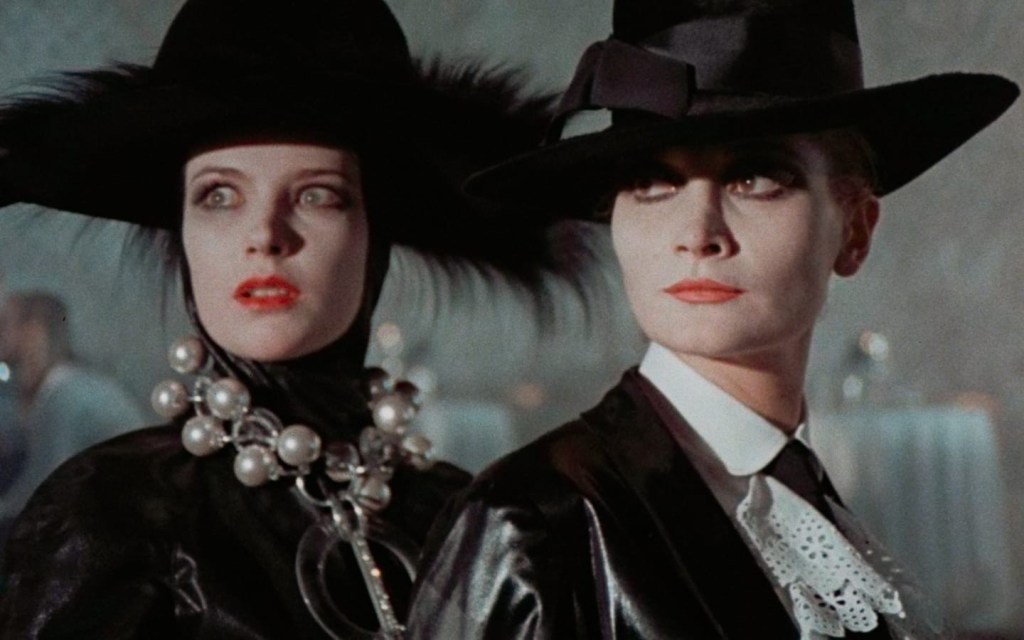
Admittedly, it’s been a while since we read “Metzengerstein.” It is entirely possible that Frederic wore this exact outfit in the story and the adaptation is true to its source material.
We loved the costumes, Terence Stamp, Jane Fonda, the Devil, the stressful Ferrari ride, the Catholic Western that Toby’s set to star in (complete with cowboy Jesus and all), the award ceremony and basically everything about Fellini’s entry. We also enjoyed the fact that these filmmakers have chosen relatively unknown Poe tales to adapt (at least, lesser known compared to “the big ones”). This may of course be related to the fact that there were supposed to be more directors and stories filmed for the series, but one by one they all dropped out, leaving the three we have today. While the project may not have reached the heights originally envisioned, the ones that were completed are definitely worth a watch, and the film is a perfect choice for Halloween (which, as you all know, is celebrated from October 1st through (at least) November 30th).
I believe we just found this year’s costume
What we learned: Dammit, Toby! Also, if you stand by and do nothing, or participate in the slightest, when people are trying to rape or kill, you’re as culpable as the perp. Do better!




















 1000 Films Blog