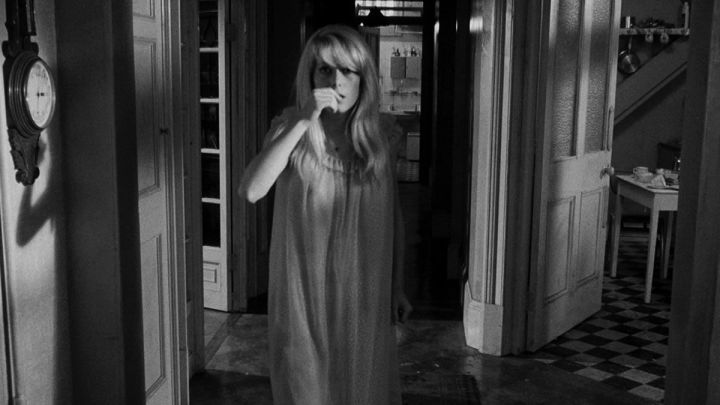
So, here’s the thing. We enjoyed the movie. We loved Catherine Deneuve. The story is intriguing, and the men are sleazy and disgusting. However, watching Polanski-movies is difficult in light of, well, him… (And yes, we know this might seem a bit hypocritical seeing as we actually did review Knife in the Water. We have just given it a bit more thought since then. And sure, there are probably lots of other problematic directors as well, but in this case there is so little doubt and it is so well publicized that it cannot be ignored.)
It’s the continuous debate of whether one can truly separate the artist from the art. Considering that he still goes free and is even rewarded (and awarded) despite being a rapist piece of shit, viewing and reviewing his movies is conflicting. Especially when they involve sleazy men trying to take advantage of mentally ill women. But, like, sexy mentally ill women. So that makes it ok, apparently…
Cause as we all know, nothing is sexier than a spiralling woman. She probably just needs a penis to set her straight.
We’re not going to tell you whether to watch this or not. It’s entirely up to you. The film itself is intriguing and beautifully shot, but it is also problematic in oh so many ways.
What we learned: Watching (old) Polanski movies is difficult…
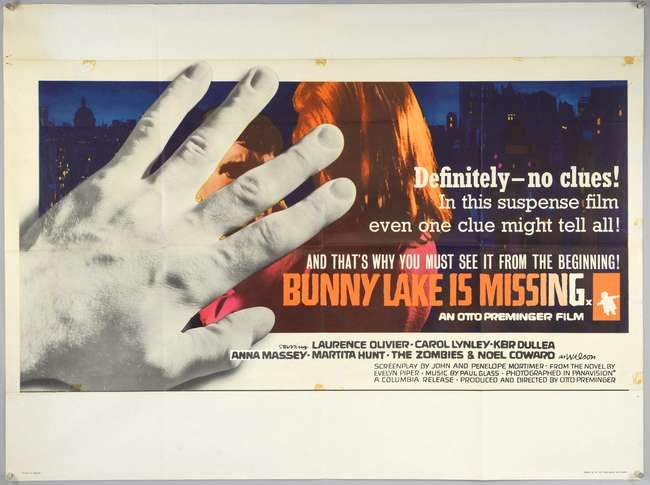
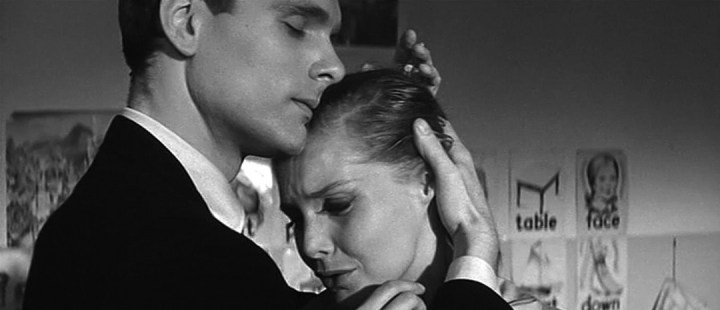
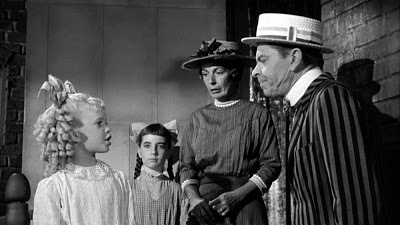
When Ann Lake (Lynley) comes to pick up 4 year old Bunny from preschool, the child is nowhere to be found. Not only that – she has not been seen by anyone the entire day.
“Hi! It’s my daughter’s first day of school in a new country! I couldn’t find anyone, so I left her to her own devices in an empty room. I’m sure someone will come find her eventually. If not, maybe you can check in on her at some point during the day, random stranger. Gotta dash! Ladida, mother of the year!”
As she desperately starts searching for her girl, Ann finds that she has trouble convincing people that Bunny really exists. Apart from her brother Steven (Dullea), no one in England has ever seen the girl since they came over from the USA – not even the audience.
“Darling sister – are you sure you remembered to take her with you when you moved..?”
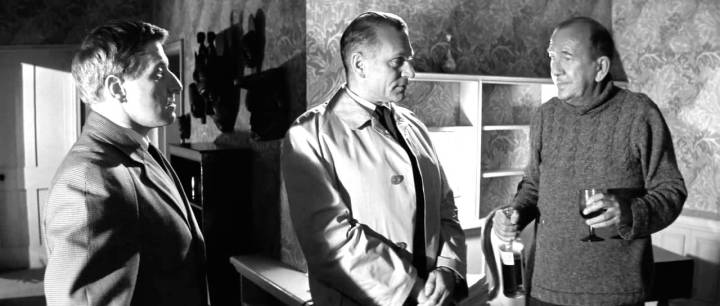
Even Bunny’s things have gone missing from their new house, and supercreepy landlord Horacio Wilson (Coward) cannot remember seeing them despite being very invasive while Ann was unpacking her toys and clothes. And now we are no longer sure there ever was a girl. But fear not! Superintendent Newhouse (Olivier) is on the case and determined to get to the bottom of the mystery!
“And when she said her daughter was missing, what did you do then?” “Well, I tried to dick her, of course!” “Ah yes, naturally. “
We loved this SO much! The characters are amazing and the mystery is very well done. Carol Lynley is wonderful as the increasingly frustrated and desperate Ann (while looking very much like a 1960s Keri Russell. Or the other way around, we suppose). Noël Coward is Creepy McCreeperson, Keir Dullea is slightly sinister, and Laurence Olivier’s Newhouse is likable from his very first appearance.
Trying to figure out who to believe and what is really going on was fun and kept us guessing (although our suspicions were eventually confirmed. Yay us!) Despite her slow start, Ann turned out to have agency and cunning – she was not just a damsel in distress!
Even surrounded by eerie dolls, she puts to shame all those men who question her sanity. Take that, woman-not-being-believed-by-authorities-when-she-worries-about-her-child-trope!
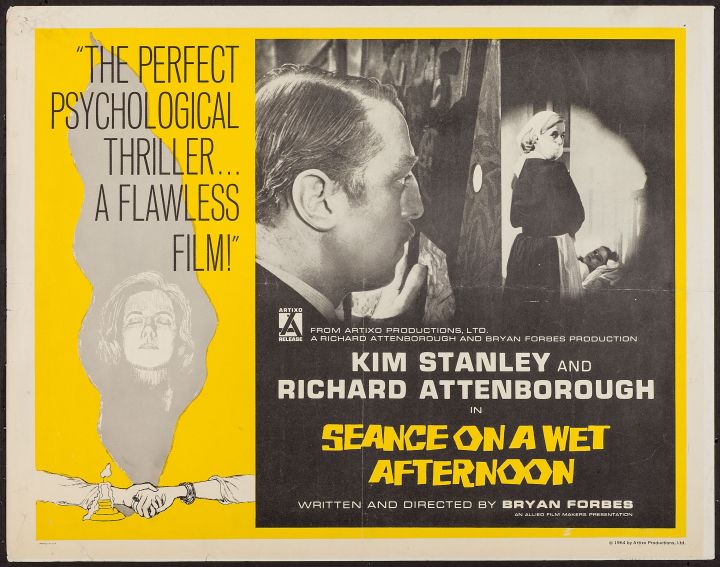
Myra Savage (Stanley) holds seances in her house for a living, but she feels very underappreciated. With her gift she should be more famous! Luckily her “spirit guide” has an excellent idea. Why not assist in a kidnapping case and get loads of publicity?
“It is my right. I am a special snowflake. The spirits tell me so.”
The unfortunate lack of local missing children will not stop this gal – if no children are willing to go missing for such a noble cause, she will just have to rope her submissive husband Bill (Attenborough) into taking care of it.
“Don’t think of it as a felony. Think of it as a bonding exercise to save our marriage. 9 out of 10 therapists recommend trying new things together!”
With little Amanda Clayton safely stashed in the nursery, Myra contacts the anguished parents to offer her services. For free, of course. She would never consider making money off of other people’s misery.
“Why, officer, that would be completely immoral. I would not dream of charging this wealthy couple for helping them. But there’s nothing wrong with getting my name in the paper, is there?”
This movie is so good! It’s an intriguing and engaging psychological thriller, and very atmospheric. Thematically (and atmospherically) it would go excellently with The Haunting and The Innocents for a creepy-and-suspenseful-with-possible-supernatural-elements British triple feature extravaganza. A little Halloween tip for all you non-party people out there.
This is our perfect Halloween. Preferably with even fewer people.
We loved the mysterious start and the gradual exposition. The relationship between Myra and Bill is fascinating, manipulative and very unhealthy, and it is extremely well portrayed by the two stars.
“Look dear, when I said I wanted you to dress up in a nurse’s uniform this was NOT what I had in mind!”
What we learned: The best laid plans… Also, does “The Swan and Edgar” still exist? ‘Cause that’s a name we can get behind! (Apologies if this is like a super-famous place that we Norwegians have somehow missed. Our cultural knowledge is vast yet limited.)
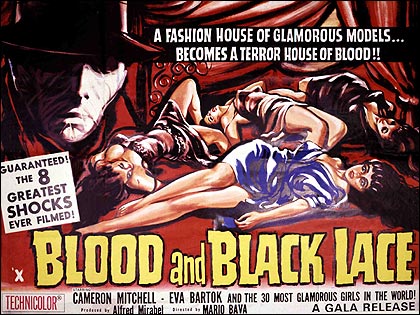
Isabella, a model at a large fashion house, is brutally murdered and her body hidden in a closet. As the investigation gets on, it soon becomes apparent that a serial killer is on the loose. No gorgeous lady is safe!
Isabella’s diary, where she had detailed every vice and sin of everyone connected to the fashion house, soon surfaces, which is not popular among her friends and colleagues. As the diary is passed around from model to model, the killer starts going after each one in turn, disposing of them in various brutal (and lurid) ways.
Remind us never to buy from that fashion house. Every stitch of clothing rips apart the second a psycho tries to murder you. #notimpressed
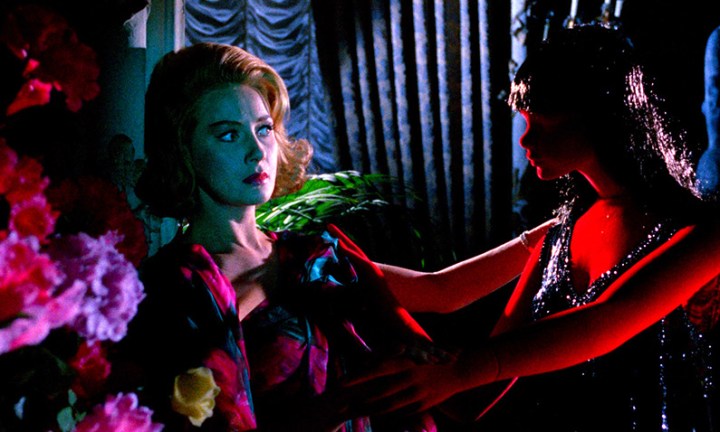
This movie was tailor made for us (no pun intended). Serial killers and gorgeous dresses? Those are our top two areas of interest and expertise! As always in Bava movies, we loved the colours and the lighting. We were completely in love with the red mannequins and all the curtains, and the scene where they prepped for the show was pure perfection.
The killer’s mask is simple but amazingly unsettling
For giallo and/or horror fans, if you have the opportunity (and the inclination), we would recommend you watch both the English and the Italian versions. You’ll get two slightly different stories and it’s very fascinating!
But seriously: do not buy from “Christian’s Haute Couture.” Especially not tops. V low quality
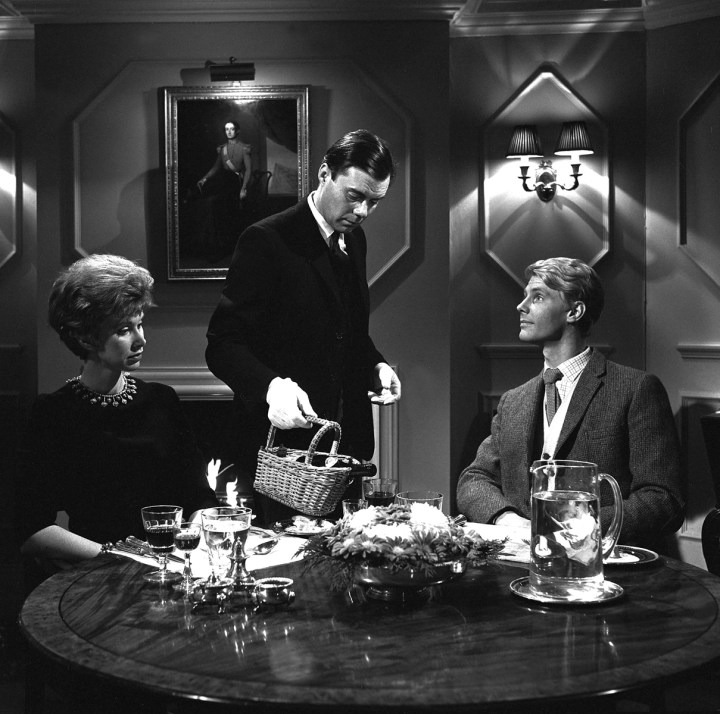
Tony (Fox) has recently bought a house and like all houseowners he is now in dire need of a manservant. This need is met in the form of Hugo Barrett (Bogarde) and he is immediately hired. Tony seems content with his new employee and they fall into their roles quite naturally.
One: the careless sleeper. The other: the sinister observer
Despite playing his devoted servant-role to perfection, whenever Tony is not around, we see a different Barrett: he drinks, smokes and even moves differently. Tony’s girlfriend Susan (Craig) seems to be the only one who picks up on the more malevolent side of Barrett, and she soon becomes directly hostile towards him. We can’t blame her though – he goes out of his way to ignore her, even when she speaks directly to him.
Personally, we tend to be careful about insulting the man in charge of the wine, but we admire her courage.
Then, when Barrett moves his “sister” Vera (Miles) in, the tension in the household reaches new heights. Tony and Vera soon have an affair, then Tony catches Barrett with Vera (who, of course, is not actually his sister), and gradually the power in the relationship shifts from one man to another.
“What does the fact that we have both slept with my ‘sister’ say about the nature of the tension between us..?”
The Servant might start off like Jeeves and Wooster, but then it goes oh so dark. Bogarde is wonderfully creepy as Barrett, and there’s an air of malice and threat about him which we absolutely loved.
The house is wonderful and practically a character in it self, and the dinner scene where we caught glimpses of people’s lives was amazing. We also loved the tension built by the dripping sink, as well as the Pinocchio nose shadow, the use of mirrors, and the score.
We enjoyed this awkward seduction too. How many suggestive and impractical poses can one girl strike on a kitchen table before she is kissed?
It’s a slow build, but exceedingly enjoyable, full of detail and hugely suspenseful. Just a beautifully successful union of writer, director and stars.
What we learned: It’s just as well we cannot afford servants… Also, deep focus was all the rage in the 1960s!
After a (slightly hostile) meet-cute, Melanie Daniels (Hedren), a socialite and prankster so good she makes news headlines, is intrigued by attorney Mitch Brenner (Taylor). She decides to stalk him, and follows him back to his weekend hideaway outside the city.
Cause stalking is cute when a pretty, rich girl does it, but when we try it we’re slapped with a restraining order…
Once there, Melanie ingratiates herself with Mitch’s ex and scores a dinner invite with his family where she learns that he is currently going through his Freudian phase – Melanie is the spit of his overbearing mother Lydia (Tandy).
“Would you like to stay the night? I’m sure my mother can lend you some clothes. In fact, why don’t you check her closet right now? Put something on? Please..?”
However, while Melanie and Mitch are flirting and working out their inner demons, the birds are starting to act strangely…
“Alright, quiet down. I’m glad so many of you could make this assembly. First order of business: who wants to organize this month’s bake sale? Also, let’s kill all humans.”
We don’t really need to say anything else about The Birds, do we? It’s one of the most well known and popular horror films in history, and also frequently referenced in other works. And while not all the special effects have aged gracefully, it’s still a fun watch.
And it’s a good public service reminder to always close up your fireplace when not in use.
Like Psycho, The Birds starts in one genre and ends up in a whole different place than where it was originally going. And while the eponymous birds are ever present, we’re almost halfway through the movie before they start constituting a threat and we’re reminded that we are indeed watching a Hitchcock film.
We loved the very silly lovebirds-in-the-car-scene, Mrs Sholes the bird expert lady, the focus which was on everything but the birds until they attacked, the long siege without dialogue, and the fact that there is absolutely no explanation for the sudden viciousness of nature. Classic!
Any movie which can make us fearful of these cute little things is a winner in our book
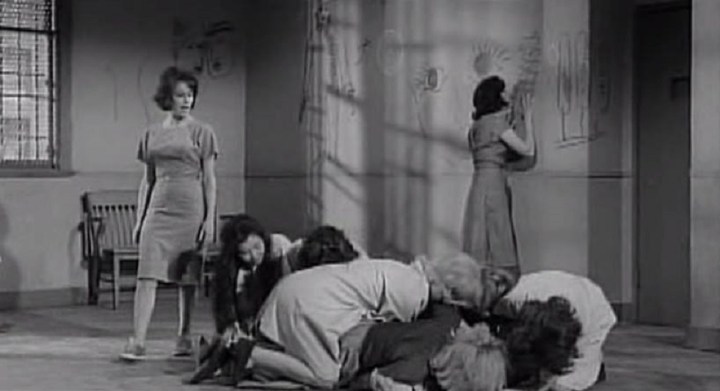
Reporter Johnny Barrett (Breck) goes undercover as a patient in a mental hospital to solve a murder and win a Pulitzer. His girlfriend Cathy (Towers) is against it, but is finally pressured into acting as his sister to get him admitted for incestuous thoughts.
“It’s not my fault, doc. She regularly shrinks down and seductively dances on my chest. How is a guy supposed to react to that?”
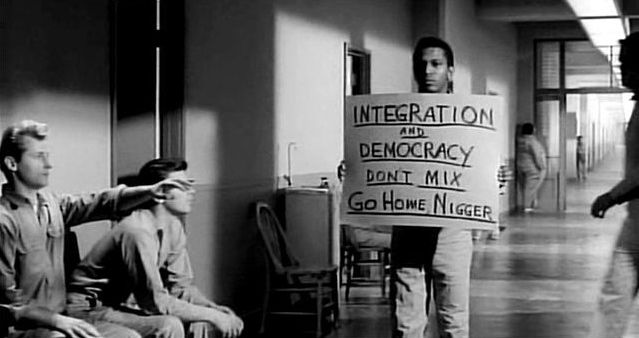
Once inside, the ambitious reporter tries to make sense out of the three witnesses to the murder: Stuart (Best), a former soldier brainwashed by the Koreans into communism and then branded a traitor; Trent (Rhodes), an African American who imagines himself as a Ku Klux Klan member after a horrible time as one of the first black students in a segregated college; and Boden (Evans), a nuclear scientist whose guilty conscience regressed him to the mental state of a child.
Interestingly, while the men’s ward has patients with a variety of fascinating problems, all the female patients suffer from the same affliction: zombieism nymphomania.
With unreliable witnesses, dire circumstances and an opera singing “sidekick,” will Barrett solve the murder and win his prize? Or will he lose his mind, his girl and his career trying?
“Your guess is as good as mine, ghost-and/or-racist-guy!”
We loved Shock Corridor despite the fact that it features one of the worst reporters in the history of reporting. Seriously, each one of the stories he encounters from the patients he interviews is easily as interesting and important as the story he is chasing, but he is too focused on his goal to see it.
Any personal history which led to this scenario would be Pulitzer worthy in our book
The voice-over is very noiry, which we always enjoy, although we did feel like it made the movie a bit “tell, don’t show” at times. Still, we loved the dream sequences and how we could see what went on in the characters’ heads. We also loved the WTF choreography to Cathy’s striptease, the rainy corridor, and the backstories of all the patients. And we were glad that the horrible, horrible rape scene was portrayed as a nightmare rather than a dream…
Though while we appreciate the aesthetics of such a scene, we are always left wondering who are the poor people tasked with cleaning up after?
Oh, God, we love this movie! We’ve been looking forward to rewatching it ever since we first decided to let the list control the next ten years of our lives, and it was worth the wait.
If we are to be truly honest with ourselves, this will be us by the end of this project. The only question that remains: who’s who…
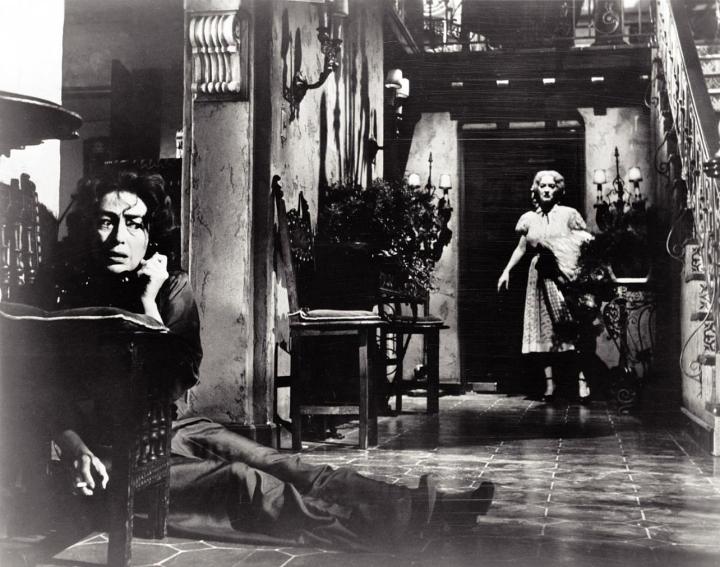
Jane (Davies) and Blanche (Crawford) are sisters, and as children Jane was a vaudeville star while Blanche lived in her sister’s shadow. Twenty years later, their roles have reversed, and Blanche has become a successful movie star while Jane has turned into an alcoholic, washed-up has-been.
Then, one fateful night, Blanche is paralyzed in an accident blamed on Jane, and the two start a reclusive life by themselves in a mansion where Jane takes care of the increasingly isolated Blanche.
“My nursing experience includes singing strangely romantic duets with my dad as a child and dressing like a toddler even though I’m pushing 60.” “You’re hired!”
Jane, resentful of her more successful sister, becomes obsessed with recapturing her glory days as a child star, and hires pianist Edwin Flagg (Buono) to help her revive her act. She cuts her sister completely off from the outside world by removing her telephone, and starves her by feeding her rats and dead pets.
“Oh, I couldn’t possibly have another rat. I must watch my figure.”
Both main performances in What Ever Happened to Baby Jane? are spectacular, and that’s probably the main reason this film is so incredibly engaging. Bette Davies as Jane is deliciously deranged and demented, and is just a joy to watch.
Joan Crawford is (almost) equally engaging as the victimized Blanche, a more toned down and possibly more challenging role. However, we grew increasingly frustrated by her uselessness. Seriously, woman! You know your sister has completely lost it! And that is as hard as you’re prepared to fight???
Just scream bloody murder down the phone, you useless lady!
Blanche is not the only frustratingly incompetent character in the movie – pretty much everyone, from neighbour Mrs Bates (Lee) who’s too polite to interfere, to maid Elvira Stitt (Norman) who underestimates Jane’s madness despite her knowledge of both sisters, fail to help Blanche and stop Jane due to being basically completely fucking useless.
“I realise that you are batshit crazy and I suspect you are torturing and starving your sister, but instead of calling the police, I am going to snoop around a bit and confront you unarmed.”
Watch it for the performances, the characters, the costumes, the hair and make-up, the story, the music and the tension. And to have a really good (if frustrated) time!
What we learned: It’s a good thing none of us are super successful…
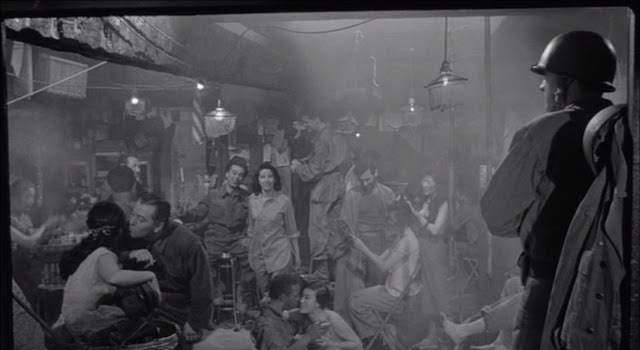
Korea, 1952. A patrol is ambushed and taken prisoner. When they return to the US, generally despised Sergeant Raymond Shaw (Harvey), who’s cursed with a busybody mother (Lansbury) and a fanatic senator stepfather (Gregory), is awarded Medal of Honor. The medal is given to him based on the testimony of his fellow soldiers, who cannot say enough good things about him, although they are unsure why.
“We just really respect the way he used to break up our parties with local prostitutes”
Meanwhile, a few members of the same patrol, including Major Bennett Marco (Sinatra), are troubled by nightmares in which the celebrated Sergeant kills two fellow soldiers on the command of a bunch of ladies talking about agriculture and occasionally morphing into communist leaders.
“Welcome to my talk on how to make blossoming gardens and sleeper agents. I’m very happy to see so many morphing faces here today.”
Marco’s fears are dismissed by the military, and he is eventually placed on sick leave. He meets Eugenie (Leigh) on a train, and she becomes his support system as he tries to make sense of what actually happened in Korea.
She is witty and fantastic, but also insanely reckless. Who talks to an unknown man who’s clearly having some sort of breakdown, and after three minutes decides to give him all her personal details?
Marco’s suspicion is that Shaw, and the rest of the patrol, are all brainwashed and returned to the USA to carry out some sort of plot. But what exactly is Shaw’s mission? Who is his local handler? And will they have any chance of stopping whatever it is in time?
And will Shaw ever get out from under the thumb of his controlling mother?
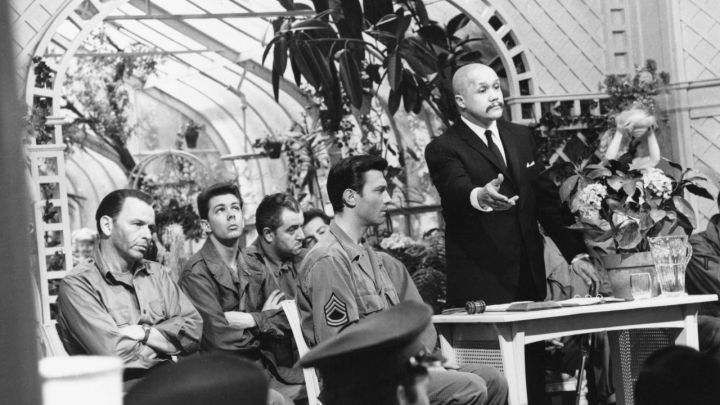
The Manchurian Candidate is a tense and compelling thriller which keeps going off in unexpected directions. We loved the horticulture talk the soldiers imagined, and the cross cutting between their perception of it and the reality.
Pictured: The Annual Women’s Society Lecture on Communist Leaders™
We also loved how the different soldiers saw this scene differently – the black soldier seeing a room filled with black women, etc. Now, the plot is perhaps a bit far-fetched, but in the time of the Cuban Missile Crisis and the aftermath of McCarthyism, we’re sure it hit all the right buttons.
We found Frank Sinatra to be a surprisingly good actor, and we loved Angela Lansbury: her character could have snatched the “World’s Greatest Mother” trophy right from the cold, dead hands of Mrs Bates…
Surprisingly good actor or not, Frank Sinatra’s card playing skills were clearly below par
After almost hitting a young man with their car, a couple angrily invite him to hitch a ride with them. They drive down to a lake, and the hitchhiker (Malanowicz) is invited to go sailing with the couple, Andrzej (Niemczyk) and Krystyna (Umecka), an offer he accepts for some reason.
Clearly, none of these people had ever heard of a serial killer.
Once out on the water, both men take turns being suddenly angry and/or insulted and aggressive towards each other while Krystyna lounges about, makes food and does a great job hiding anything which could be deemed a personality.
There is really no trace of personality there until she gets wet… Which might be somewhat symbolic.
Tension builds as the trio are exposed to harsh weather and alpha male competitions, and it culminates with the loss of the young man’s pocket knife in the water and his subsequent presumed drowning.
Now, the Norwegian translator for the DVD we watched apparently decided only half the lines were worth subtitling, so we may have missed a few things. Like major plot points. But the tension between the characters was clear even if the reason was not always so.
We’re going to go out on a limb and assume that some of that tension might be because of the half naked woman whose attention the two men vie for.
The entire movie is set in just two locations (albeit moving ones), a car and a boat, which we really enjoyed. We loved the crocodile, the tense start and the ambiguous ending. We also found the couple strangely adorable when they were in the water, despite their chilly relationship in the rest of the film.
See? They look like a perfectly harmonious couple once they’ve been out swimming.
Roman Polanski’s debut feature film is beautifully and interestingly shot, and the filming plays a huge part in building the tension. Especially for those of us who do not speak Polish and who are at the mercy of a translator who’s a really slow typist and who doesn’t have time to go back and fill in the blanks… We’re pretty sure we understood about two thirds of the dialogue though, so we’ll call that a win.
No fun caption here. Just wanted to show you this cool shot.
What we learned: It is a bit weird to invite a random hitchhiker to go sailing, right..? Also, don’t introduce a knife in the first act unless you’re going to use it by the third. And don’t introduce a woman in the first act unless you’re going to give her a personality by the third.