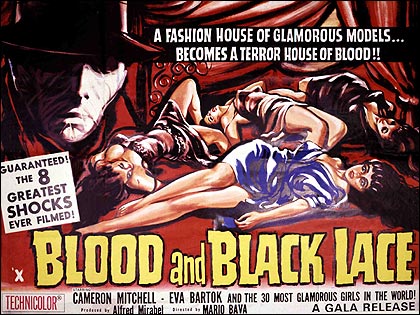
Isabella, a model at a large fashion house, is brutally murdered and her body hidden in a closet. As the investigation gets on, it soon becomes apparent that a serial killer is on the loose. No gorgeous lady is safe!
Isabella’s diary, where she had detailed every vice and sin of everyone connected to the fashion house, soon surfaces, which is not popular among her friends and colleagues. As the diary is passed around from model to model, the killer starts going after each one in turn, disposing of them in various brutal (and lurid) ways.
Remind us never to buy from that fashion house. Every stitch of clothing rips apart the second a psycho tries to murder you. #notimpressed
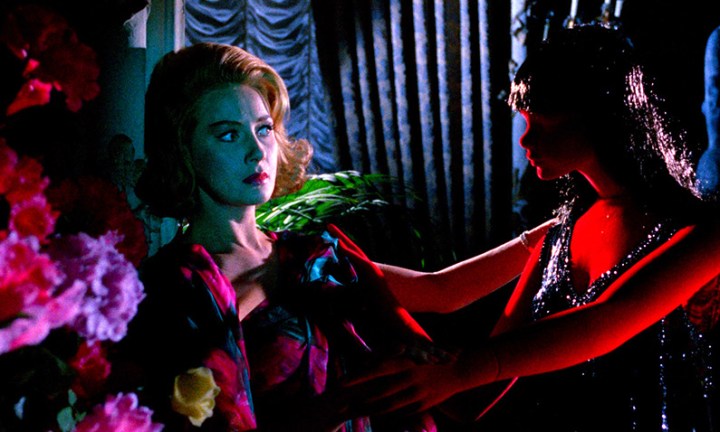
This movie was tailor made for us (no pun intended). Serial killers and gorgeous dresses? Those are our top two areas of interest and expertise! As always in Bava movies, we loved the colours and the lighting. We were completely in love with the red mannequins and all the curtains, and the scene where they prepped for the show was pure perfection.
The killer’s mask is simple but amazingly unsettling
For giallo and/or horror fans, if you have the opportunity (and the inclination), we would recommend you watch both the English and the Italian versions. You’ll get two slightly different stories and it’s very fascinating!
But seriously: do not buy from “Christian’s Haute Couture.” Especially not tops. V low quality
Starring: Peter Sellers, Elke Sommer, George Sanders, Herbert Lom, Tracy Reed, Burt Kwouk, our dad’s old guitar.
Year: 1964
Runtime: 1h 42min
We’re back! After charging our batteries in lovely Vietnam (you must go!) we’re ready for another year of classic A-, B-, and C-movies, starting with the very silly and charming A Shot in the Dark.
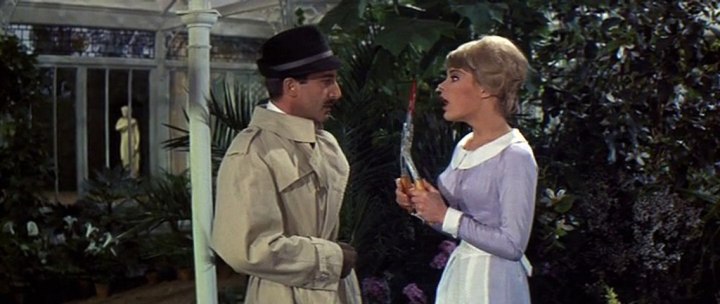
We open on a series of illicit affairs and romances all taking place in the same building, and the scene ends in a shot. In the dark. And then a dead chauffeur. Enter Inspector Jacques Clouseau (Sellers).
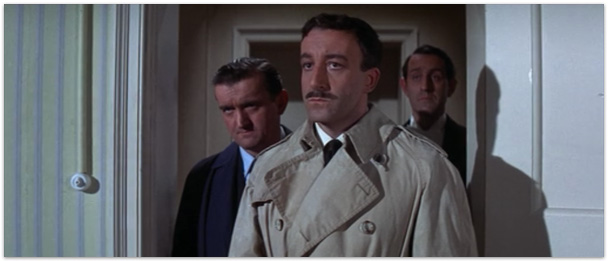
Mustache and trenchcoat ready for beumbs and beumps!
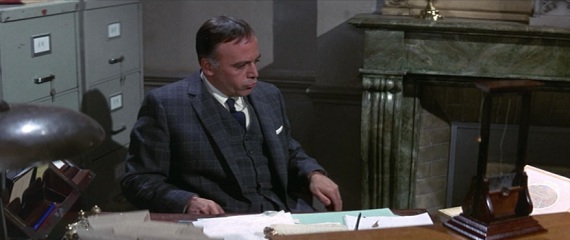
The incompetent and clumsy inspector is the only one convinced that main suspect, the beautiful maid Maria Gambrelli (Sommer), is innocent, and he sets out to prove this. In the course of his investiation, the bodies keep piling up and his superior, Commissioner Dreyfus (Lom), is gradually driven mad and homicidal by Clouseau’s apparent bungling of the case.
“Bungling? Who’s bungling? This was always the plan. I am solving this.”
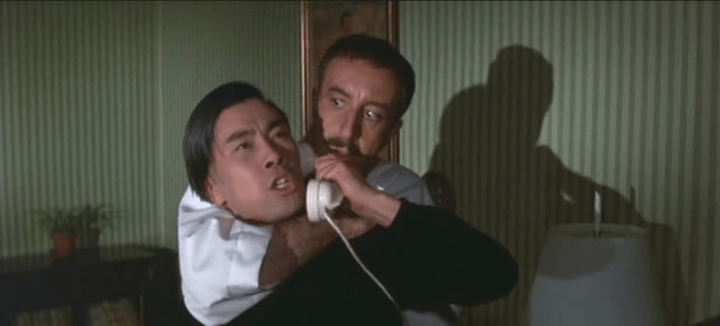
There are so many things we adored in this movie. We particularly loved Kato and his sneak attacks, the lethal (and multicultural) date night, all Clouseau’s disguises, and the synchronising of the watches. However, the gags are too numerous to list, and the entire movie is just a masterclass in slapstick and physical comedy.
Also, could it possibly be an inspiration for one of the murders in Hot Fuzz..?
We were slightly traumatised by Sellers using our dad’s old guitar to cover up in the nudist colony (we swear it’s the exact guitar!) but otherwise we had a blast with this movie. Often, we become frustrated and annoyed with bumbling, incompetent characters and farces, but Sellers is so damned good that in this case we were just charmed instead. Well done, Edwards and Sellers!
“I can’t believe that idiot inspector was an actual success! FML.”
Reporter Johnny Barrett (Breck) goes undercover as a patient in a mental hospital to solve a murder and win a Pulitzer. His girlfriend Cathy (Towers) is against it, but is finally pressured into acting as his sister to get him admitted for incestuous thoughts.
“It’s not my fault, doc. She regularly shrinks down and seductively dances on my chest. How is a guy supposed to react to that?”
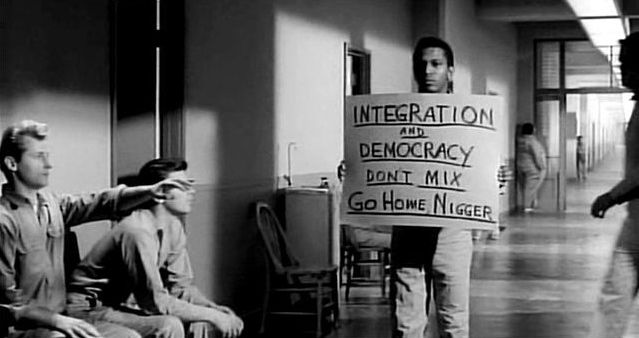
Once inside, the ambitious reporter tries to make sense out of the three witnesses to the murder: Stuart (Best), a former soldier brainwashed by the Koreans into communism and then branded a traitor; Trent (Rhodes), an African American who imagines himself as a Ku Klux Klan member after a horrible time as one of the first black students in a segregated college; and Boden (Evans), a nuclear scientist whose guilty conscience regressed him to the mental state of a child.
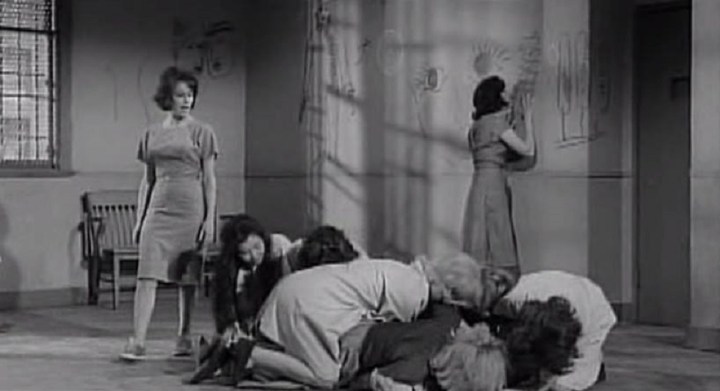
Interestingly, while the men’s ward has patients with a variety of fascinating problems, all the female patients suffer from the same affliction: zombieism nymphomania.
With unreliable witnesses, dire circumstances and an opera singing “sidekick,” will Barrett solve the murder and win his prize? Or will he lose his mind, his girl and his career trying?
“Your guess is as good as mine, ghost-and/or-racist-guy!”
We loved Shock Corridor despite the fact that it features one of the worst reporters in the history of reporting. Seriously, each one of the stories he encounters from the patients he interviews is easily as interesting and important as the story he is chasing, but he is too focused on his goal to see it.
Any personal history which led to this scenario would be Pulitzer worthy in our book
The voice-over is very noiry, which we always enjoy, although we did feel like it made the movie a bit “tell, don’t show” at times. Still, we loved the dream sequences and how we could see what went on in the characters’ heads. We also loved the WTF choreography to Cathy’s striptease, the rainy corridor, and the backstories of all the patients. And we were glad that the horrible, horrible rape scene was portrayed as a nightmare rather than a dream…
Though while we appreciate the aesthetics of such a scene, we are always left wondering who are the poor people tasked with cleaning up after?
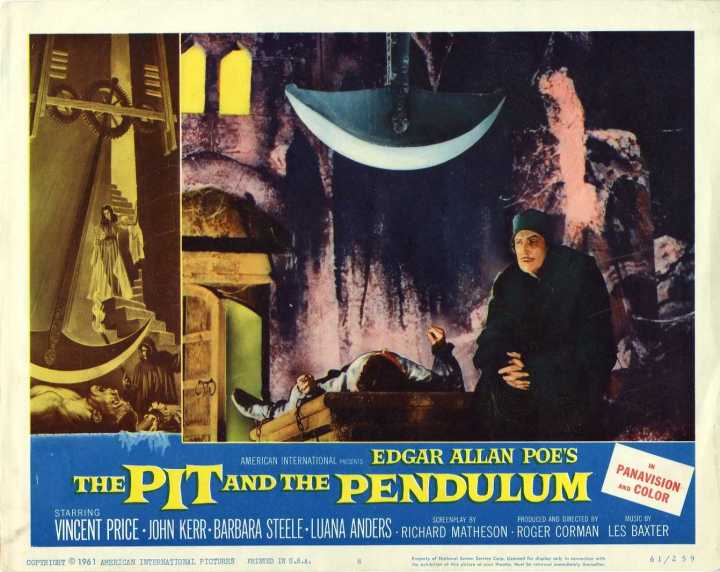
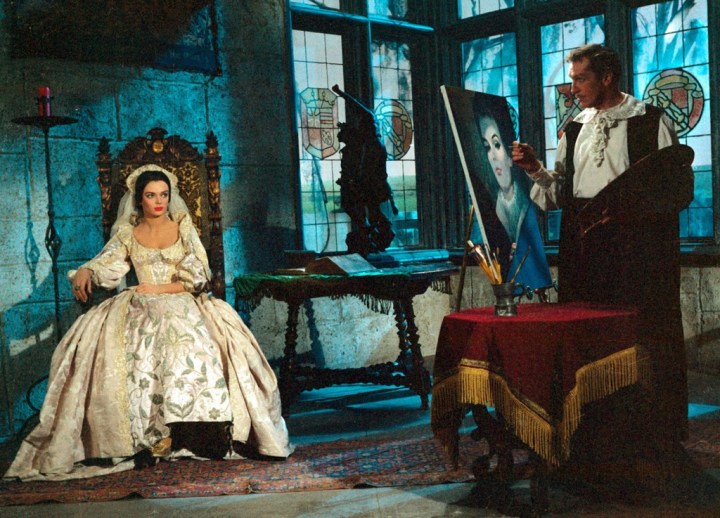
Spain, 1546. Mr Barnard (Kerr) comes from England to see where and how his beloved sister Elizabeth (Steele) died. He meets his brother-in-law Nicholas Medina (Price) and his sister Catherine (Anders) and is offered a strange and vague explanation of Elizabeth’s death.
“Suffocation from too-tight corset” is not among the excuses. Neither is “tripped over own voluminous skirt and broke neck.”
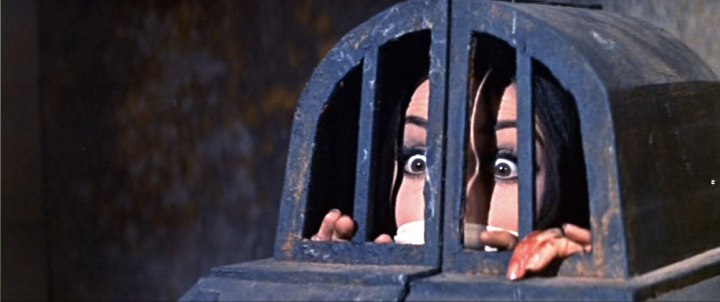
Family doctor Leon (Carbone) later reveals to the grieving brother that his sister died of fright. Since more details are surely required after such a statement, Medina confesses that his bride had become obsessed with the inquisition era torture chamber in the cellar, and that she perished in an Iron Maiden.
We’ve always felt that a house is not a home without a fireplace, a lounge area, and an indoor torture chamber. We’re having ours installed next weekend.
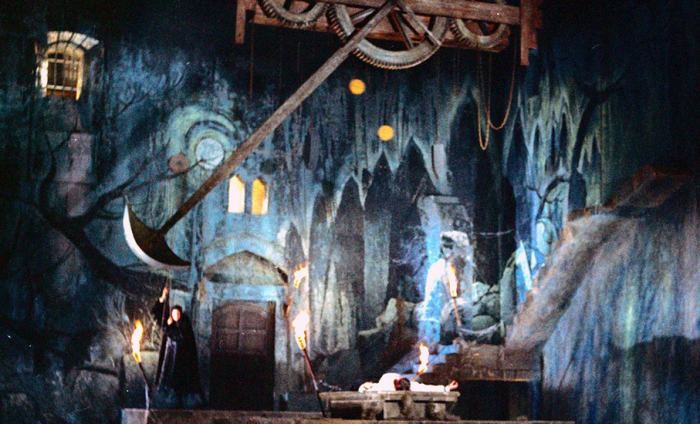
But is this all there is to it? Barnard is still not satisfied, and as we delve deeper into the house’s secrets, we learn that Medina’s father killed his brother and wife in the chamber when his children were young. Young Nicholas witnessed the ordeal and was never the same again.
As Medina devolves into madness, strange things also begin to happen in the castle… So what really happened to Elizabeth? Is she haunting them? Or was she buried prematurely, House of Usher-style?
And why didn’t anyone bother informing doctor Leon of the dress code for the evening? These questions will haunt us…
Pit and the Pendulum has everything we love: Gothic castles, secret passageways, hidden torture chambers, ghosts, murder, madness and torture. It is morbid, grotesque and lovely, and we completely adored Vincent Price as the confused, distressed widower. Barbara Steele’s eyes are as haunting as they were in Black Sunday, and she is the perfect Gothic heroine/villain (take your pick here). Personally, we are of course suckers for anything Poe (and Corman. And Price.), so we had no choice but to include this even though it is no longer on the list. It’s fantastic!
Best watched by squinting from inside an Iron Maiden. Well, we say “best”…
Ingeri (Lindblom) is an unwed pregnant servant for a prosperous Swedish family. Angry at her circumstance and jealous of spoiled rich girl Karin (Pettersson), she prays to Odin for justice while the rest of the household are Christian.
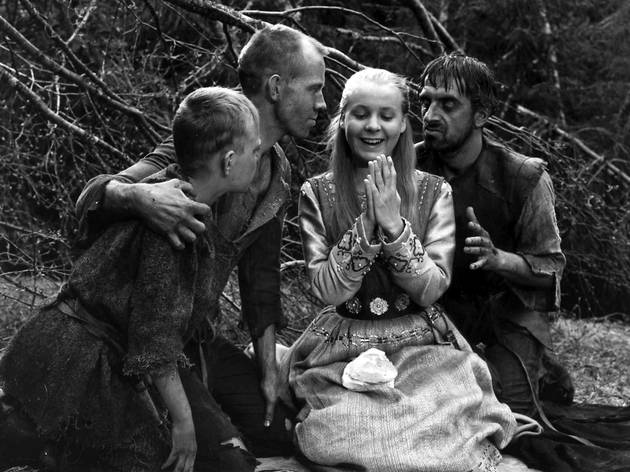
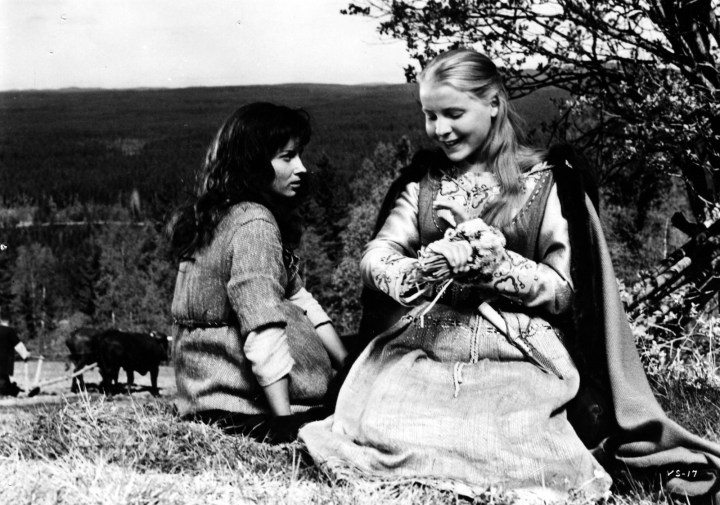
The two young women are sent to church to deliver candles for mass, but Ingeri is spooked by the forest (and an appearance by Odin himself, probably) and Karin goes off on her own. She runs into a trio of goat herds who she invites to share her meal but being pampered and naïve, she does not sense the danger they pose until it’s too late.
Clearly, she’s never met anyone not interested in her well-being before. They’re not even trying to be non-creepy!
With Ingeri watching from the trees, two of the three men rape and then kill Karin, steal her clothes and valuables, and then leave her half naked body in the woods to rot. Later that night, the brothers seek shelter with Karin’s parents Märeta (Valberg) and Töre (von Sydow). The now worried parents only discover the brutal truth when their guests try to sell Märeta Karin’s distinctive and expensive dress, spotted with blood. They start preparing their revenge…
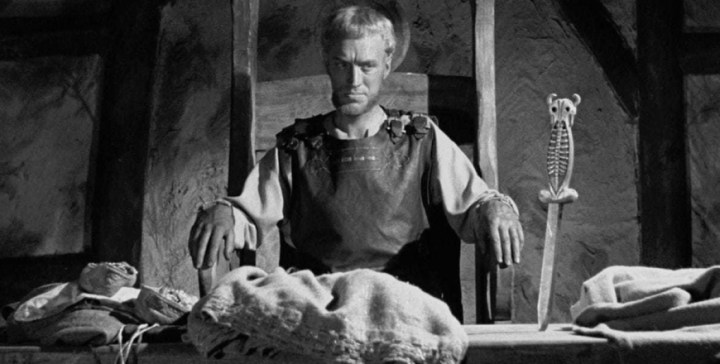
Daddy forgets all about his Christian values when faced with his daughter’s brutal murder. Luckily for him, he keeps a pagan/satanic knife handy for just these kinds of situations.
The Virgin Spring is like a dark and brutal fairytale – Karin is the innocent princess and Ingeri the dark witch (although she does seek redemption in the end). The three headed troll popular in Scandinavian folklore is also present, and there’s friction between the old faiths and beliefs and the relatively new Christian faith (which technically raped its way through Scandinavia, so the roles are slightly reversed) which we also often see in traditional fairytales.
It’s almost as if thy’re going for some sort of contrast or something. We’re not sure.
The rape scene is extremely uncomfortable to watch, even by today’s standards (as, indeed, all rape scenes should be) and the tension throughout the movie is palpable. For us Norwegians though, the appearance of Allan Edwall as a beggar residing with the prosperous farmers is a welcome distraction from the horror. Anyone who grew up in the Nordic countries in the 1970s, ’80s and ’90s are familiar with him from his roles in several films based on Astrid Lindgren.
The man never fails to remind us of happier, more innocent times. Although, of course, there was no way Bergman would have foreseen that. (Sorry for picture quality. There’s a distinct lack of Edwall-stills from this movie online.)
This is a fantastic, tense and uncomfortable movie about jealousy, hatred, revenge and redemption, and we truly recommend it. Even if you have no relationship with Allan Edwall.
What we learned: Hell hath no fury like a parent bereft. Also, try not to summon the old gods if you’re not 100% sure you can handle it. Just a little tip for you.
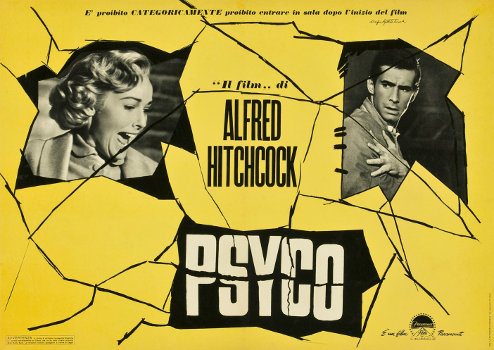
Psycho probably needs no further introduction as it’s one of the most watched, loved and spoofed/homaged films of all time. Still, for those hermits who have been living secluded lives in the woods for the past 60 years but have also inexplicably stumbled upon this blog (hello, stranger! To be honest, you’re probably better off crawling back under that rock, given the current state of the world), we’ll give a very brief synopsis.
In short, wood dwelling hermit: if you see this place, just keep driving. Or walking. Or riding your tame bear.
Marion Crane (Leigh) is having an affair with Sam Loomis (Gavin) but they cannot afford to get married. When Marion gets her hands on $40 000 at work, she decides to steal the money and run away to elope with her beau. She is caught in a rainstorm and checks in for the night at the secluded Bates Motel.
Marion is reported missing by her sister Lila (Miles) and wanted by the police for theft. Lila decides to investigate the disappearance herself with the help of Sam and private investigator Milton Arbogast (Balsam) who is also on the case. What they find is not what they expected…
The shower scene is perhaps the most famous scene in cinematic history, and no matter how many times you’ve seen it or its various recreations, it still has impact. As does Norman Bates’ transformation from sweetly awkward and likable young man to creepy insane murderer.
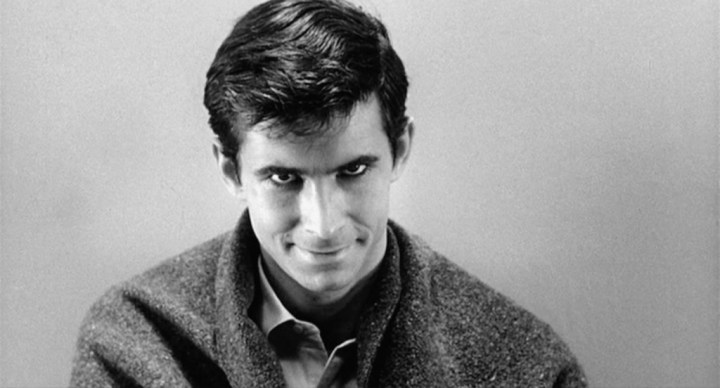
He actually seems quite charming at first, making Marion supper and all
As mentioned in our last entry, this goes perfectly as a double feature with Peeping Tom, if you want a night filled with serial killers and crazy. And who doesn’t?
“We’re off to see the killer! The wonderful killer of girls!”
For those of you who want more context than the initial summary, Mark Lewis (Böhm) is an aspiring film maker who shoots soft porn during the day and murders at night. His neighbour Helen (Massey) takes an interest in the socially awkward weirdo, and we learn that Mark was used as a guinea pig by his psychiatrist father who studied fear.
Daddy also filmed the child abuse. Father of the year!
Peeping Tom was initially hated by critics and basically killed the career of its director, but time has worked in its favour and it is now a beloved classic. And we absolutely loved it!
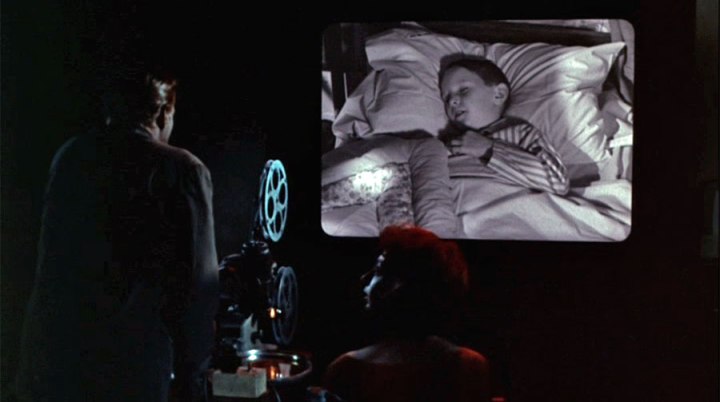
We loved this movie almost as much as this guy loves his camera. Which is a bit of a love/hate-relationship to be honest.
We were enthralled from the very beginning, with the camera point-of-view, and we were on the edge of our seats throughout. Mark is a complex and strange character; is the real him the awkward and timid man he is in social situations, or is it the dynamic take-charge man we see when he’s about to commit murder?
We’re sure this woman was super-impressed by his sudden alfa-maleness just before she was brutally murdered
It’s a must-see for horror fans (or movie fans in general), and it works fantastically as a double bill with the upcoming Psycho. Get out your blankets, wine (or tea – we don’t judge) and snacks, and enjoy!
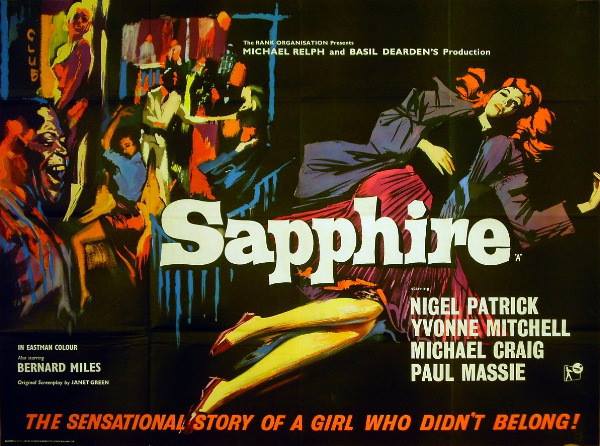
A young woman is found murdered in Hampstead Heath with nothing to identify her but a monogrammed handkerchief. Investigators Hazard (Patrick) and Learoyd (Craig) identify her as Sapphire Robbins and start trying to find the truth behind her death.
“Fill up on pipe tobacco! We shall get to the bottom of this!”
They track down her devastated boyfriend, David Harris (Massie), and her big brother Dr Robbins (Cameron), but surprises keep coming. First off, the autopsy reveals that Sapphire was pregnant at the time of her death, and the investigators are then baffled when her brother comes in as he is black and Sapphire appeared to be white.
“…and you’re absolutely sure none of you were adopted? And that you’re not using the word ‘brother’ in a wider sense..?”
These new revelations lead to an investigation which encounters racism and prejudice, both from the white and black communities and even from within as not all investigators manage to stay neutral. But was her ethnic background motivation for murder? And if so, who was enraged enough by her “transition” from black to white to murder the young girl?
Look at this happy family she was about to marry into! There’s no way anyone in this blissful household would ever kill anyone.
We love a good murder mystery, and we love it even more when it deals with real political and social issues. Sapphire may be from 1959 and deal with racism and prejudice in the wake of the first waves of Commonwealth immigration in Britain, but there are parallels to be drawn to recent debates considering Brexit.
We’re sure there are lots of idiots out there who would love it if all non-whites had stayed in their own clubs like this one…
We were also reminded of Sarah Jane although her and Sapphire’s stories are different and so are their societies. A great mystery movie with real social and political commentary, we can definitely recommend this.
What we learned: School teachers are very respectable and a bit above the rest. Thank you! Also, racism sucks and we need to stop this shit already!
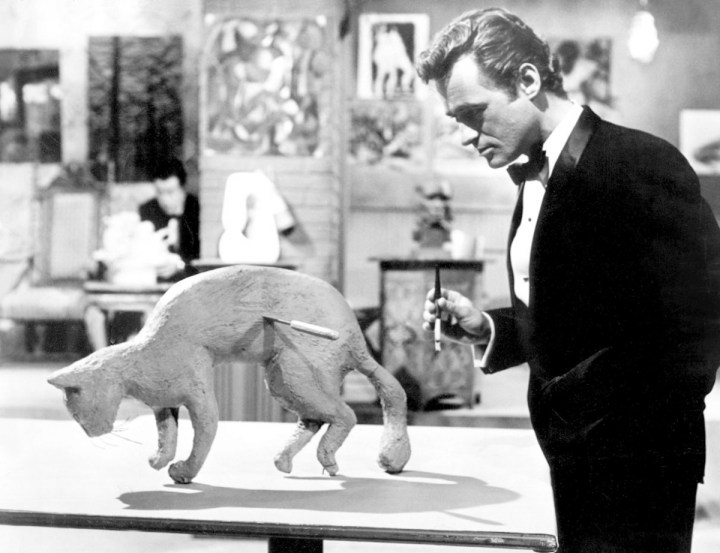
In a beatnik café, pretentious poet Maxwell H. Brock (Burton) is performing his latest work, to the fascination of busboy Walter Paisley (Miller). Inspired by the artists he surrounds himself with, and also driven by their ridicule of him, Walter decides to try his hand at sculpting.
“So, how did we do this in Arts and Crafts again..? I just knead it for a while and then it turns out amazing? Can’t be more to it than that!”
Realising that sculpting is harder than it looks, he takes a break to save his landlady’s cat who’s stuck inside the wall. However, stabbing through it, he accidentally stabs the poor cat. Naturally, he proceeds to cover the dead animal in sculpting clay and the next day he turns up to work with his new sculpture.
“Dead Cat” is an instant success, admired by art lovers and drug enthusiasts alike
Walter’s newfound success leads to admiration from his crush Carla (Morris) and other patrons of the café, and a lady gives him some heroin as a gift, as one does. This in turn leads to an attempted arrest as an undercover cop follows Walter home and tries to book him for drug possession. Afraid, Walter hits him over the head with a frying pan, killing the cop instantly.
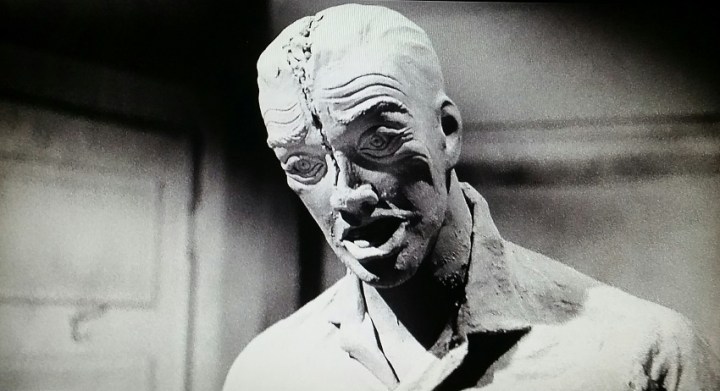
What do you do when you accidentally kill a cop? Why, cover the body in clay and pass it off as a life sized sculpture, of course!
Walter gradually goes from underestimated and accident-prone simpleton to calculating killer who lets every small slight become justification for murder. He is, however, not smart enough to avoid killing people he knows and is known to dislike.
“It is so sweet that you made a sculpture of a strangled woman who looks exactly like the one who spent last night insulting you very publicly. I simply must kiss you!”
Leonard (Carbone), the owner of the café, is the only one to see through his newly discovered talent, but he is making money off of Walter’s work and has a vested interest in keeping up the illusion. But how long can this go on? And who is next on Walter’s kill radar?
“This severed head has been bothering me all week, so I clayed it!”
A Bucket of Blood is the farcical version of House of Wax. The concepts are similar, but this one is more comedic and strangely also more sinister in many ways. Walter is the epitome of the stereotypical “good guy” – he sees himself as sweet, kind, underestimated and misunderstood, but if he’s rejected by someone, or made fun of, he becomes violent and murderous while simultaneously justifying his actions in his head.
“I’m a famous and celebrated sculptor now, so you must date me. Unless you’re just a bitch and a whore!”
We loved his first attempt at sculpting Carla’s face, the extremely pretentious Maxwell and the morbidity of the whole film. We also understand perfectly why Roger Corman made so many films based on the works of Edgar Allan Poe – it’s a match made in heaven! Or probably hell, to be quite frank.
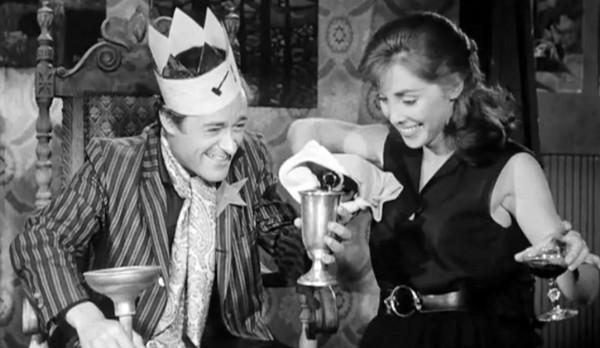
“If it’s hell, can I still be king..?” “Of course you can, Mr Futterman.”
Starring: James Stewart, Kim Novak, Barbara Bel Geddes, Tom Helmore
Year: 1958
Runtime: 2h 8min
For those of you wondering what happened to #167 to #172, Mr Wright has made a few changes to the list and we have had to update the numbering to the current version, as outlined here. A number of new films have been added to the ’30s and ’40s, and we’ll try to catch up with them as soon as we can get our hands on copies. Until then, we continue where we left off, but with updated numbers.
During a roof top police chase, John “Scottie” Ferguson (Stewart) almost falls to his death and witnesses another police officer die trying to save him. After the accident, he retires from the force and suffers vertigo as a result of the traumatic incident.
If there’s one thing we’ve learned from American Ninja Warrior it’s that once your arms straighten, you’re doomed. That, and Gbaja-Biamila is really fun to say.
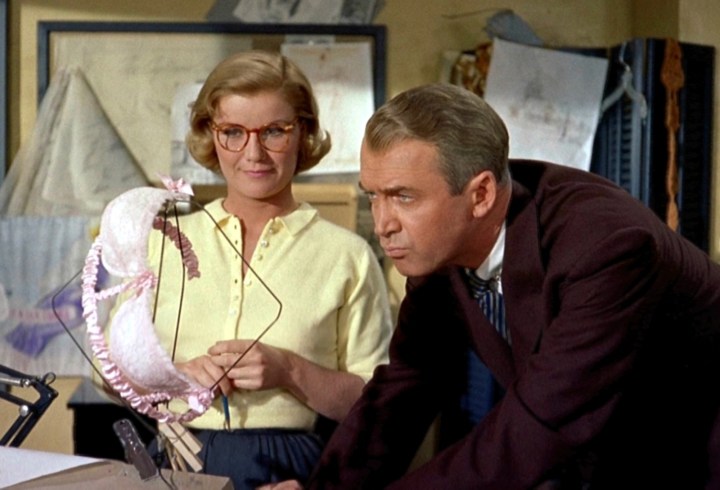
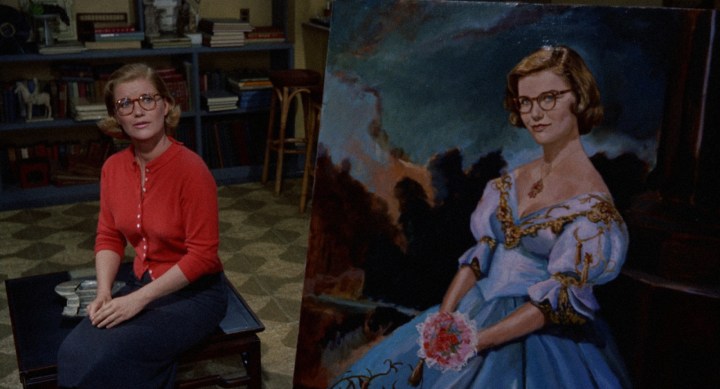
Spending his downtime in the (fantastic) company of friend Midge Wood (Bel Geddes), Scottie is contacted by old school friend Gavin Elster (Helmore) who hires him to stalk his wife. Elster claims Madeleine (Novak) has been possessed by the spirit of her great-grandmother Carlotta, who killed herself after being betrayed by the man she loved.
“No woman is that interested in art. She must be possessed by the woman in the painting.”
Hesitant at first, Scottie agrees to the job after seeing the gorgeous Madeleine. He follows her to the florist and the cemetery where she visits Carlotta’s grave. When she later flings herself into the river, he saves her and brings her home, and they promptly fall in love.
“I’m aware that you’re my friend’s wife and quite possibly possessed and/or crazy, but those eyebrows just make me weak!” “What, these old things? They we’re just something I threw on.”
However, it’s far from smooth sailing from then on. Turns out newfound love does not erase madness/ghosts and Scottie is unable to save Madeleine, leading him to a complete meltdown. But what was actually going on?
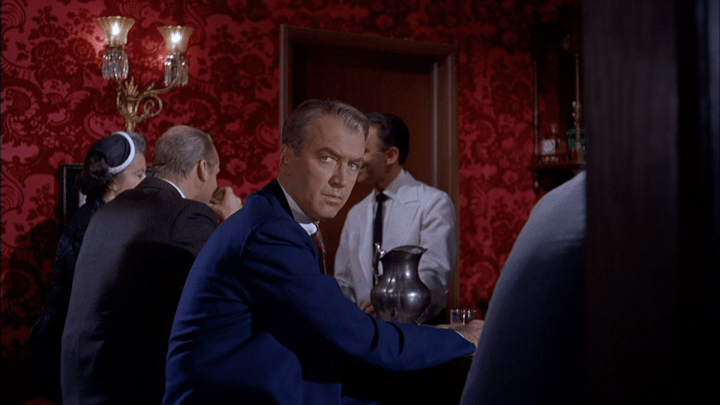
From the awesome opening titles (by Saul Bass) to the end credits, Vertigo is fantastic. We loved the colours (especially the red restaurant), all the spirals, the dolly zoom, the very judgemental judge, the dream sequence and of course Midge. Lovely, lovely Midge and her lovely, lovely apartment.
We thought it was funny too, Midge. Scottie’s just too sensitive.
Also, any mention of ghosts have us hooked from the very start, even if there’s no actual supernatural forces at work. And we find James Stewart oddly charming.
We covet that wallpaper… And, to a lesser degree, that man.




























 1000 Films Blog