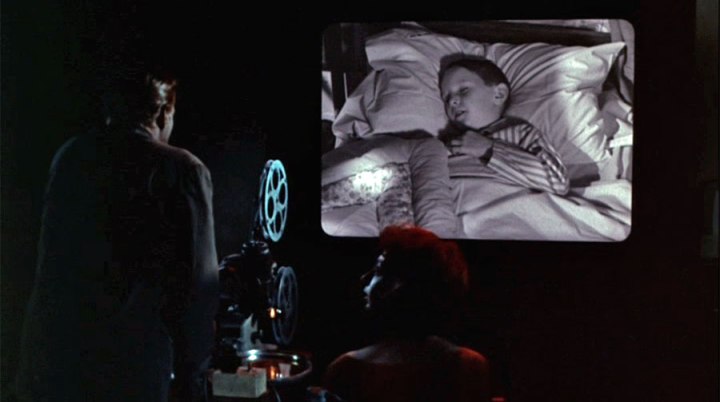
For those of you who want more context than the initial summary, Mark Lewis (Böhm) is an aspiring film maker who shoots soft porn during the day and murders at night. His neighbour Helen (Massey) takes an interest in the socially awkward weirdo, and we learn that Mark was used as a guinea pig by his psychiatrist father who studied fear.
Daddy also filmed the child abuse. Father of the year!
Peeping Tom was initially hated by critics and basically killed the career of its director, but time has worked in its favour and it is now a beloved classic. And we absolutely loved it!
We loved this movie almost as much as this guy loves his camera. Which is a bit of a love/hate-relationship to be honest.
We were enthralled from the very beginning, with the camera point-of-view, and we were on the edge of our seats throughout. Mark is a complex and strange character; is the real him the awkward and timid man he is in social situations, or is it the dynamic take-charge man we see when he’s about to commit murder?
We’re sure this woman was super-impressed by his sudden alfa-maleness just before she was brutally murdered
It’s a must-see for horror fans (or movie fans in general), and it works fantastically as a double bill with the upcoming Psycho. Get out your blankets, wine (or tea – we don’t judge) and snacks, and enjoy!
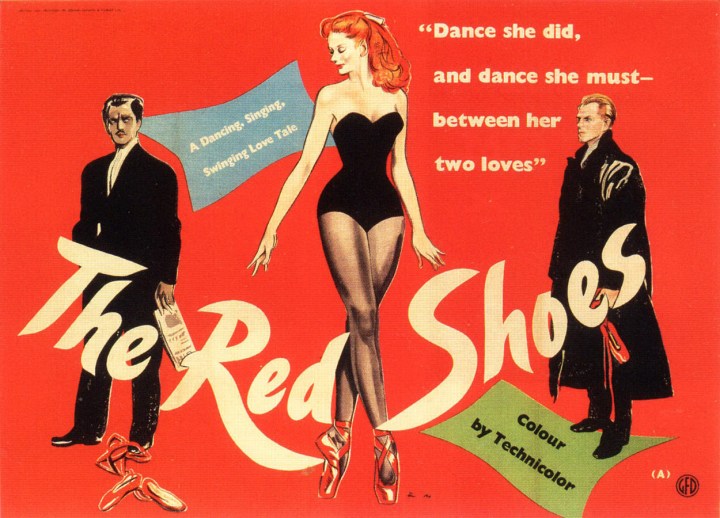
Victoria Page (Shearer) is a young, ambitious ballet dancer who, after a party, is invited by ballet impresario Boris Lermontov (Walbrook) to try out for his company. At the same time, young composer Julian Craster (Goring) gets a job with the same company coaching the orchestra. As Vicky rises to be the new prima ballerina (after the old one got married), Julian also rises through the ranks as a composer. The culmination of both their work is a new ballet, The Red Shoes, based on H. C. Andersen’s classic fairy tale. Julian composes while Vicky dances the lead.
While the others work, Lermontov does his very best impression of a creepy old man
The ballet is a great success, and its two rising stars fall in love, something Lermontov is none too happy about. He fires Julian, and Vicky, though torn, decides to go with her boyfriend. She marries him and he starts composing operas, also to great success. However, despite her meteoric rise to fame in Lermontov’s ballet, Vicky spends the following year out of work.
We strongly suspect Julian didn’t like other men’s hands this close to his wife’s hoo-ha..
Next season, Vicky goes back to Monte Carlo on holiday with her aristocratic aunt and runs into Lermontov again. He convinces her to dance The Red Shoes once more, but on the night of the performance, Julian comes and demands his wife choose between him and the ballet. Crazed (or possessed?) by this ultimatum, Vicky loses her mind and her control, just like the protagonist in Anderson’s fairy tale.
Ah – innocence ruined by the lure of passion. It’s like the fairy tale reflects the fate of the innocent ballerina…
It’s clear that Lermontov is supposed to be some sort of parallel to the shoe maker in the fairy tale, but honestly, he’s not the devil here. He encourages her ambition – an ambition that comes from her, not any outside force. Sure, his encouragement comes from mainly selfish reasons, and he may have some ulterior motive of his own, but at least he want her to follow her passion. Julian seems to think she should be content being the wife and muse of a talented composer, despite her own obvious talent which she is unable to develop once they leave the company. In our opinion, Julian is the bad guy here.
It doesn’t help our impression that he shows up for her performance wearing something very close to a Nazi outfit and goes straight for the boobs
This film is spectacular and definitely a new favourite of ours. It’s an intriguing story with great, often eccentric, characters (we particularly love the other members of the ballet company), gorgeous costumes and breathtaking dancing. The performance of The Red Shoes – a ballet within the film – is wonderful and somewhat reminiscent of the Berkeley musicals from the ’30s, beautifully incorporating cinematic effects with amazing dancing to tell the story.
We’re quite certain that the audience cannot be replaced by an ocean in a real live performance.
It seems to us that women’s ambition is a dangerous thing (in which case Lermontov is the devil), although we’re not sure for whom. Is it scary for the men who lose control over them, or for the (fragile) women who will crack under the pressure of trying to balance a traditional role (doting wife and house maker) with a professional career? Possibly both, but it seems like women tend to pay the price – especially in morality tales and fiction (let’s not even go into the sexual undertones of this film and, indeed, the fairy tale on which it’s based).
What we learned: A happy and full life should have room for love and ambition. To have to choose is unfair (especially when it’s one gender asking the other to choose while they themselves can have it all..). Also, things haven’t changed much for ballerinas in the last 7 decades, judging from the parallels between this film and Black Swan (2010).






 1000 Films Blog