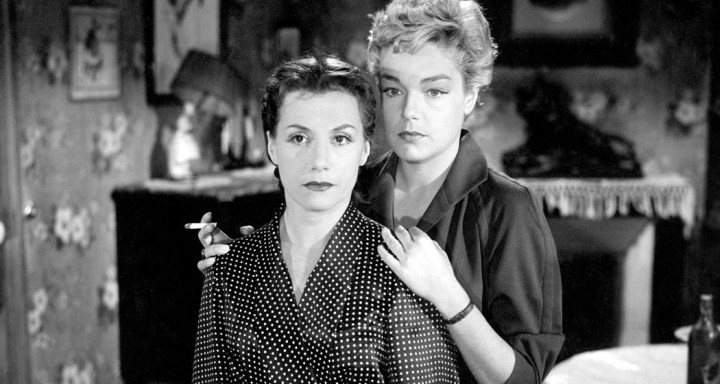
Christina Delassalle (Clouzot) and Nicole Horner (Signoret) are colleagues at a boarding school for boys somewhere in France, but that’s not all they have in common. They are also involved with the same man – Christina’s tyrannical bastard of a husband Michel (Meurisse).
Michel does not only mistreat his poorly (but wealthy) wife – he is also abusive to his mistress and the children in the school. Fed up with him, Nicole concocts a murderous plan to rid the two women of their shared lover. Christina is hesitant at first, but after her husband humiliates her and rapes her, she has finally been pushed too far.
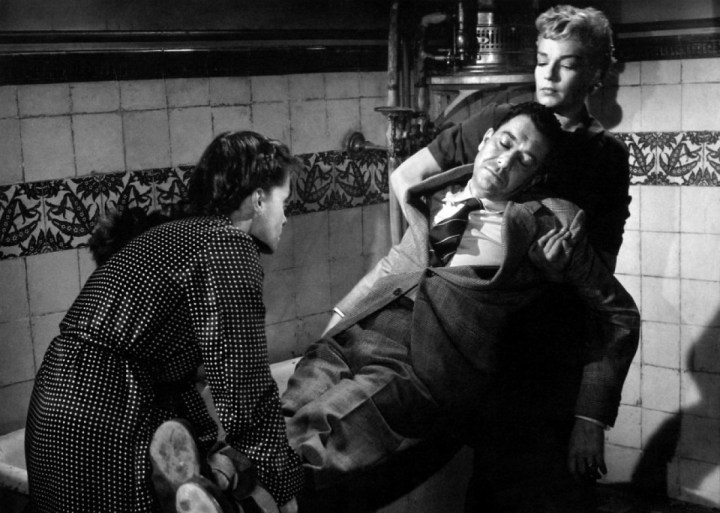
Not what most men have in mind when they picture being bathed by two women
They go through with their plan, but the already mentally and physically fragile wife is quickly deteriorating from the stress and the guilt. Then, the body disappears, freaky stuff starts happening and things turn creepy.
Diabolique is very, very creepy and suspenseful. Michel is extremely unlikable and we’ve never wanted two people to get away with murder more than in this case. This film kept us guessing to the end (although we had a theory which turned out to be spot on) and there are a lot of exciting twists and turns in the plot.
We won’t say much more as we do not want to spoil this gem for anyone, but if you haven’t seen it, it should go to the top of your to-watch list. So good.
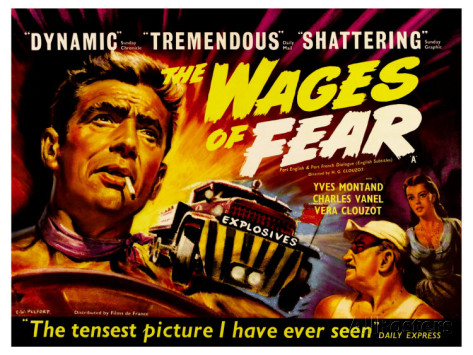
In a small village somewhere in South America, men of various nationalities are looking for work and a ticket out of extreme poverty and to more civilized places. After a horrible accident at a nearby oil field, the American owned “Southern Oil Company” needs to transport huge quantities of nitroglycerin to the field, but have no inclination to spend time and money putting security measures in place.
Not prepared to sacrifice proper American lives on this suicide mission, the company recruits drivers among the unemployed village vagabonds – desperate men ready to do anything for the $2000 offered as payment.
“Just, you know, don’t shake the cargo. Or make loud noises. Or crash. Or have a nervous breakdown. Yeah, you’ll be fine.”
The lucky(?) selected drivers (after some light corruption and implied violence) are Mario (Montand) and Señor Jo (Vanel) in one truck, and Luigi (Lulli) and Bimba (van Eyck) in the other. They are informed of what they are transporting as well as warned by another potential driver that even if they survive the impossible task, they will be mentally scarred for life. However, desperate people are willing to do desperate things, and the chosen men go on their way.
What could possibly go wrong on these well-maintained roads?
The ensuing road trip is one of the tensest we’ve ever seen. Every tiny obstacle, of which there are many, is potentially fatal, and the relationships between the characters grow very strained. It is a good film that can get us to care about characters who are intrinsically unlikable, and Clouzot manages that difficult task.
Despite their (many) flaws and their treatment of each other and others in their lives (such as Mario’s girl Linda [Clouzot]), we really don’t want them to suffer a fiery death
This is another film which we did not expect to enjoy as much as we did. It is excruciating to watch the four men attempt to get their deadly cargo to their destination, and the tension manages to stay high all the way to the final scene. Despite a slightly slow start, the 147 minutes fly by and leaves you a nervous wreck. We’d really love to see this on the big screen one day, so if the local film club ever does a screening, we’re first in line.
Not what we had in mind when we saw there would be men covered in oil. The only slight disappointment in this film.
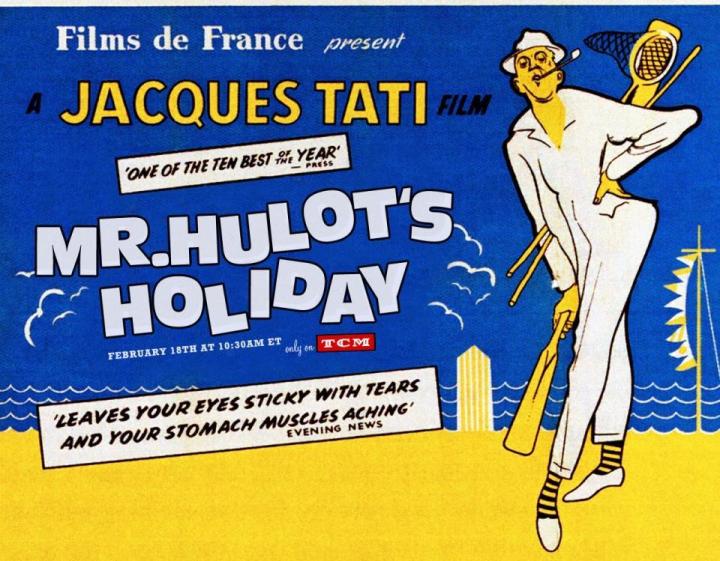
It’s vacation time in France, and everyone (in the upper middle classes) is getting on a train to sunny beaches. Headed the same way is a run down disaster of a car, threatening the peace of the holiday makers. An ill wind blows into the hotel – Monsieur Hulot (Tati), an OCD weirdo who’s very kind to animals, approaches.
Hulot, despite being a polite and well meaning character, has a tendency to exacerbate any problematic situation he gets himself into, of which there are many. Mainly because he causes them in the first place, such as unwittingly crashing a funeral, although often technology also plays a part.
M. Hulot’s Holiday is basically a silent slapstick comedy, 30 years after they were in vogue. It has lots of silly gags and characters and is just a jolly good time. Hulot himself could have been really annoying, but he’s oddly endearing (something we personally feel Rowan Atkinson failed to achieve with his similar character Mr Bean decades later, although we understand that may be a controversial statement).
This film is so, so silly and fun, with lots of nods to earlier silent comedy geniuses and the tradition of mime and physical theatre. In addition, there’s a series of eccentric supporting character, such as the British tennis referee and poor Arthur. All together, they make a hilarious experience for any comedy fan. Check it out!
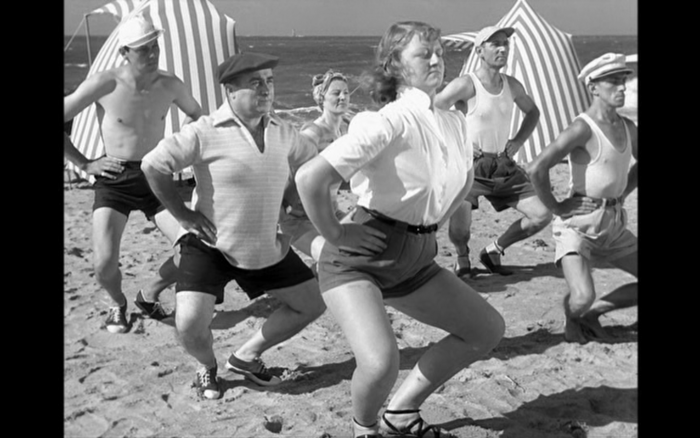
We’ll just leave you with this image, completely out of context
It’s the day of the annual party in a small French village and everyone is getting ready, as explained to the viewer by an adorable old lady’s running commentary on their efforts. In the middle of the preparations is François (Tati himself), the local postman and part time village idiot.
For reference, this is his most intelligent expression throughout the film
The poor man is trying to complete his round, but is sidetracked by the other villagers who recruit him to set up a pole (not a euphemism), get drunk with them and watch a propaganda film about the high-tech American postal service. The latter inspires him to step up his own game, with hilarious consequences.
He is constantly being taken for rides, both literally and figuratively
Jour de Fête is a silly, silly film with loads of throwbacks to old silent movies in the physical humour and slapstick found throughout. There’s also verbal humour though, so it does not stay too much in the silent movie era. Among our favourite scenes were the meeting of the potential lovers with the Western soundtrack playing, the old lady narrator in the beginning, and of course François’ amazing chicken catch. If you have no idea what we’re talking about – watch the film.
For those of you wanting something deeper than a silly, French comedy, there are also political undertones as the protagonist confuses the U.S. M.P.
We recommend this one to everyone who likes a bit of silly in their lives, although we did feel sorry for François when the other villagers made fun of him all the time. Still, that’s the price you pay for being the village idiot (which is an important position, make no mistakes). We’re looking forward to more Tati in the future.
Hopefully, the upcoming films will also include the old lady and her goat. Fingers crossed!
Belle (Day), the beautiful young daughter of a merchant, is being Cinderella’d by her rooty tooty snooty sisters after their family’s fortune was lost at sea. As her father gets word of one of his ships having reached port safely, he travels to the city to regain some of his fortune, only to find it has all been seized in payment of his debts. Returning home through a scary forest in a storm, he seeks shelter in a castle which seems abandoned yet has a marvelous feast set out for him.
There’s nothing at all sinister or creepy about the place
He spends the night in the castle and, when leaving the next morning, picks a rose for his daughter as that was her only request for a present. Big mistake. A frightful Beast (Marais) sets upon him and tells him he must die for this offence. The merchant manages to make a deal to go home home to see his family if he promises to return promptly or send a family member in his place. Belle, being the good daughter, offers to go to the castle instead of her ailing father.
The pretty dresses and jewellry sort of make up for the creepy living statues and ornaments of her new home.
Instead of finding a primitive beast ready to devour her, Belle meets a gentlemanly one who proclaims her mistress of the castle and himself her humble servant. She stays with him for months, and though every night she refuses his marriage proposal, they develop a friendship and companionship which is quite mutual, despite him looking like he’s always on the verge of reciting Shakespearean soliloquies. Case in point:
We’d like to think his tendency to lurk behind her is more a kindness so that she won’t have to look at him, rather than something sinister. Despite the neverending marriage proposals.
After a while, Belle finds out that her father is grievously ill and asks to go home to see him. The Beast agrees on the condition that she returns one week later, and gives her a magic mirror to see him, his glove which will return her to the castle whenever she’d like and, for some reason, the key to his fortune.
“I’m sure there’s no way anyone would abuse that power”
Of course, Belle’s cunty sisters, her idiot brother and his friend Gaston, uh, we mean, Avenant (also played by Marais), persuade her to stay on a bit longer, steal her key and decide to go kill the Beast and steal his fortune. However, Belle sees the Beast half dead from grief in her magic mirror and uses the magic glove to return to him at the same time her brother and Avenant arrive to dispose of him. There are declarations of love, the Beast transforms to his true princely form and all live happily ever after. Except for the intruders, one of whom is himself transformed (to take the Beast’s place as guardian of the castle? Of the afterlife? Of purgatory? Who knows?), but that’s their own fault.
“Them bitches had it coming, trying to interfere with our strange and possibly Stockholm syndrome-induced romance!”
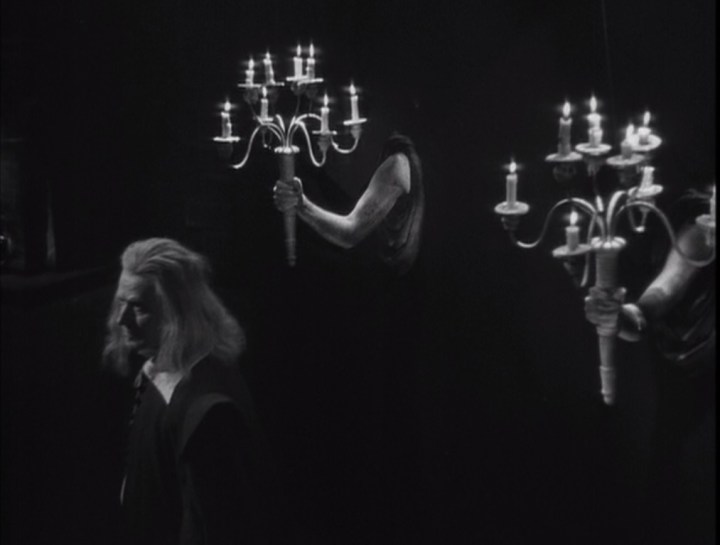
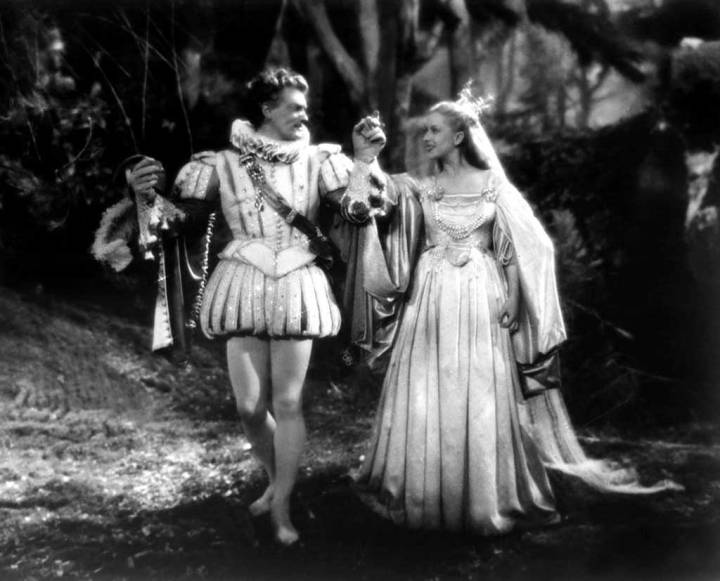
Cocteau’s version is a very faithful adaptation of the traditional French fairy tale despite him, naturally, having taken some artistic licenses. Visually, this film is wonderful with amazing details, especially in the enchanted castle which is like Barbie’s Gothic Dream House – creepy but luxurious. The disembodied arms which act like servants and the half-living statues that adorn the halls and rooms are fantastic (in all senses of the word) and add an extra layer of surrealism and magic to the film. The costumes are extravagant, if not necessarily always flattering, and the beast is superbly made up.
The food even looks appealing in black and white, which is impressive in itself
If your only cinematic experience of Beauty and the Beast is the 1991 Disney version, we really recommend this one as well, as it is a very different perspective on the same story.
What we learned: women must learn to look beyond physical appearance, but the same is not necessary for men. Also, don’t trust your relatives – them bitches be greedy!
Pro tip: want to make a Buñuel/Dalí film even more surreal? Try watching it in the original French with very limited French skills and some help from Google Translate with the intertitles. You’ll never have a movie experience quite like it! What we could decipher ourselves without help from Google was that scorpions are arachnids and that they are (not?) very sociable and can attack. Something then happened a few hours later. There was also a dialogue which definitely included the words “Quick!”, “yes” and “no.” Thank you, French lessons in school!
The cause of death for these religious types is still unclear. Scorpions may or may not have been involved.
From what we could understand, this is a sort of love story between a couple who cannot copulate. A very horny (and literally dirty) guy sees sexy things everywhere and likes to kick everything. His lady love is equally frustrated and at one point finds a cow in her bed. They finally meet up at a party where he slaps her mother, they suck each other’s fingers, and she fellates the toes of a statue.
When she then starts making out with her father(possibly?) the man gets angry and starts throwing things out of a window, including a burning tree, a bishop and a giraffe.
A Marquis is mentioned at one point, and towards the end we are told of a castle where four criminals have been locked up for 120 days with eight teenaged girls, so there are some clear allusions to the Marquis de Sade (fun reading for the whole family, by the way!).
Turns out Jesus has found a new career organising orgies for depraved criminals
We must be honest and say that we were a bit apprehensive about watching this film after the horrible eye incident in Un Chien Andalou, but we thoroughly enjoyed ourselves. Obviously, we probably missed a lot of the plot due to language problems, but nonetheless we had a great time watching it. And the chien finally makes an appearance. Yay!
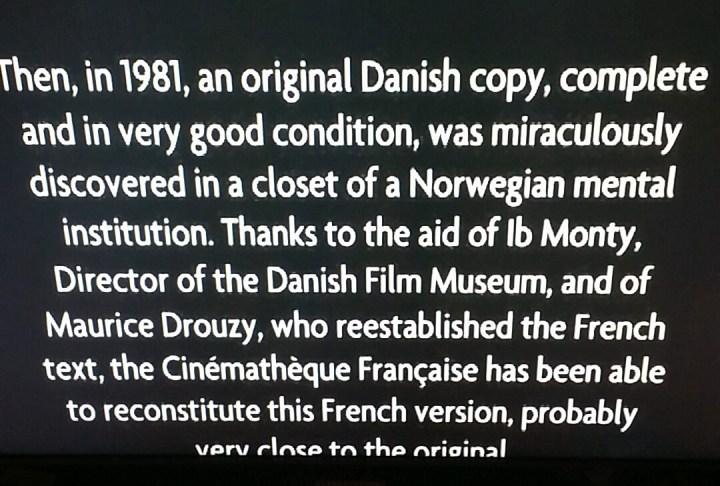
After several comedies (and other uplifting films) in a row, the time had come for something more disturbing. La Passion de Jeanne d’Arc (original title – check out our French skills!) tells the story of the trial and (spoiler alert!) execution of Joan of Arc. It was believed to be a lost masterpiece for many years until a copy was found in 1981, and check out where:
Ah! Norwegian mental institutions. Sources of lost art, every last one of them!
The film is a disturbing display of the time-honoured tradition of men standing in judgment of women. Joan, aged 19, is tried for heresy by the church after leading French troops by order from, according to her, God. The judges use torture and extortion to make her confess and lecherous guards ridicule and tease her, but she does not break. While a few of the judges are sympathetic and kindly towards her, most of them are treacherous and very “unchristian” indeed.
“What do you mean this hairdo makes me look demonic? I’m a fucking priest!”
Joan is played by Maria Falconetti who gives an outstanding performance. It is worth watching the film for her alone (as well as the gorgeous lighting). Whether Joan was a saint or just a mentally ill teenager is never made clear, but that is not really important. The villains are the priests and judges either way with their lust for power and fear of anything that might take some of that power away. And their fear and hatred destroy something beautiful and innocent.
This was a disturbing watch (whisky had to be brought out at one point), but well worthwhile. However, is this really what they used to show mentally ill Norwegians? I think we just discovered the origins of black metal.


















 1000 Films Blog