Arthur Seaton (Finney) is an Angry Young Man™ who works in a factory and spends his weekends drinking, annoying the neighbours, and sleeping with his coworker’s wife, Brenda (Roberts).
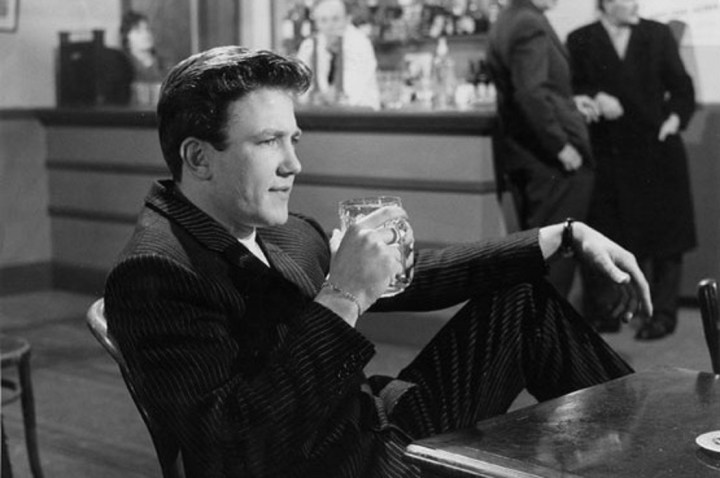
He’s also heavily into competitive drinking, which never fails to impress the ladies
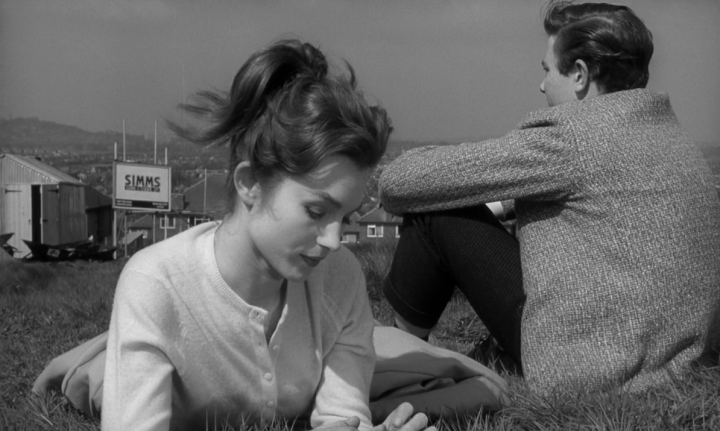
Even striking up a relationship with the charming and beautiful Doreen (Field) does nothing to break his illicit affair. However, he runs into trouble when Brenda becomes pregnant while Doreen is ready to go to the next level.
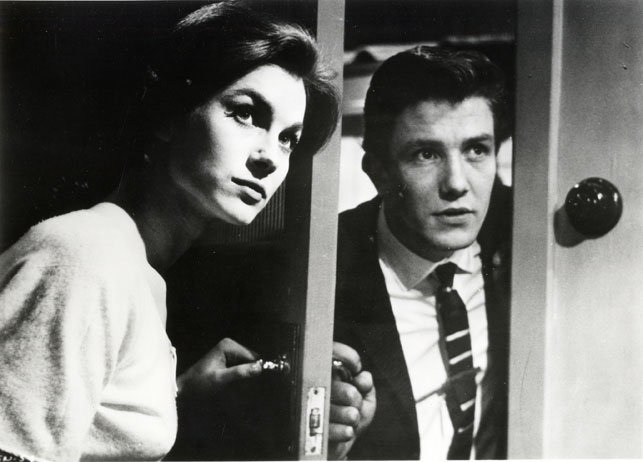
After months (?) of courtship, she’s ready to actually let him in the door
Arthur is immature and oppositional, but he’s charming and seems to have a good heart. Although it’s sometimes deeply buried… His greatest fear is to turn into his parents, who he feels have not really lived life – just survived it. Still, getting away from that life is harder than it seems, and while he has ambition, he has no real outlet for it, or any sort of plan to alter the direction of his life.
It’s hard to save up for adventure and excitement when you drink up your paycheck every weekend
Saturday Night and Sunday Morning is an early British New Wave kitchen sink drama (check out our terminology!), and the very sophisticated, educated and cultural Sister the Oldest actually read the book at some point. Oh yes.
It was during one of her breaks from watching television, which are few and far between…
It’s an engaging film, and we loved it. When it comes to social realism, none of them would be our first pick for weekend entertainment, but we never regret watching them. This particular one was also not quite as bleak as we were afraid it would be, although we suppose Arthur’s greatest fears were likely to come true judging by the ending…
One man’s dream is another man’s nightmare. We’re just not sure which side of that Arthur is on right now.
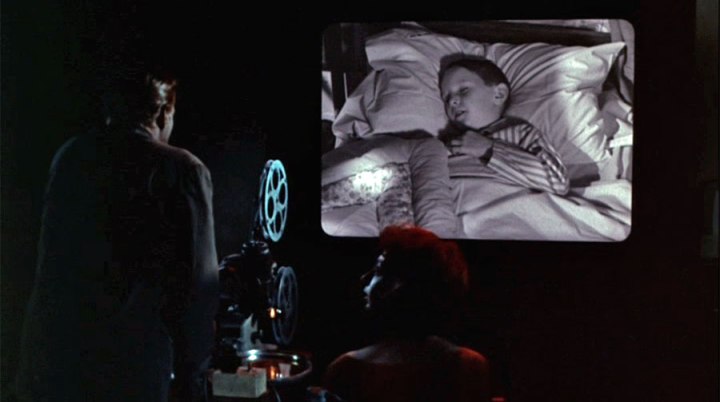
For those of you who want more context than the initial summary, Mark Lewis (Böhm) is an aspiring film maker who shoots soft porn during the day and murders at night. His neighbour Helen (Massey) takes an interest in the socially awkward weirdo, and we learn that Mark was used as a guinea pig by his psychiatrist father who studied fear.
Daddy also filmed the child abuse. Father of the year!
Peeping Tom was initially hated by critics and basically killed the career of its director, but time has worked in its favour and it is now a beloved classic. And we absolutely loved it!
We loved this movie almost as much as this guy loves his camera. Which is a bit of a love/hate-relationship to be honest.
We were enthralled from the very beginning, with the camera point-of-view, and we were on the edge of our seats throughout. Mark is a complex and strange character; is the real him the awkward and timid man he is in social situations, or is it the dynamic take-charge man we see when he’s about to commit murder?
We’re sure this woman was super-impressed by his sudden alfa-maleness just before she was brutally murdered
It’s a must-see for horror fans (or movie fans in general), and it works fantastically as a double bill with the upcoming Psycho. Get out your blankets, wine (or tea – we don’t judge) and snacks, and enjoy!
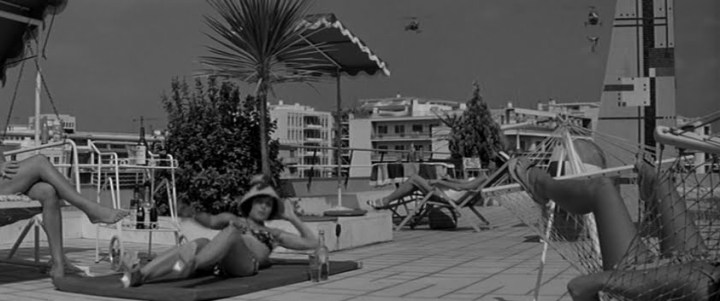
Jesus is out flying in Rome, followed by journalist Marcello Rubini (Mastroianni) whose pursuit of religious iconography is momentarily distracted by a bunch of sunbathing girls on a rooftop.
The failure of all major religions: not enough sex appeal
Source
We continue to follow Marcello as he chases stories, fame, love, sex and meaning, and on the way he encounters a series of more or less fortunate events.
The most famous of which is fountain-bathing sex-symbol Sylvia (Ekberg)
In addition to the failed seduction of Sylvia, Marcello hangs out with intellectuals at a party, sleeps with an aristocrat in a prostitute’s bed, and saves his girlfriend’s life when she tries to kill herself (because of his philandering).
It’s challenging keeping your affairs secret when all your best friends are photographers and all your lovers are famous enough to get their pictures printed in magazines
Among his other adventures are reporting on children who see the virgin Mary (and others killed in stampedes brought on by this), partying with daddy and some showgirls, kicking it with aristocrats and film stars, ghost hunting, lover’s quarrels, murder/suicide, drag queens and growing into a proper douchebag.
There’s been so much said about La Dolce Vita by people much smarter than us that there’s really very little we can add. We loved Iris and the costumes, and while the movie is almost 3 hour long, it never gets boring. Marcello is somewhat hard to read, but the society falling apart all around him is oh so easy to see.
Nothing says “disillusioned” like sitting down in the sand in a white suit
It’s a fantastic movie and you can see its influence in numerous other films and other works of art. It’s one of those classics where even if you haven’t seen it, you still sort of have. However, if you really haven’t, it’s well worth your time.
What we learned: If your man is a serial adulterer, don’t try to kill yourself. Just leave him. You’re better than that. Live your life! Also, fucking paparazzi, man. Oh, and also modern society and stuff, etc.
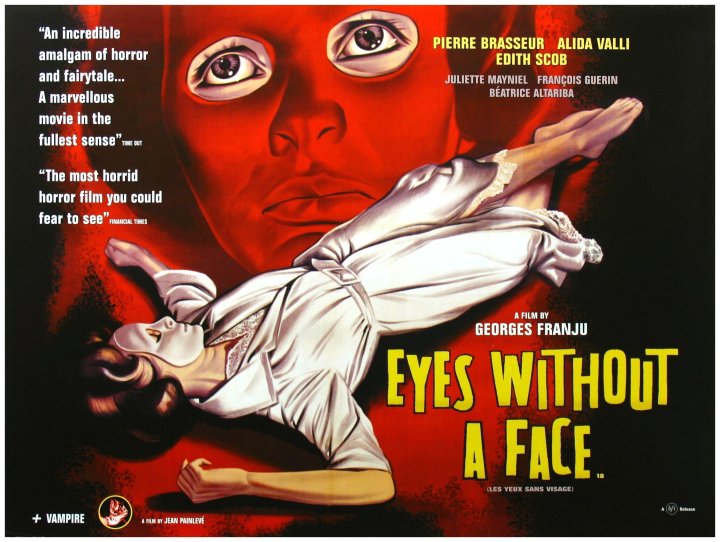
A woman dumps a faceless body in the middle of the night. The body is found and identified as Christiane Génessier (Scob) by her father, Doctor Génessier. Her face was destroyed in a car accident caused by the doctor and she is presumed to have killed herself.
“Yes, yes, definitely my daughter. I would recognize her lack of face anywhere.”
The body is buried and no one questions its identity, but what is the deal with all the missing girls in the area? The ones who resemble the presumably dead girl? The one with the ruined face and the surgeon father..?
They’re certainly not having their faces removed and transplanted to Christiane. No siree!
Doctor Génessier is riddled with guilt and hubris, and despite his daughter’s protests he’s trying to repair the damage he’s done, leaving in his wake a trail of faceless bodies. With the help of former patient Louise (Valli), he kidnaps young women, removes their faces, and tries to transplant them onto his own daughter who he keeps locked up in the house like the stray dogs he experiments on.
At least the prisoners can take comfort in each other’s company
We love everything about this film! The circusy music, the surgery shown in excruciating detail, the haunting mask and outfits of Christiane which make her look like a doll, and the ending with the gorgeous final shots – there’s nothing here not to love.
She’s like the adorable ghost of a life-sized doll wandering about the mansion, bonding with animals Gothic Disney-princess style.
Daddy is a giant douche whose pride is more important than the happiness of his daughter, even if he tells himself he’s doing this for her. Also, there’s some seriously shoddy police work going on – we mean, why would they send in Paulette (Altariba) for a consultation with the doctor without keeping an eye on her or instructing her to report back when she was discharged? Amateurs.
Terribly unprofessional police work aside, Eyes Without a Face is a haunting horror movie which should be on everyone’s to-watch list. It’s terrible and beautiful, and it reminds us of a twisted and dark fairytale. Love it!
Michel (Belmondo) steals a car and sings and narrates his way towards Paris. The misogynistic crook ends up shooting a cop who catches up with him and is soon wanted all over France.
“No worries. I’ll just don a hat and some shades and Clark Kent my way out of this mess”
For such an unlikable man, Michel has a way with the ladies and manages to get some money out of one female friend before moving on to the main object of his desires, American journalism student Patricia (Seberg). He tries to convince her to run away with him while she tries to figure out how she feels about the man she spent a few nights with.
Michel wants to be a tough guy and he models himself on Humphrey Bogart. Patricia is also trying to figure out who she is – perhaps the Bonnie to his Clyde? With the police closing in, they are running out of time and decisions must be made. Who are they really?
Breathless is stylish and artsy, sometimes with a documentary feel to it, while other times it feels more like a romantic comedy or a noir. We love how cool it is, the breaks in the fourth wall, the cuts and close-ups, the opening line and Patricia’s gorgeous stripy clothes (really – she only wears stripes).
With many to choose from, this dress remains our favourite
Jennifer (Hills) is a poor little rich girl with daddy issues and a need to distinguish herself and find her identity. She spends her time with sort-of boyfriend Dave (Faith), a musician with a magical guitar that can play all instruments, and his beatnik friends in a bar in Soho.
As all teenagers, they are the only ones who have found the real answer to life. Skipping school and living for kicks, unlike those other squares!
When her rich architect dad Paul (Farrar) brings home his new French wife Nichole (Adam), Jennifer is less than impressed. She rejects all of Nichole’s attempts at forming a relationship, even though her new stepmom might just be the only one who really tries to understand the girl.
It helps that the daughter and the new wife are practically the same age
Paul is more interested in his vision of a future city he wants to build than he is in his daughter, which drives Jennifer to increasingly risky behaviour to get his attention. When a local stripper recognizes Nichole, Jennifer makes it her mission to dig up dirt from her stepmother’s past, which puts her on the radar of dangerous strip club owner Kenny (Lee).
We really enjoyed Beat Girl despite our sympathy for Jennifer being a bit limited. Maybe we’re too old to empathise completely with a spoiled girl playing at being special and shocking, although we can understand her motivation and we like that she shows some spunk and self-preservation, especially in her dealings with Kenny.
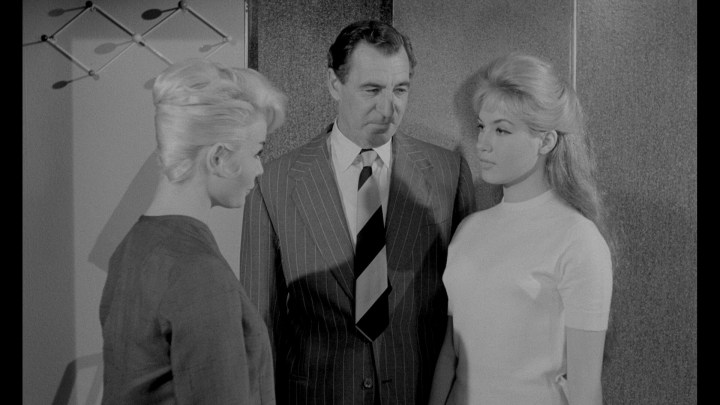
Pictured: not the father figure you’re looking for.
Still, she’s a bit of a pretentious bitch. However, we loved the opening scene, the music (by John Barry), the now dated slang used by the teenagers, and the very salacious strip tease.
FYI, if you like women who know their way around a sheet, this is the film for you!
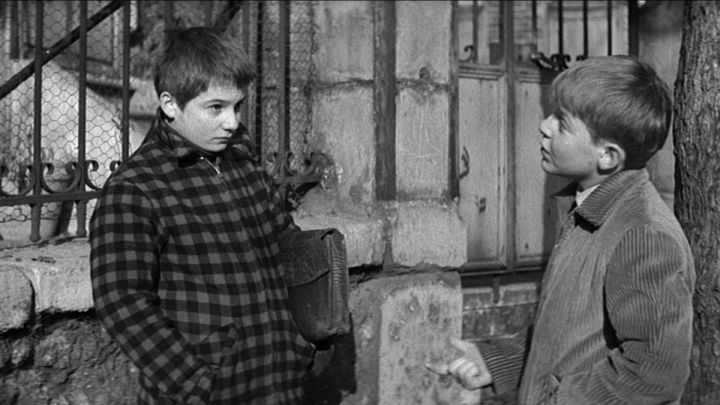
Antoine Doinel (Léaud) is a pretty average kid. He lives with his self-centred mother (Maurier) and nice enough, but very strict, stepfather (Rémy) in a small apartment in Paris. He doesn’t do too well in school and occasionally gets in trouble, although his best friend René (Auffay) seems to be the instigator at least some of the time.
“I’m thinking we should hire some hookers and then kill some puppies?” “Yeah, I was thinking more like skip school and go to the fair..?”
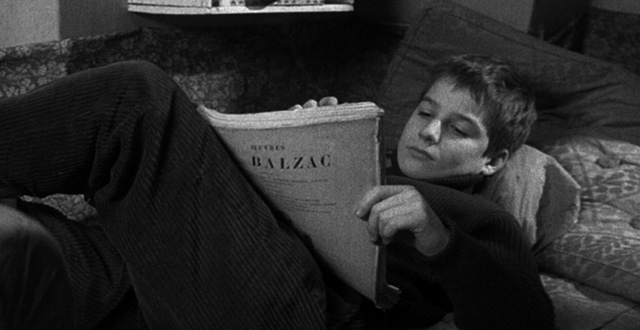
After he’s caught skipping school and lying about his mother’s death to cover for it, Antoine runs away from home. It only lasts for a day or so though, but when his teacher later accuses him of plagiarising Balzac, Antoine runs away again. This time for a while, and with more serious consequences.
Antoine is misunderstood and/or ignored throughout the film. None of the adults in his life take the time to listen to him, and his actions are very often misinterpreted and harshly punished, such as his homage to Balzac and his return of the stolen typewriter (which, granted, he did steal earlier).
Considering the irony of being caught returning stolen goods…
We loved The 400 Blows. While it’s a fairly tragic tale of a talented but misunderstood young boy who gets into all sorts of (quite serious) trouble, it’s not all bleak. We loved the P.E. sequence with the rapidly diminishing student body, the centrifugal carousel, the shrine to Balzac and the kids watching the puppet show.
Without spoiling it, the ending is also (possibly) optimistic, with Antoine standing at several thresholds and between two chapters of his life. There are four more films made about the same character played by the same (wonderful) actor, and we’re tempted to make a night of it and watch them all. In about ten years when we’re done with everything on the list…
In case you were wondering, we do bring this amount of energy and enthusiasm to every single film screening. Every. Single. One.
A brawl (of the murderous kind) in a saloon leads to the arrest of Joe Burdette (Akins), criminal brother of a local hot shot rancher. As many forces are looking to get Joe out, sheriff John T. Chance (Wayne) enlists the help of former deputy Dude (Martin) to keep him safely locked away, despite Dude’s alcohol problem and the fact that he was one of the reasons for the brawl in the first place.
Together with comic relief Stumpy (Brennan) they must defend the jail, the sheriff’s office and the town, something which proves difficult when Joe’s henchmen and Big Brother Nathan (Russell) get involved. Reinforcements (reluctantly) arrive in the form of young gunslinger Colorado Ryan (Nelson) and, in another way, poker player Feathers (Dickinson).
“Age gap? 24 years is no age gap! My last boyfirend was 78.”
How will this ragtag team of alcoholics, kids, oldies, cripples and (gasp!) women manage to survive until the Marshall comes to pick up the condemned prisoner? Why, with song and explosions, of course!
Rio Bravo has everything you could ever hope for in a western – rugged men; feisty women; fancy, semi-colour-coded hats; shootouts; explosions; horses; clearly defined bad guys and romance.
One man learns that there exists a different kind of romance than that between a man and his horse
We loved the silent scene at the start, the tension throughout, the character names (Chance, Stumpy, Dude and Feathers – are we sure this isn’t a cartoon?) and Angie Dickinson. Clocking in at well over two hours, this movie just flies by and was great family entertainment when we sat down to watch it with our parents and brother on May 17 – the Norwegian national day. After a day of wholesome fun with nephew and niece, what’s better than watching a bunch of manly, yet sensitive, men kill each other?
“Hear that, boys? The crowd is ready for an encore!”
What we learned: Wild West men were surprisingly sensitive and in touch with their feelings. Also, some will go to great lengths to ensure justice is served.
On a busy beach, aspiring actress/model Lora Meredith (Turner) is looking for her daughter. She finds the girl in the company of an African-American lady, Annie Johnson (Moore), who she hires as a live-in babysitter after learning she and her daughter are homeless.
Ah – the good old days when you could invite random people you met at the beach to come live in your home and it didn’t end in murder-robbery but lifelong friendship.
Lora goes to see a theatrical agent, Allen Loomis (Alda), who basically tells her that to succeed she must prostitute herself, something she’s not yet quite desperate enough to do. However, she gets a break when a playwright likes her honest critique of his play, and is soon catapulted to stardom, much to the chagrin of love interest Steve Archer (Gavin) who’d rather have her be a stay-at-home mom and his wife.
“Why would you possibly desire to have your own career and make your own money when you can just shack up with me? I forbid it!”
Lora and Annie stay friends for the next 10+ years, as the former finds success and the latter eventually gets paid for being her maid. Their daughters grow up, but while Lora’s daughter Susie (Dee) is a well-adjusted blonde with a private school education, Annie’s daughter Sarah Jane (Kohner) is light enough to pass for white and develops some serious identity issues.
“This is America! There’s no way anyone will treat you differently just because they find out that you are black!”
As is tradition, we loved this Sirk film more than we thought we would. Sarah Jane, though an atrocious dancer and slightly annoying, is a tragically intriguing character, Annie is just the best, Susie is pluckily charming, and Lora is self-centred yet understandably ambitious. And there are also some men there, more often than not screwing up the women’s lives.
There are also gorgeous costumes and sunglasses to die for
Lora and Annie’s friendship seems to be fairly mutual even though Annie works for Lora, but we learn that Lora knows absolutely nothing about her friend’s life outside of the house, which is very telling.
“Friends? What friends? But you cease to exist when I leave the house, don’t you?”
Imitation of Life is about friendship and family and heritage and sexism and racism and authority. And probably lots of other things as well. We loved it, and we’re now off to plan our funerals. Those things are not to be left to chance.
What we learned: If you love someone, apparently it gives you the right to decide for them. And control them. And be petulant if they make their own decisions. Also, racism sucks!
In those days Caesar Augustus declared that everyone throughout the empire should be enrolled in the tax lists. This first enrollment occurred when Quirinius governed Syria. Everyone went to their own cities to be enrolled. Since Joseph belonged to David’s house and family line, he went up from the city of Nazareth in Galilee to David’s city, called Bethlehem, in Judea.
“Uh, yeah, I’m here to register..? Yeah, with my wife. She’s about to give birth. No, no, I’m totally the father. Joseph. J-O-S-E-P-H. Know any good hotels hereabouts..?”
We all know that story. However, this is not that story, but set in the same time. In 26 A.D. (probably not called that at the time, to be fair) Judah Ben-Hur (Heston) was a Judean prince and childhood friend of newly returned Roman tribune Messala (Boyd). Despite the intense homoeroticism of their interactions, the two have a falling out over political issues (one wants the other to sell out his people. That sort of thing).
After an accident involving a Roman procession and rooftop tiles, Messala finally has an excuse to arrest the Ben-Hur family and send Judah away to the galleys. His mother Miriam (Scott) and sister Tirzah (O’Donnell) are thrown in a dungeon, the family home is raided, and Judah is sent off.
“I just thought I’d take a gap year. You know, to travel, sunbathe, grow my beard and learn about new cultures.”
Strange destiny eventually brings the eponymous hero back to his hometown, now as an adopted Roman with a new fortune, new status in the Roman Empire, and excellent horse racing skills. His hatred for Messala has not diminished though, despite an encounter with Jesus, and he is also out for revenge and for the salvation of his family…
We all know the best way to really humiliate someone is to beat them at their own game. And also kill them.
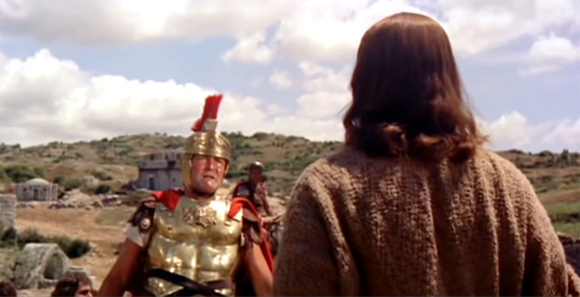
Sometimes it’s hard to get in the right mood to watch an almost 4 hour epic from the ’50s, and we must admit we didn’t rush to pick this one up despite all we’ve heard of it. However, we’re glad we did as it lives up to its reputation (despite Heston’s occasional overacting). We loved the Roman perspective on Jesus, the (possibly unintended) homoeroticism between Judah and Messala, the sheikh, the general epicness of the feature, and the fact that we never actually see or hear Jesus.
All we learn is that he has fabulous hair and can hypnotise Roman soldiers.
We also loved the Roman uniforms, but mainly because they reminded us so much of Asterix that we spent the entire film quoting Asterix chez les Bretons (1986) and had to pull some strings to get our hands on the Norwegian dubbed version (AKA the only version worth watching) of our childhood favourite. So thank you, Kristian!
“Er’re XVI her óg? Da har vi gått feil igjen, da.” – Classic!
It’s easy to think Ben-Hur is a movie about horse racing (it’s by far the most famous scene), but it is really an epic saga of revenge and redemption with Jesus hanging out in the background. And a badass chariot racing scene.
“Det skjærer meg i hjertet. Hører du, dekurion? Det skjærer meg i hjertet!” One for all Norwegian Asterix-fans. You’re welcome, people who don’t speak Norwegian and/or have no point of reference for this.




























 1000 Films Blog
.jpg)