Disclaimer: This film was added at 37th place (chronologically) after we had already reached (the old) no. 71 (now no. 73) and as such we throw it in here. The next post will be #74 but that does not mean we’ve skipped #72 and #73. Confused? Read this disclaimer. We’re sure it’ll explain everything.
We’re so glad this one made the list! Sister the Oldest has seen this one before and loved it then as she loves it now. It’s a boozy adventure of the best kind, with wonderful characters and banter.
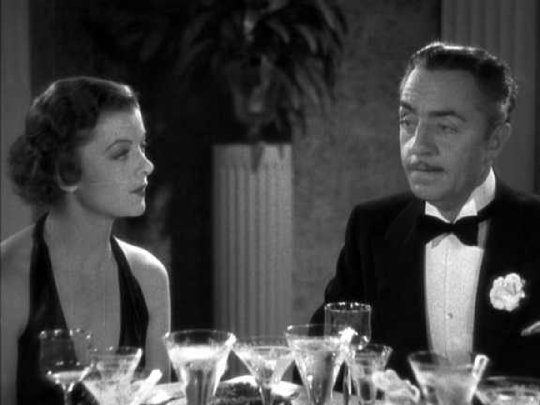
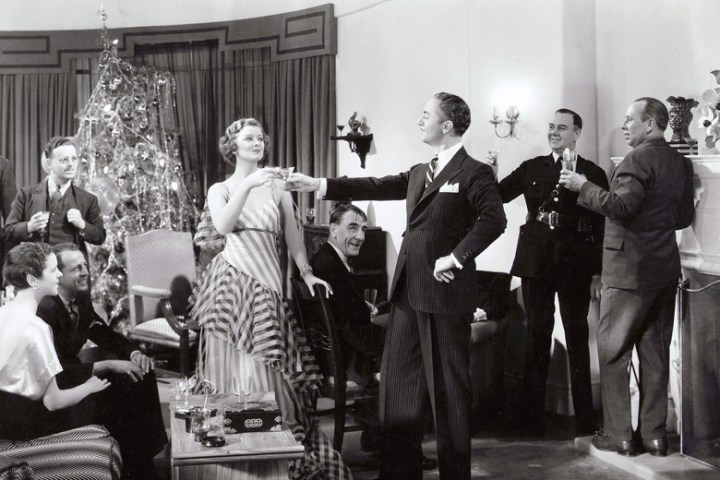
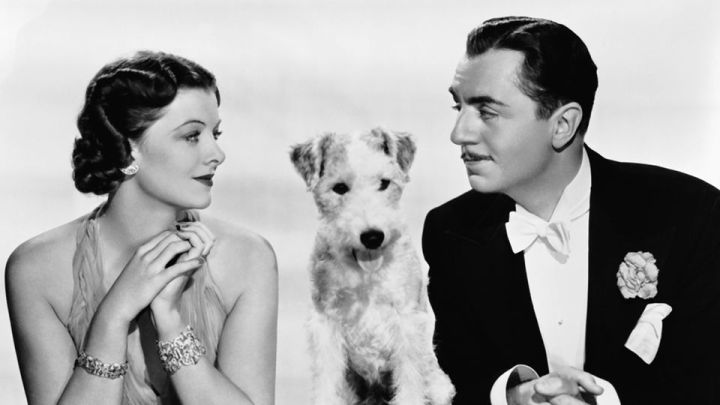
Nick Charles (Powell) is a retired private detective, enjoying a life of leisure, and copious amounts of cocktails, with his charming and charmingly rich wife, Nora (Loy), and their terrier, Asta.
An old acquaintance, Dorothy Wynant, approaches the former detective as she suspects her father is in trouble, but Nick refuses to take the case, on account of the retirement and all. However, soon after, Mr Wynant’s secretary is killed and the plot thickens considerably when Dorothy’s father, who’s missing, becomes the chief suspect. Nick, egged on by Nora who thinks all this detective business terribly exciting, takes time between cocktails to look into the matter.
The Thin Man is one of the funnest, booziest mystery comedies you’ll ever see. There are eccentric characters, dysfunctional families and lots and lots of drinks. The quick banter between Nick and Nora is magical, and their relationship is something to aspire to (in its own way). In addition, Nora has the best fashion sense, and the the dog is adorable. This film should be everyone’s traditional Christmas viewing, along with Gremlins and Die Hard, of course. Enjoy!
Since Edgar Wright’s list (though magical) is in flux and he is constantly adding and removing films as he finds new favourites, our numbering system is subject to change.
Recently, two films have been added that throw off the system with which we have so far worked (as well as some other additions which do not affect our posts so far and thus we shall completely ignore them for now). When this happens, we will post the recent additions as soon as we can, with their proper numbers, and continue on using the current number of the films as we watch them. Or something. Honestly, we haven’t really worked it out yet, but we’re sure we will in time.
Until we have a clear system, should you come across two films which are both at number 37 and none that are at number 72, it is just because we’re too lazy to go back and change all the numbers and we’re always working with the list as it is on the day of posting.
This also means that you will get BONUS POSTS! Yay! Any film which is removed from the official list after we’ve already posted it will of course stay up, and some films which are removed after we’ve already purchased the DVD, will still get a blog entry. Because we would have spent money on that and by God people will see it! (Also, any film deemed worthy of being on the list at some point is definitely worthy of watching) Our guess is that we’ll end up with something more like 1500 films by the time it’s over.
Our sincere thanks to Mr Wright himself for alerting us to the recent changes, and to everyone who reads our musings. We appreciate you all.
The Lost Weekend is a classic tale of an alcoholic writer who is struggling to create his masterpiece while keeping the severity of his habit from his girl and his brother.
Don Birnam (Milland) is packing for a weekend away with his brother Wick (Terry) and is desperately trying to find an opportunity to smuggle some whiskey into his luggage, as his brother is not exactly impressed by his alcohol consumption.
After failing to bring with him his hidden whiskey, Birnam decides to stay in the city and get drunk rather than join his brother for a sober weekend in the country. Like a true addict, he’ll do anything to get a fix, and while he’s funny in his quest for a drink, it is also incredibly sad to watch a talented and generally good man go down this road of self destruction.
It’s almost as if someone is trying to say that his life is ruled by drink
The four day weekend (such luxury!) includes, but is not limited to, him hurting his long suffering girlfriend Helen (Wyman), flirting with (and also hurting) fellow barfly Gloria (Dowling, who’s incredibly hip with the lingo!), trying to pawn his precious type writer, ending up in the alcoholic ward of a hospital, ditching church to rob a liquor store instead (it’s a choice), and finally succumbing to delirium and depression.
Like Mina, he is also attacked by bats, but that’s a whole other story
The Lost Weekend is based on a (fairly autobiographical) novel by Charles Jackson, which we have not read, but definitely should. It is a powerful and realistic story which does not shy too far away from the horrifying truth of substance abuse. When younger, we may have seen the character of the young alcoholic writer as romantic, but we are far older and wiser than we once were (but not, you know, too old. Just charmingly so. And very wise.) and we now see the tragedy of it all. In the end, the talented but dried-up (in some sense of the phrase, at least) artist is saved by love and purpose, although how long it will last we will never know. Unless we dig into the life of Charles Jackson, we suppose.
In a way he is also, somewhat ironically, saved by his bartender.
Milland won a well-deserved Oscar for his portrayal of Birnam, and the film was also awarded Best Picture, Best Director and Best Writing in 1946. If that’s not enough incentive for you to watch this classic, there’s really nothing more we can say.
What we learned: alcohol may help creativity but it will stop you actually realising your ideas.
Next time: The Thin Man (1934) – new addition to the list
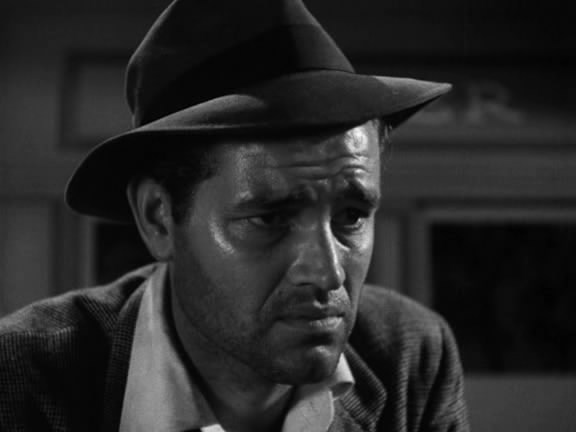
Roberts is a pianist in a nightclub where his best gal Sue (Drake) is also employed as a singer. Walking home from work one night, through the (extreme) fog and darkness, she tells him that she’s planning on seeking her fortune in Hollywood. Roberts is not happy about it, though to be fair, he wasn’t exactly a ball of sunshine before she broke the news either.
This may be the only time he smiles throughout the entire 67 minutes.
After she moves, he decides to hitchhike from New York to Los Angeles to see her, and it’s all downhill from there. He considers himself lucky when he gets a ride from rich (and misogynistic) Charles Haskell, Jr (MacDonald), but he could not be more wrong. After Haskell unexpectedly dies, Roberts makes a horrible decision to bury the body and pose as the dead man to stay out of trouble. Already here, we can see where this is going, but not just how bad it’s going to get.
It never gets really bad until you bring a Dame into it…
Enter Vera (Savage), a bona fide Dame with all the credentials, including previously fighting off the advances of the now deceased real owner of the car. His new angry and disillusioned passenger leads Roberts to make even more terrible decisions than the ones he’s already made, and they keep spiralling towards inevitable doom.
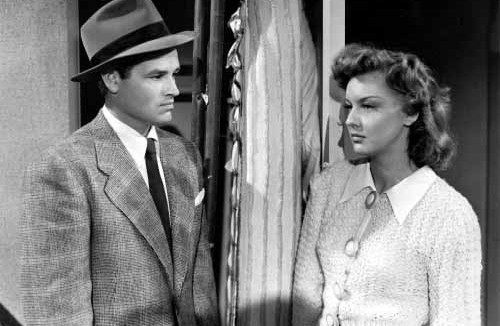
Who knew a young woman in a lace knit sweater could be so vicious!
Now, Roberts is made out to be the victim in this film, and in a way he is. However, he is also the one telling the story and as such there’s a chance his narration is a bit on the unreliable side. Perhaps Haskell’s death (and any subsequent ones) weren’t as accidental as he claims, and his decision to rob the dead man may not have been as spontaneous as we are led to believe. Either way, his life is forever altered and his plans are not to be. Poor Sue.
Seems guys (with big instruments) are already lining up to take Roberts’ place, though. We’re sure she’ll be fine. After all, it’s not like young, attractive women have ever been mistreated in Hollywood.
What we learned: Film Noir-narration is the best narration. Also, if someone (accidentally) dies in your presence, just go to the police and fess up at once.
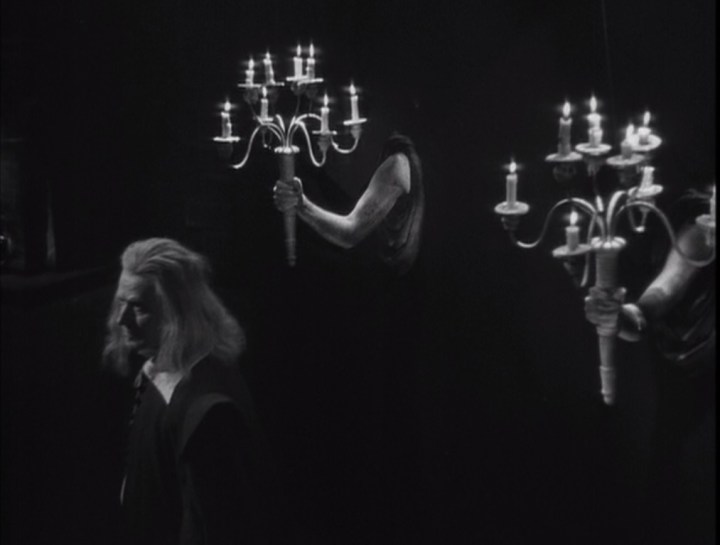
Dead of Night is the first of the horror anthology films on the list, and a good start to this scary and brilliant subgenre.
Architect Walter Craig (Johns) comes to look at a house he has been approached to alter or expand, and experiences a very strong case of déjà vu. It turns out he has had recurring dreams about the house and all the people who are currently there, but he cannot recall the ending of the dream, just that it is not a happy one.
What horrible fate could possibly befall these respectable looking people? Stay tuned to find out!
As Craig is trying to remember the details of his dream, the other guests take turns telling of their own experiences with the supernatural or uncanny. You know, to lighten the mood. The stories vary in length and seriousness, but some of them are very unsettling indeed.
Ventriloquist-centred plots will always creep us out
Among the guests’ tales we find a creepy ghost story involving children and murder (always a good combination) as well as a game of Sardines; a race car driver who’s saved from certain (?) death several times by the appearance of a strange man; a scary haunted mirror (a subject which we always find unnerving – childhood literature trauma might be to blame); a silly, silly ghost story involving two very competitive (and self-centered) golfers and the girl they’re both in love with (who by the way has no personality of her own and somehow agrees to marry whoever wins a golf game… Have some self respect, lady!); as well as the aforementioned ventriloquist tale starring Michael Redgrave of The Lady Vanishes-fame.
Other nightmare fuel is also available for those not particularly freaked out by dummies
Four different directors helmed the various segments, and they vary a lot in tone and style, with Cavalcanti’s two segments our personal favourites. We’re both partial to horror anthologies, and we cannot wait for the upcoming ones, such as #230 Dr Terror’s House of Horrors (1965), #359 Asylum (1972), #367 Tales From the Crypt (1972), #553 Creepshow (1982) and #582 Twilight Zone: The Movie (1983) to name but a few (numbers are liable to change as Mr Wright tends to alter his list now and then..). If you’re one of us (one of us!) we heartily recommend Dead of Night. Its circular plot is interesting, there are great performances, some good comic relief and it is genuinely scary at times. And we do eventually find out the ending of Craig’s nightmare… A new favourite for sure.
Just make sure you NEVER buy an antique mirror. Trust us.
What we learned: stay the fuck away from ventriloquist dummies! (Unless it’s the one from Buffy the Vampire Slayer, who’s quite naughty but not really evil.)
Brief Encounter is David Lean’s film version of a Noël Coward play, and it is beautiful.
Laura Jesson (Johnson) and Dr Alec Harvey (Howard) are sitting in a station café when they are steamrolled by a whirlwind known as Dolly. She blabbers on, completely oblivious to the fact that she has clearly interrupted something very special and important.
“I can’t believe you let her hijack us like this!”
Dr Harvey leaves and Laura goes home to her husband (Raymond) and tries to process what has happened through internal dialogue and flashbacks, as a story told, but not told, to her husband.
She probably could have just told him the whole story for all the attention he pays
Alec and Laura met by chance in the station café some weeks prior to the opening scene. They then keep running into each other until they start to plan their meetings and eventually admit to falling in love with each other. They start a (unfulfilled) romance which changes at least her perception of her life and identity.
Shared ridicule of unfortunate musicians is always a turn-on
Their relationship is doomed from the start as they both have families (who they seem to love as well) and are too proper and middle class to divorce or even “properly” cheat on their partners. The story is told from her perspective, and parts of it reminds us of Ibsen’s A Doll’s House (though that may be because we’re Norwegian and prone to finding Ibsen-parallels in everything). She is stuck in a too small life and Alec is as much the catalyst for her “awakening” as anything else. When she imagines their life together, she does not see him as a replacement for her husband – their life will be one filled with travel and adventure, not the mundane and routine based life she’s currently leading.
There will be no sitting around while Dr Harvey reads the paper! No sirree!
Of course, therein lies the appeal of “brief encounters” – the routine of day to day life never has a chance to ruin the perfect romance. Laura and Alec’s dalliance does not go on far enough for us, or the characters, to know whether their relationship would be better in the long run than the ones they are too “proper” to escape. In fact, in the end it seems Laura’s husband understands her better than she thinks, and there may be some hope there after all. However, she is still stuck in the same routine, with only the memory of romance to keep her going.
Despite the inherent betrayal of their actions, it really is a rather sweet and innocent romance between two somewhat alienated people
We loved this film. The story is well told from Laura’s perspective, and the need for something “real” to happen in her life is very clear. It is also beautifully shot, especially everything involving trains, from the first shot of the speeding train scored by Rachmaninoff to the gorgeous shot of Laura reflected in the train window while dreaming of an alternate life. The last moments of her “vertigo” and suicidal impulse upon Alec leaving for the last time are both disturbing and wonderful.
We continue our sordid Noir journey with our first encounter with Philip Marlowe, Raymond Chandler’s private detective who’s made numerous film and TV appearances. In Dmytryk’s Murder, My Sweet, we open with his interrogation for murder as he recounts the events leading up to his arrest.
For once, it doesn’t start with a Dame, but with a strong simpleton of a man
A man walks into his office and what a man! Legs up to here and strong as a bull. Moose Malloy (Mazurki) is his name and of course, he’s looking for a Dame. Velma. A redhead. She used to sing. Marlowe (Powell) takes on the case and they go out looking for her. Although finding a girl eight years later isn’t done in a night.
A bar is never the wrong place to start looking for lost Dames
It doesn’t take long for Marlowe to be approached by two more clients, one of whom gets himself killed and Marlowe knocked out within hours of hiring him. Luckily he paid in advance. He hires the detective to act as backup while trying to buy back a priceless jade necklace from some robbers, but the deal goes horribly wrong.
Then, finally, a Dame walks into his office.
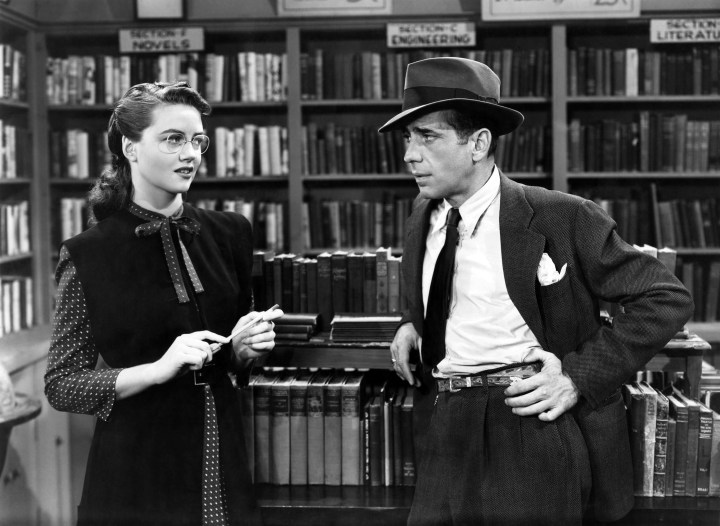
The glasses exclude her from being a real romantic interest. Luckily for Marlowe, they were just a disguise.
Reporter Allison, real name Ann Grayle (Shirley), tries to get information about the jade and when he sees through her ruse, she admits that the necklace was worn by her stepmother when it was stolen. Marlowe goes to investigate and meets the stepmom (Trevor). And she’s a real Dame! Not much older than her stepdaughter, she puts the moves on Marlowe and plays the victim quite well.
From then on the plot thickens. Marlowe is knocked out, threatened with guns and fists, drugged and put in a very amusing dream sequence. He also kisses all the dames and hatches all the plots in order to satisfy those clients he can and bring justice to those he cannot. All the while, his amazing internal dialogue narrates his actions. The similes! The quips! The banter! We need to start talking more Noirish in our daily lives.
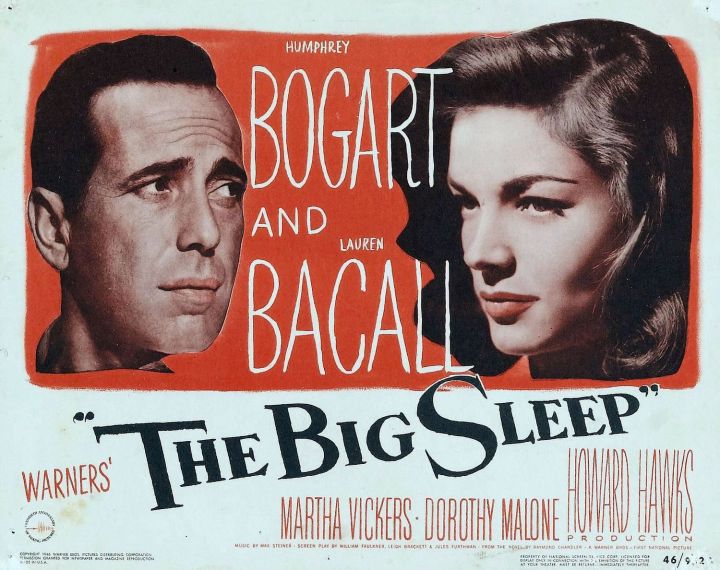
Admittedly, taking the juvenile from all those Busby Berkeley musicals seriously as a hard boiled detective was a bit difficult at first, but he does actually pull it off. That being said, we’re very much looking forward to Humphrey Bogart’s Marlowe in the upcoming The Big Sleep, which is an old favourite of ours. Murder, my Sweet was very good and entertaining though, and we’re very excited about all the Film Noir in this part of the list. Now we just need to practice our banter.
What we learned: stay away from Dames! Also, we need to read more Raymond Chandler.
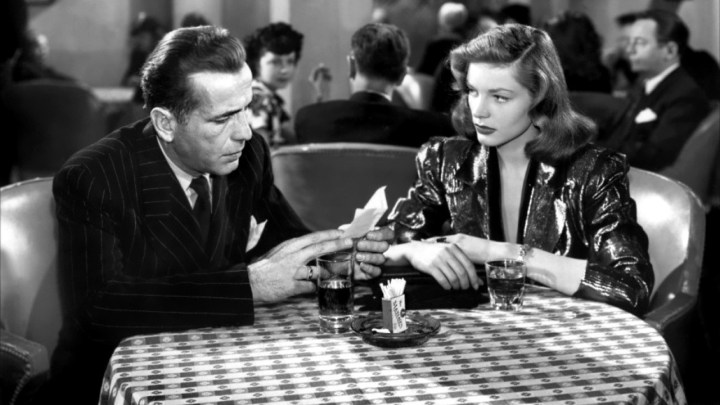
Oh, the dialogue! If you’re not interested in Film Noir, you should check this one out for the snappy dialogue alone. Old-timey flirting is the best flirting!
Insurance salesman Walter Neff (MacMurray), swings by a client’s house to renew his car insurance, but meets a Dame instead. The Dame is Phyllis Dietrichson (Stanwyck), the client’s wife and winner of History’s Sexiest Name Award, and flirtatious banter ensues.
“Suppose I can rid you of that anklet of yours?” “Suppose it digs into my ankle”
Turns out the dame isn’t too fond of her husband after he lost his fortune, and she’s unusually interested in accident insurance for said husband. She invites Walter back when her husband is home, but changes the appointment to make sure the they’re alone. The two start plotting ways to get her husband the insurance without him knowing it and then making sure he has an accident to cash in on. A fatal one.
Walter and Phyllis do the deed and make very sure it can’t be interpreted as anything but an accident as Walter works with insurance blood hound Barton Keyes (Robinson, of Little Caesar-fame) who is sure to investigate.
Now, Phyllis might be a femme fatale (her past certainly seems to suggest so), but Walter is not by any means an innocent man driven to murder by the woman he loves. He tells the story and so we only get his side of it, but it is very clear that he is the mastermind behind the murder. He plans everything to the last detail and Phyllis operates on his orders. This does not mean that she is innocent, but either Walter is the driving force behind the whole thing, or his male ego won’t let him admit that Phyllis was smarter than him and so he makes it look as though he planned the crime. None of those options reflects very well on him.
She does have a tendency to hover in the background, but we’re sure that’s perfectly innocent
Double Indemnity is exciting and suspenseful, but the main reason we love it is easily the dialogue and banter! The first encounter between the main characters is amazing. We need to practice our old-timey flirting.
What we learned: sometimes murder smells like honeysuckle.
Theatre critic Mortimer Brewster (Grant), against his convictions, is getting married to Elaine (Lane). While they get hitched, his sweet old murderous aunts (Hull & Adair) entertain his new father-in-law along with Teddy “Roosevelt” (Alexander), Mortimer’s insane brother. And the body of their latest victim.
On their way to their honeymoon, Mortimer and Elaine stop by Dark and Godless Brooklyn to greet their relatives, and Mortimer stumbles across the dead body in the window seat and panics. Naturally. He is then completely shocked to find that his lovable aunts committed the deed and not only this one! They have so far killed 12 men and had Teddy bury them in the cellar.
“But… They looked so peaceful after we poisoned them. So relaxed. We can’t see that we’ve done anything wrong!”
While Mortimer tries to sort out the mess and have Teddy institutionalized to take the blame (without serving prison time), another brother shows up to further complicate things. Jonathan (Massey) is also insane, but more in the I’ll-kill-you-and-everything-you’ve-ever-loved kind of way and not the bugle blowing, stair charging way of innocent Teddy. He also brings his own plastic surgeon, Dr Einstein (Lorre – who does not age!). Oh, and their very own body to be disposed of.
Guess who was the inspiration for Einstein’s latest surgical miracle?
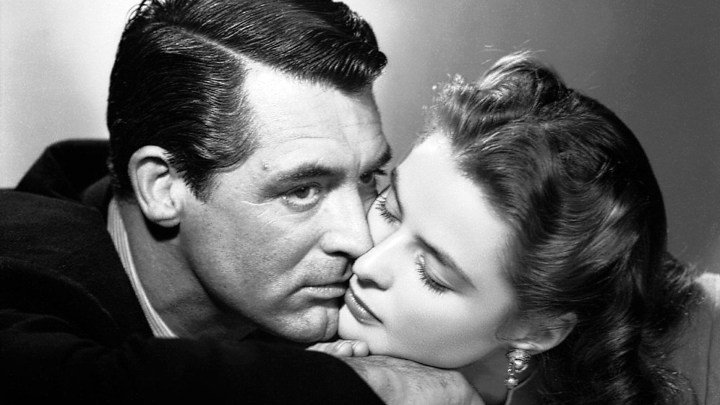
Mortimer, as the only sane member of the family, desperately tries to make everything right while also protecting his more loveable relatives. And the results are very silly, very funny and also strangely suspenseful. Grant’s face is EVERYTHING in this film, and aunt Abby (Hull) is one of the most adorable murderers in history. Poor Lane doesn’t really get much to work with though, despite her being billed second on the poster (though, we realise, not the one we chose to go with for this blog..). She’s mainly there to serve as another complication for Grant and perhaps to represent sanity in this insane world.
As if Cary Grant isn’t perfectly capable of representing sanity on his own!
Arsenic and Old Lace is a silly and hilarious farce which we absolutely loved. The spinster sisters living together weren’t in any way a glimpse into our own futures at all! No sir. There’s no way we’ll ever be able to afford a house like that…
What we learned: Brooklyn is not part of U.S. proper. Also, inbreeding is never a good idea…
An epic masterpiece in glorious technicolo(u)r, The Life and Death of Colonel Blimp follows soldier Clive Candy (Liveley) through three wars and the untimely deaths of many African animals.
During World War 2, Major-General Clive Wynne-Candy, commander in the Home Guard, is “captured” in a Turkish bath by overzealous soldiers who cannot wait for the actual exercise to begin. A scuffle ensues, Wynne-Candy is assaulted and insulted by the young leader, and we are then treated to a two-and-a-half hour long flashback of the aging soldier’s life.
Meanwhile, the poor man has to sit around like this
It begins during the Boer War, when young Candy is on leave and hears of some anti-British propaganda being spread in Germany. After being told clearly by his superiors to leave it alone, he goes off to Berlin to see Edith Hunter (Kerr), the British governess who brought the offence to his attention. Because why listen to your superiors?
After some (hilarious) musical bullying in a restaurant, it all escalates into a proper duel. As is tradition.
For offending the entire German army, Clive must fight a duel with Theo Kretschmar- Schuldorff (Walbrook) which leads to injuries for both fencers. They end up in the same hospital for convalescence, where they strike up a lifelong friendship together with Edith. As Clive recovers and prepares to return to England, he finds that his two friends have fallen in love and celebrates their engagement with them. It is only after he leaves he realises that he too is in love with the governess.
Who wouldn’t fall in love with a woman who uses an entire bird as a fashion accessory?
The two men go their separate ways, but keep in touch. World War 1 begins, and both soldiers are fighting, though obviously on different sides. On the last night of the war, Clive sees nurse Barbara Wynne (also Kerr) who is the spit of Edith (naturally) and once home, he tracks her down and marries her. Probably healthy.
“Of course I love you for you, my dear! Your money and your striking resemblance to my sort-of almost ex-girlfriend are completely irrelevant!”
After 1918, Theo is a prisoner of war in England for a year before he’s allowed to return home, defeated and defiant as many Germans at the time. However, his attitude changes during Hitler’s regime, and he eventually seeks refuge in England.
Old, disillusioned and broken, Theo once again teams up with his old friend.
The second World War is a difficult time for the now aged Clive, and his attitudes to war and how it should be fought give him a dismissal from the military where he has lived his life. The friendships of Theo and Clive’s driver (and confidant) Johnny Cannon (Kerr again) help him find new new purpose and brings us right up to the start of the film.
It gives Clive a chance to get up from the bath and restores his dignity as well
This was a wonderful film and despite its long run time it flies by. All major actors give great performances, and the glorious technicolor really does justice to the soldiers’ uniforms as well as Deborah Kerr’s amazing hair. We loved the clips showing the passage of time between wars, and the handling of Barbara’s death through newspaper clippings was oddly emotionally effective. There are some very good comments on a then ongoing war which are still good observations 70 years on.
The friendship between Clive and Theo is beautiful and the characters are wonderful as well. They’re both flawed, yes, but they are likable and human, which made us very invested in the outcome. We loved it, and it’s well worth the three hour run time.
What we learned: Oh, so many things! Old people have lived long, full lives. Never go off at half cock. Avoid politicians like the plague. Political ideas are best discussed by drinking beer and fighting duels. You so rarely see a good fencing duel nowadays. Only part of the title is true.