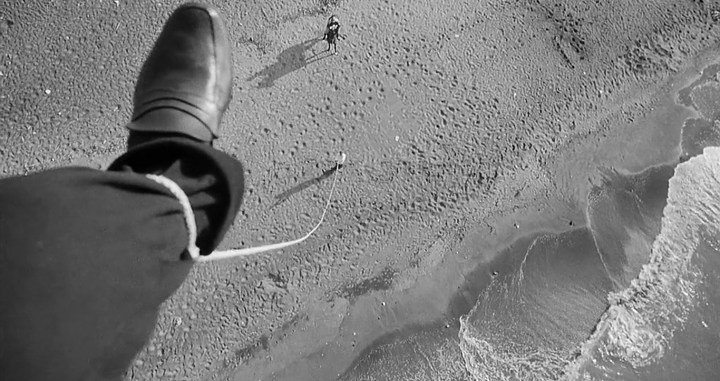
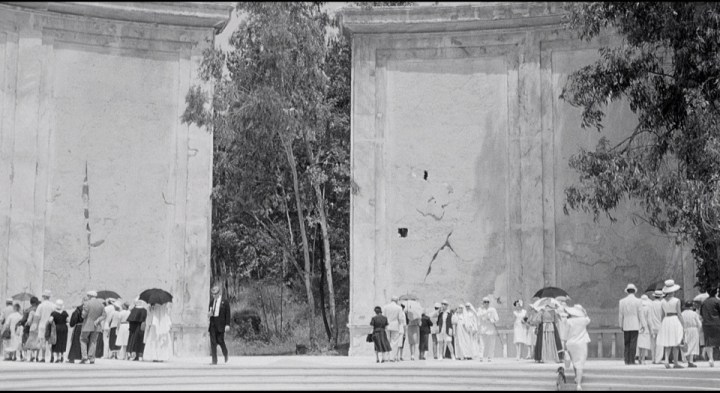
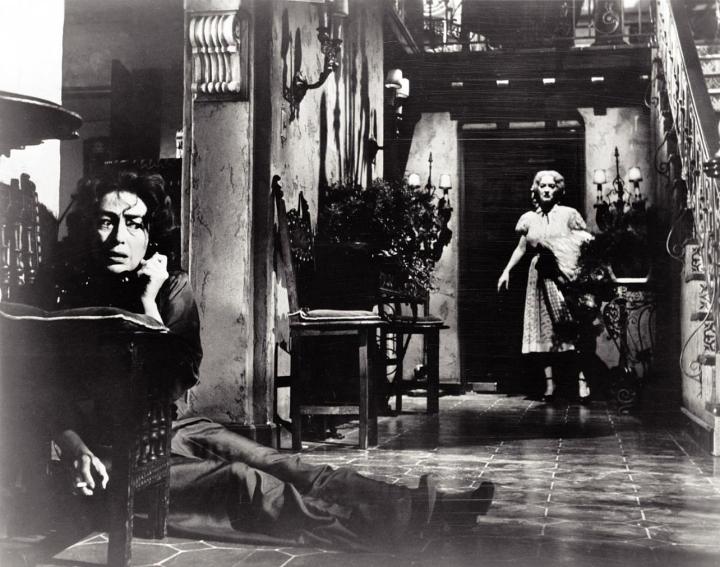
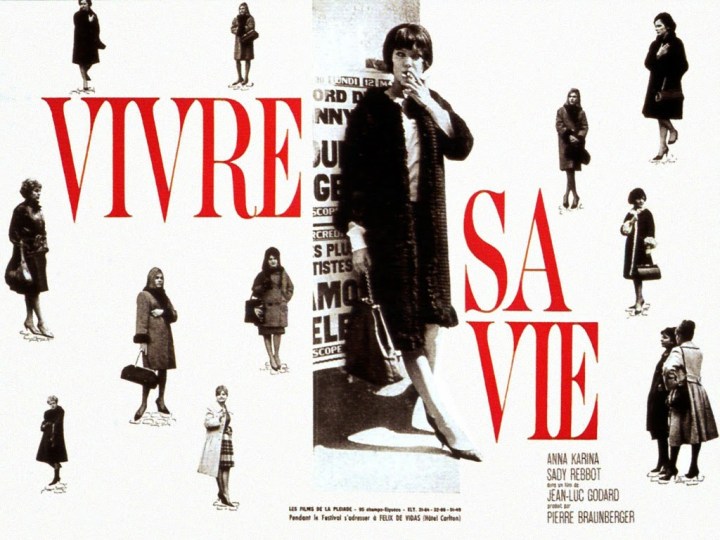
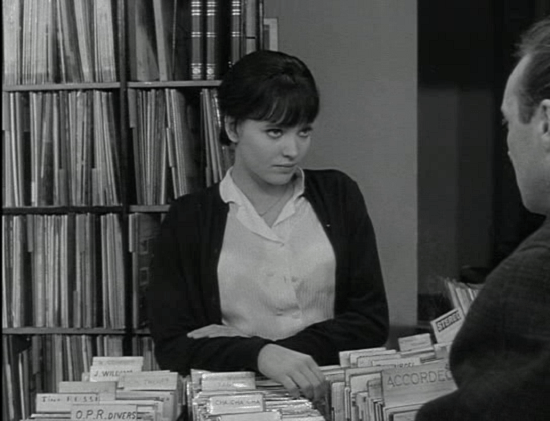
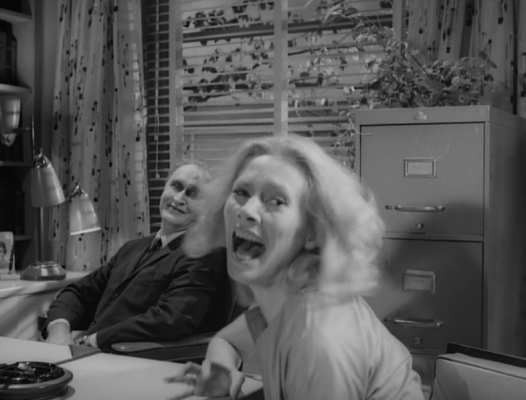
Engaging and visually interesting, Vivre sa Vie is a must for all fans of French new wave cinema. For hardcore fans, we may also recommend two classic shorts: one here, and the other here. Enjoy!
What we learned: In France, the lion is DEAD tonight.
Next time: What Ever Happened to Baby Jane? (1962)
Korea, 1952. A patrol is ambushed and taken prisoner. When they return to the US, generally despised Sergeant Raymond Shaw (Harvey), who’s cursed with a busybody mother (Lansbury) and a fanatic senator stepfather (Gregory), is awarded Medal of Honor. The medal is given to him based on the testimony of his fellow soldiers, who cannot say enough good things about him, although they are unsure why.
“We just really respect the way he used to break up our parties with local prostitutes”
Meanwhile, a few members of the same patrol, including Major Bennett Marco (Sinatra), are troubled by nightmares in which the celebrated Sergeant kills two fellow soldiers on the command of a bunch of ladies talking about agriculture and occasionally morphing into communist leaders.
“Welcome to my talk on how to make blossoming gardens and sleeper agents. I’m very happy to see so many morphing faces here today.”
Marco’s fears are dismissed by the military, and he is eventually placed on sick leave. He meets Eugenie (Leigh) on a train, and she becomes his support system as he tries to make sense of what actually happened in Korea.
She is witty and fantastic, but also insanely reckless. Who talks to an unknown man who’s clearly having some sort of breakdown, and after three minutes decides to give him all her personal details?
Marco’s suspicion is that Shaw, and the rest of the patrol, are all brainwashed and returned to the USA to carry out some sort of plot. But what exactly is Shaw’s mission? Who is his local handler? And will they have any chance of stopping whatever it is in time?
And will Shaw ever get out from under the thumb of his controlling mother?
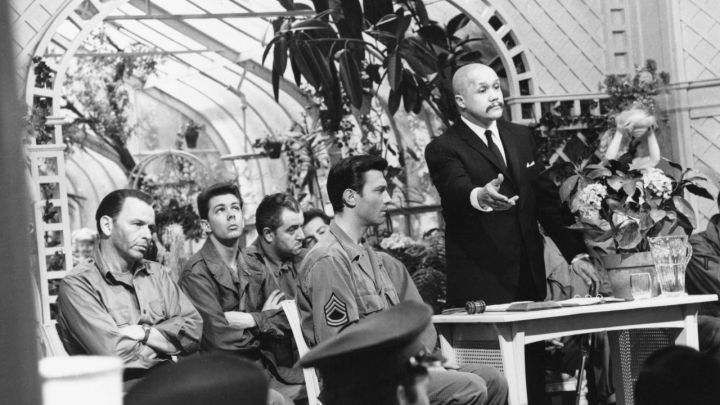
The Manchurian Candidate is a tense and compelling thriller which keeps going off in unexpected directions. We loved the horticulture talk the soldiers imagined, and the cross cutting between their perception of it and the reality.
Pictured: The Annual Women’s Society Lecture on Communist Leaders™
We also loved how the different soldiers saw this scene differently – the black soldier seeing a room filled with black women, etc. Now, the plot is perhaps a bit far-fetched, but in the time of the Cuban Missile Crisis and the aftermath of McCarthyism, we’re sure it hit all the right buttons.
We found Frank Sinatra to be a surprisingly good actor, and we loved Angela Lansbury: her character could have snatched the “World’s Greatest Mother” trophy right from the cold, dead hands of Mrs Bates…
Surprisingly good actor or not, Frank Sinatra’s card playing skills were clearly below par
Shinbone, somewhere in the Wild West. Senator Ransom Stoddard (Stewart) and his wife Hallie (Miles) arrive to attend the funeral of old friend and town loner Tom Doniphon (Wayne). Together with former sheriff Link Appleyard (Devine), they recount to reporters the reason they returned to pay their last respects to Doniphon.
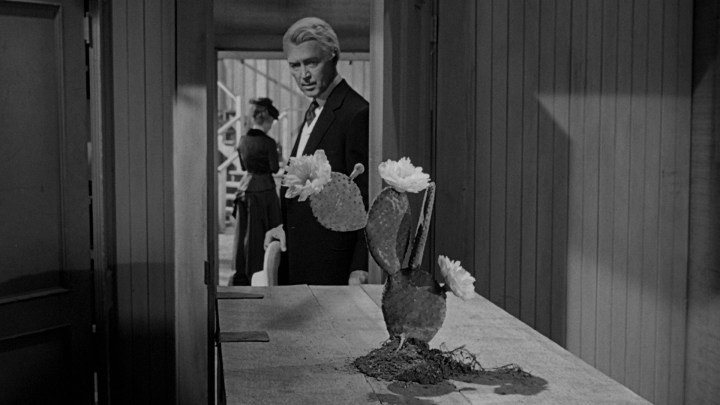
“That man could grow a cactus like no one I ever met.”
Flash back 25 years, and Stoddard is an idealistic lawyer ready to start his practice in the then lawless Shinbone. On the way into town, his stagecoach is ambushed by local gang leader Liberty Valance (Marvin). After refusing to yield to the bully, Stoddard is brutally beaten and left to die in the desert. He’s found by Doniphon and nursed back to health by Hallie.
“I have a good mind to throw this dish in your face, you dirty rotten scoundrel, you!”
Once he recovers his strength, Stoddard decides to go ahead and open his law practice, as well as start a school to teach all the locals to read, something Valance is not happy with. Doniphon tries to tell Stoddard that he needs to use force in order to deal with the outlaw, but Stoddard is sure that the only way is the way of the law. Meanwhile, romance blossoms between “Ranse” and Hallie, although Doniphon is also in love with the only eligible woman in town.
After all, Hallie is of Norwegian ancestry. We’re scientifically proven to be irresistable [citation needed].
The Man Who Shot Liberty Valance is a wonderful and tense Western where philosophies collide with the transition from old to new ideals. On the one hand, we have the old west represented by the rugged, stoic and righteous gunslinger Doniphon, and on the other we have the new hero and male ideal: the educated, sensitive and refined Stoddard.
Stoddard woos the girl and wins over the townspeople by teaching them about history and politics, and how to better themselves. Meanwhile, badass macho man Doniphon protects them with force and his own form of love: he works hard to build his farm in order to have something to offer Hallie, but he never actually got around to asking her to marry him, or to ask her what she actually wanted from him.
She might have married him ages ago if he ever actually thought to ask her
There are some not-so-subtle references to all men being created equal, which would have been very timely in 1962 and, sadly, also in 2019, and which we absolutely loved. We also loved James Stewart, but then again, we always do…
This movie has it all: sassy women (mother more than daughter), bad criminals, intriguing politics, a stoic gunslinger, a young idealistic educated man, a love interest, and a bumbling town marshal. And once again, we find ourselves loving a Western classic. Fantastic stuff!
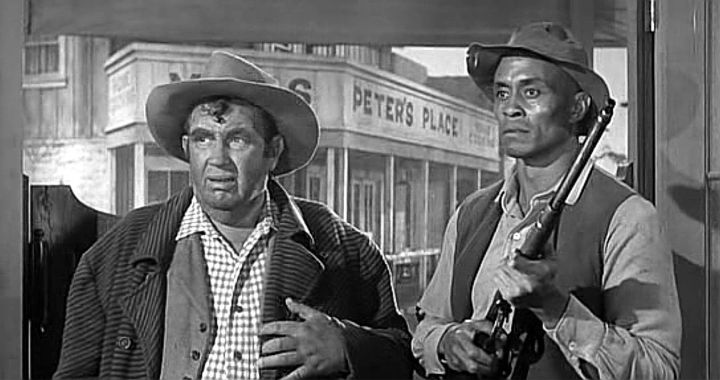
He’s only an elected official – he can’t make decisions on his own!
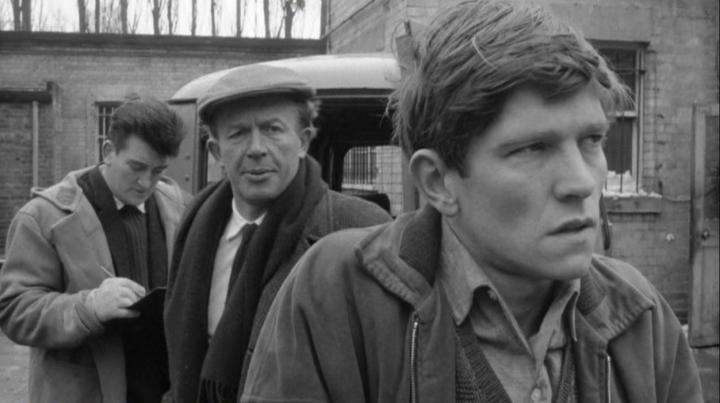
Colin Smith (Courtenay), a working class boy with anger issues, is sent to a borstal school (or reform school for those of us not in the know) for burgling a bakery. Once there, he is sorted into Drake House in a ritual we found disappointingly lacking in hats.
Face says Slytherin. Actions say Gryffindor. Absolutely nothing says Ravenclaw…
The school’s philosophy is that hard work, discipline, and exercise will put these young men on the right track in life. During training, the governor of the school (Redgrave) observes Colin’s brilliant running skills and takes a special interest in his new pupil.
By “brilliant running skills” we refer to his speed and endurance. Not running style.
Colin is given special permission to train outside the school’s fence for an upcoming race against a public school (or private school for those of us not in Britain), and in between training sessions, we get flashbacks to his life before this and the circumstances which led him to this point.
Before his arrest, he led a happy, fulfilling life, filled with laughter and friends
Like many of the old dramas we’ve watched in the past few years, we enjoyed this movie so much more than we thought we would. We loved the flashbacks, the smart-ass remarks of our (anti-)hero, Colin’s singular running style, and the clash of cultures in the changing rooms before the race.
This innocent, outgoing public school kid had no idea about the world he walked into. Or the Quasimodo-looking criminal following him.
At first, the governor seemed like quite a good guy, but we soon realised that this was mainly due to what we have dubbed the “Michael Redgrave-effect,” in which a character become instantly likable because the actor playing him/her just exudes kindness and benevolence. (See also: The Innocents, in which Redgrave plays the uncle who basically abandons his young relatives and sends a youngish governess in without warning her about the circumstances, but you still go “oh, what a charming chap! I’m sure he had his reasons!”)
It is basically impossible to dislike a pipe smoker
Without spoiling it too much (although light spoilers ahead), the ending was the sort of ending which would have very much appealed to our teenage, rebellious selves and which frustrates our old, security-concerned selves. This was your chance, kid! But also: yeah! Stick it to the man!
What we learned: Don’t let the bastards grind you down. But also don’t let your own stubbornness deprive you of a chance to make a better life for yourself. Man, we’re confused on this one…
Next time: The Man Who Shot Liberty Valance (1962)
Starring: Silvia Pinal, Jacqueline Andere, José Baviera, Augusto Benedico, Luis Beristáin, Antonio Bravo, Claudio Brook, César del Campo, Rosa Elena Durgel, Lucy Gallardo, Enrique García Álvarez, Ofelia Guilmáin, Enrique Rambal, Patricia de Morelos, and just a bunch of others…
As the hours and days go by, the upper class dinner guests deteriorate and become more and more desperate, eventually contemplating murder to break their curse. But what is really going on?
Honestly, we have no idea. This is above our pay grade.
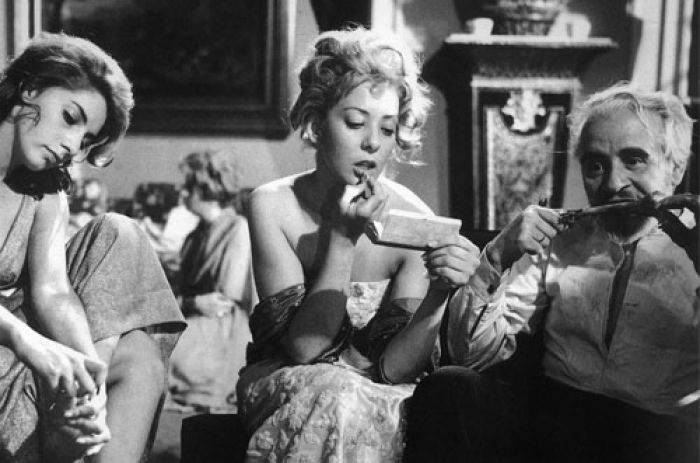
Like all of Buñuel’s movies, The Exterminating Angel requires some thought and interpretation. Which is not our forte. But we get the impression this is probably a comment on how high society deteriorates to the level of animals once the luxury and the societal structures they cling to are taken away.
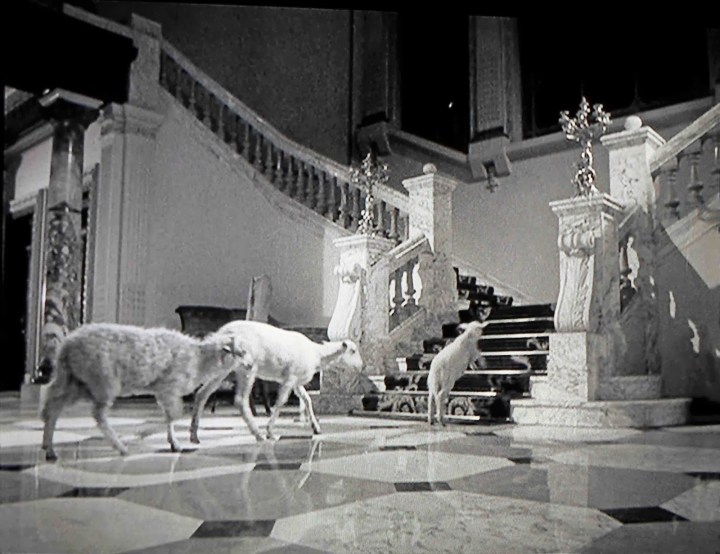
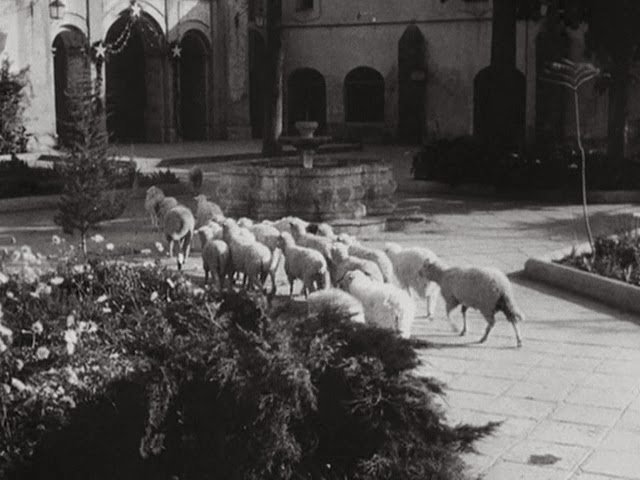
We’ll just insert this still of a herd of sheep without further comment.
We thoroughly enjoyed it! We understood absolutely nothing! You should watch it!
What we learned: You know, we would probably learn loads from this film on repeated viewings as it strikes us as the sort of movie you should really study. However, we still have 785 movies to go, so we’re gonna have to get back to you on this…
Next time: The Loneliness of the Long Distance Runner (1962)
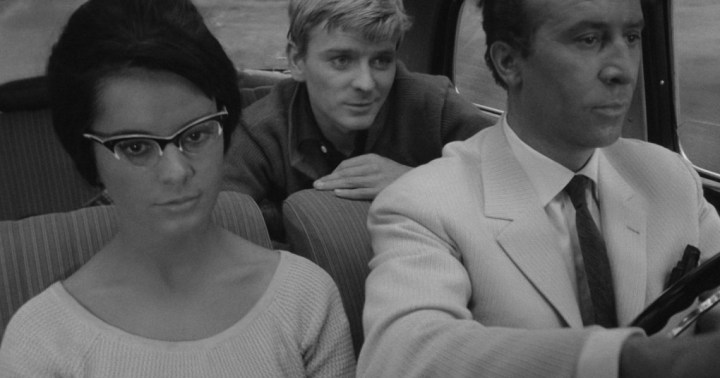
After almost hitting a young man with their car, a couple angrily invite him to hitch a ride with them. They drive down to a lake, and the hitchhiker (Malanowicz) is invited to go sailing with the couple, Andrzej (Niemczyk) and Krystyna (Umecka), an offer he accepts for some reason.
Clearly, none of these people had ever heard of a serial killer.
Once out on the water, both men take turns being suddenly angry and/or insulted and aggressive towards each other while Krystyna lounges about, makes food and does a great job hiding anything which could be deemed a personality.
There is really no trace of personality there until she gets wet… Which might be somewhat symbolic.
Tension builds as the trio are exposed to harsh weather and alpha male competitions, and it culminates with the loss of the young man’s pocket knife in the water and his subsequent presumed drowning.
Now, the Norwegian translator for the DVD we watched apparently decided only half the lines were worth subtitling, so we may have missed a few things. Like major plot points. But the tension between the characters was clear even if the reason was not always so.
We’re going to go out on a limb and assume that some of that tension might be because of the half naked woman whose attention the two men vie for.
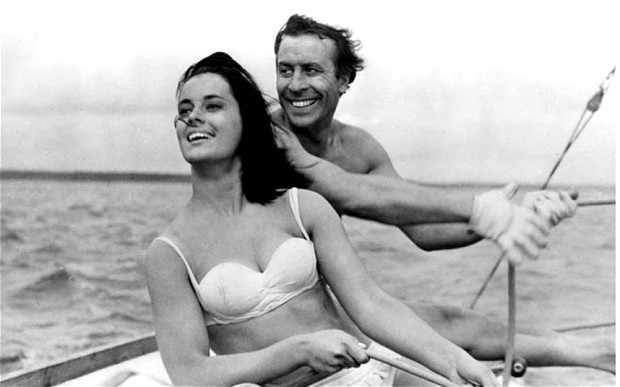
The entire movie is set in just two locations (albeit moving ones), a car and a boat, which we really enjoyed. We loved the crocodile, the tense start and the ambiguous ending. We also found the couple strangely adorable when they were in the water, despite their chilly relationship in the rest of the film.
See? They look like a perfectly harmonious couple once they’ve been out swimming.
Roman Polanski’s debut feature film is beautifully and interestingly shot, and the filming plays a huge part in building the tension. Especially for those of us who do not speak Polish and who are at the mercy of a translator who’s a really slow typist and who doesn’t have time to go back and fill in the blanks… We’re pretty sure we understood about two thirds of the dialogue though, so we’ll call that a win.
No fun caption here. Just wanted to show you this cool shot.
What we learned: It is a bit weird to invite a random hitchhiker to go sailing, right..? Also, don’t introduce a knife in the first act unless you’re going to use it by the third. And don’t introduce a woman in the first act unless you’re going to give her a personality by the third.
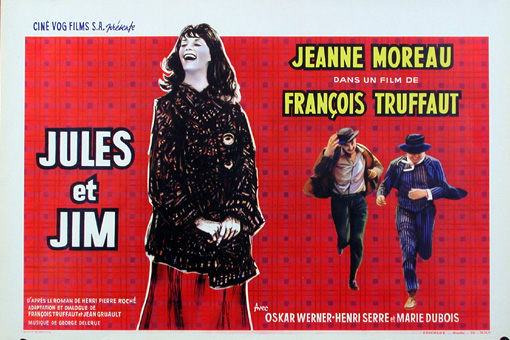
Introvert Austrian Jules (Werner) and extrovert Frenchy Jim (Serre) meet as young men in 1912 and a lifelong friendship is born. While rocking their bohemian lifestyle and moving through relationships with various women, they meet free spirited Catherine (Moreau) who they both fall for in their own way.
We’re sure there’s some symbolism in the fact that Catherine dresses up as a man when they first get to know her… But we’re not ones to speculate.
Catherine is impulsive and fun, but also intelligent and charming. Jules loves her but is a misogynistic bastard at heart despite his ideas of himself as progressive (as demonstrated by his speech after the Strindberg play they go to see). Still, he convinces her to marry him for some strange reason, although she seems a bit luke warm towards the whole thing. As WWI breaks out, the two men are drafted on opposite sides with Catherine stuck in Austria by herself.
Shouldn’t be a problem though. A statue doesn’t change just because you leave it alone for a few years.
After the war, the men rekindle their relationship, and Catherine is once again stuck in the middle with both men wanting to marry her. And they do. But while she has a daughter with Jules, she is unable to conceive with Jim which causes a rift. In addition, the fact that Jim has another girlfriend might also contribute to some tension.
“So, is this your night or mine?” “I’ve completely lost track. It’s an odd numbered weeknight starting with a T… I think maybe those are yours..?”
Jules et Jim is a very interesting movie for many reasons. It’s pretty much the epitome of French New Wave and Jeanne Moreau’s great international break out role. It’s also filled with very interesting characters. We cannot quite decide if they are all complex and realistic or just inconsistent and difficult to read. Despite the title, the film is really all about Catherine, but without ever revealing her thoughts and feelings.
She is as mysterious and inscrutable as the statue the men were initially drawn to
Because let’s face it: there’s a very strange relationship between Catherine and men. She is always surrounded by them, with no female friends. Nor does she have any friends who aren’t interested in sleeping with her. Yet none of the ones who consider themselves close to her are interested in listening to her. She is ignored whenever she tries to talk about something other than the men or her feelings towards them. Anything else is uninteresting to the men who claim to “love” her.
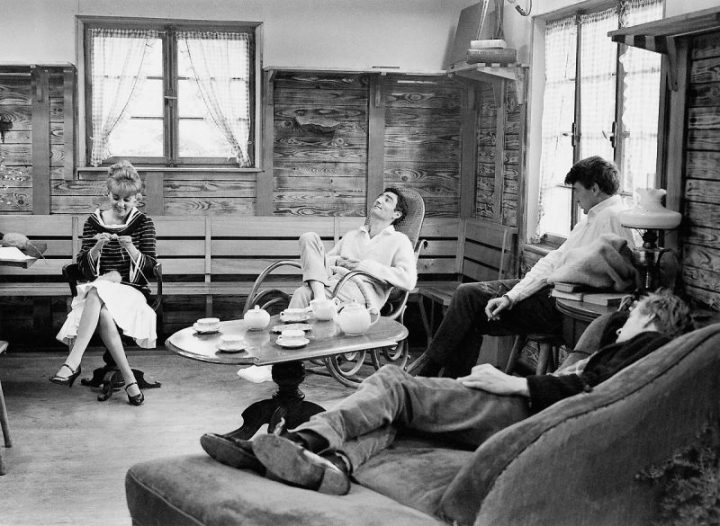
“You just get on with your knitting and let us sit here and lust after you in silence.”
This is no way excuses her final actions, but perhaps it goes some way towards explaining them. She is a nonconformist forced to conform to wife and mother, and an intellectual forced to only talk about men and relationships. It’s enough to make anyone snap.
Life would have been easier if she was an actual man
Jules et Jim is a technically interesting movie as well: we loved the voice-over; the “erratic” filming; the cuts and “fast-forward” feeling which felt like snapshots from their lives, and the distance this in many ways created; the costumes; and the complex and unusual characters. There’s a reason this is considered a classic. And we’re sure there are a thousand ways to interpret the relationship between the characters. This was just our two cents.
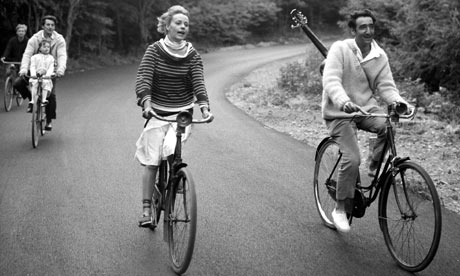
On a lighter note: it made us long for spring, summer and bicycle rides
What we learned: Relationships are hard. But sometimes it might be a good idea to actually communicate with each other… Also, real friends don’t need to fuck you to stick around.
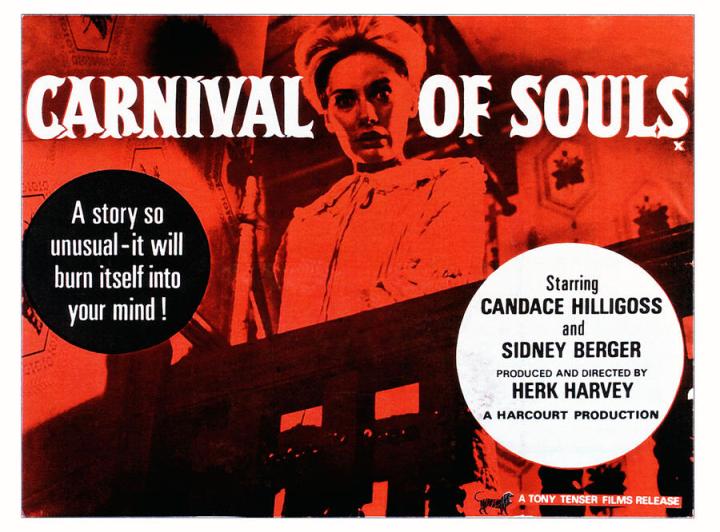
Three friends accept a challenge to a drag race (though not the fun one with RuPaul) and their car ends up in the river. Only Mary Henry (Hilligoss) comes out of the water, but soon after the accident she starts to experience strange things.
“What is this thing?? How do you even drive a car?!? Who on earth placed me behind a stearing wheel?”
Newly moved to Salt Lake City, Mary finds herself slightly obsessed with an abandoned pavilion formerly used as a carnival. Even worse, she is haunted by the creepiest neighbour in the state of Utah. Oh, and also by a ghostly visage which pops up in windows, visions and dreams. But the neighbour is almost creepier than the spectre.
Let us lay some wisdom on you: if your neighbour gives you the willies worse than this guy, it’s time to move. We don’t care how low your rent is.
While Stalky McCreeperson, real name John (Berger), next door continuously tries to get in her pants, Mary tries to stay sane and perform well at her job as an organist. But she is troubled by her hallucinations (or are they?) and some unusual episodes in which all sounds disappear and people seem unable to see her. What is really going on with our heroine?
She is tormented by confusion. How can a man simultaneously look so frightening and so amiable?
Honestly, we went into this not expecting much. It’s part of a DVD box set we own with 50 horror films, and most of them are sub-par to say the least (with some notable exceptions). But we were pleasantly surprised by this atmospheric and unsettling cult classic.
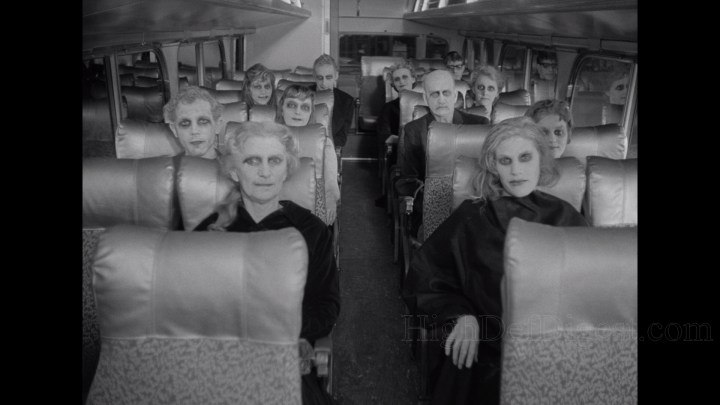
This single image will haunt our dreams for the rest of our lives. And now yours. You’re welcome. #sharethetrauma
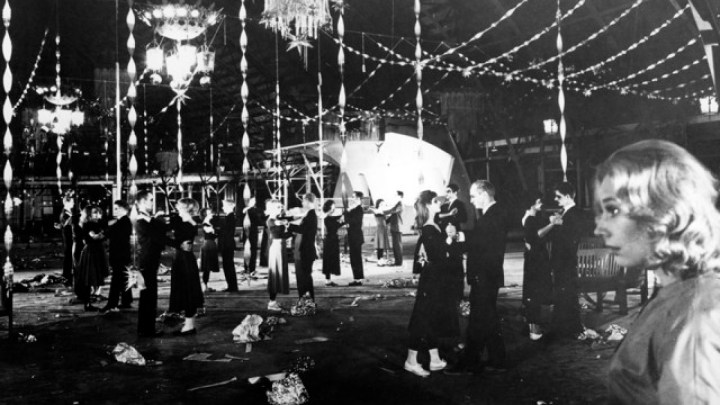
We loved the intense lighting and the reflections during Mary’s drive to Utah; the truly distressing ghosts; the main character (Mary is actually quite independent and don’t need no man!); the music; the make-up; and the dancing ghouls.
This isn’t from the film, by the way. We just really wanted to share some pictures from our New Year’s party. ‘Twas a strange affair…
Sadly, this was Herk Harvey’s only foray into the world of horror, although some of his other credits would suggest otherwise: “Dance, Little Children,” “To Touch a Child” and “Shake Hands with Danger” are all, unfortunately, enlightening and moralizing short films despite their evocative titles, and not the psychotic horror thrills we had envisioned. Our lack of research led to a very disappointing movie night indeed…
All we’re saying is, when you settle in to watch a film called “Pork: The Meal with a Squeal” directed by this guy, you expect some Hannibal Lecter stuff.
What we learned: We found 2019’s Halloween make-up. It’s a done deal now. Also, you should check out Herk Harvey’s credits as director. There are some real gems among these titles.
Spain, 1546. Mr Barnard (Kerr) comes from England to see where and how his beloved sister Elizabeth (Steele) died. He meets his brother-in-law Nicholas Medina (Price) and his sister Catherine (Anders) and is offered a strange and vague explanation of Elizabeth’s death.
“Suffocation from too-tight corset” is not among the excuses. Neither is “tripped over own voluminous skirt and broke neck.”
Family doctor Leon (Carbone) later reveals to the grieving brother that his sister died of fright. Since more details are surely required after such a statement, Medina confesses that his bride had become obsessed with the inquisition era torture chamber in the cellar, and that she perished in an Iron Maiden.
We’ve always felt that a house is not a home without a fireplace, a lounge area, and an indoor torture chamber. We’re having ours installed next weekend.
But is this all there is to it? Barnard is still not satisfied, and as we delve deeper into the house’s secrets, we learn that Medina’s father killed his brother and wife in the chamber when his children were young. Young Nicholas witnessed the ordeal and was never the same again.
As Medina devolves into madness, strange things also begin to happen in the castle… So what really happened to Elizabeth? Is she haunting them? Or was she buried prematurely, House of Usher-style?
And why didn’t anyone bother informing doctor Leon of the dress code for the evening? These questions will haunt us…
Pit and the Pendulum has everything we love: Gothic castles, secret passageways, hidden torture chambers, ghosts, murder, madness and torture. It is morbid, grotesque and lovely, and we completely adored Vincent Price as the confused, distressed widower. Barbara Steele’s eyes are as haunting as they were in Black Sunday, and she is the perfect Gothic heroine/villain (take your pick here). Personally, we are of course suckers for anything Poe (and Corman. And Price.), so we had no choice but to include this even though it is no longer on the list. It’s fantastic!
Best watched by squinting from inside an Iron Maiden. Well, we say “best”…
Somewhere in 18th century Spain, a beggar (Wordsworth) goes to a castle to ask for some food and/or money. But the marquis (Dawson) is a cruel man and a bully, and he imprisons the beggar and promptly forgets about him. Left in the dungeon for fifteen years, the poor man is forgotten about by all but the jailer and his mute daughter.
One look at this man and we would have run for our lives. Unfortunately the beggar didn’t share our instincts for people.
After those fifteen years, the daughter (Romain) refuses to be raped by the marquis, and he throws her in the dungeon with the beggar. Apparently, he has forgotten all about the girl’s kindness to him and rapes her himself, and then dies (karma’s a bitch!). The girl is sent back to the marquis so that he can have his way with her, but having been raped once already, she’s not about to let the bastard win, so she kills him and flees.
Sometimes it’s a good, and righteous, thing to be a backstabbing bitch
The runaway girl, now pregnant, is later found in the woods by Don Alfredo Corledo (Evans) and Teresa (Talfrey) who take her in and, when she dies in childbirth on Christmas Day, take on the responsibility of her newborn son.
“Say, Teresa, do we know who the boy’s father is..? I only ask because he seems to be displaying some rather unusual dental development here which has me quite confused”
Turns out though, unwanted children born on Christmas Day are cursed to be werewolves. Which makes us wonder why lycanthropy isn’t a bigger social problem than it currently seems to be. While young Leon (Reed) at first manages to keep his condition under control, once he grows up and faces adversity as well as love, he loses what little control he has and all hell breaks loose.
Honestly, we were half expecting him to break into song once he had climbed the bell tower. Colour us disappointed.
The Curse of the Werewolf was removed from the list after we’d already bought it, so as is tradition, we’re doing it anyway, dammit! And we’re glad we did. We loved the opening credits with the sad werewolf, the interesting explanation for the condition, and Leon’s partner in crime (not literally though) José.
Also, even though it preceeds it by almost 5 decades, this is yet another werewolf better than the atrocity in The Prisoner of Azkaban. No, we’re still not over it.
In many ways, it’s more a drama than a horror, except the ending which is very Frankenstein. But we believe it works for fans of both genres. Well worth watching! Even though there are apparently at least 1000 films which are better than this one… Let’s call it number 1001 and recommend it anyway. Happy New Year!
What we learned: Don’t give birth to unwanted children on Christmas day. We know, it’s a bit late for 2018, but keep it in mind for next year.