Starring: Steve McQueen, James Garner, Richard Attenborough, James Donald, Charles Bronson, Donald Pleasence, James Coburn, Hannes Messemer, David McCallum, Gordon Jackson, John Leyton, Angus Lennie, Nigel Stock, Robert Graf
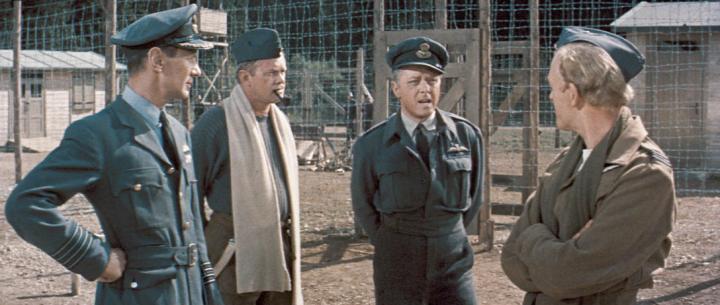
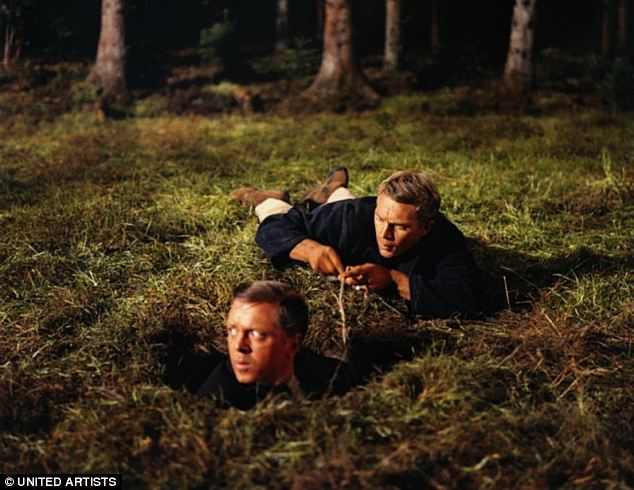
Right away, the prisoners start plotting their next breakout, although Hilts (McQueen) and Ives (Lennie) don’t have the patience for all that planning “Big X” (Attenborough) and his crew are into. They start an almost daily bolt for freedom, constantly landing them in the cooler.
Now, we know we say this a lot, but this movie really is unmissable. Do not be put off by its almost three hour run time – The Great Escape is funny, exciting, suspenseful, sad, and extremely engaging. We promise the time will fly by.
And if, against all odds, you do get bored, just turn off the sound and do a David Attenborough-style commentary to his big brother’s meerkatty exploits.
We loved the tradition of escape, the five escape attempts in the first three minutes, the ingenuity, the humour, the action, the motorcycle chase and the characters – especially sweet, adorable Blythe and poor Ives.
Also, bonus information for you, Sister the Youngest watched this in her early, impressionable youth and it sparked a lifelong crush on Steve McQueen. Consider yourselves warned.
After a (slightly hostile) meet-cute, Melanie Daniels (Hedren), a socialite and prankster so good she makes news headlines, is intrigued by attorney Mitch Brenner (Taylor). She decides to stalk him, and follows him back to his weekend hideaway outside the city.
Cause stalking is cute when a pretty, rich girl does it, but when we try it we’re slapped with a restraining order…
Once there, Melanie ingratiates herself with Mitch’s ex and scores a dinner invite with his family where she learns that he is currently going through his Freudian phase – Melanie is the spit of his overbearing mother Lydia (Tandy).
“Would you like to stay the night? I’m sure my mother can lend you some clothes. In fact, why don’t you check her closet right now? Put something on? Please..?”
However, while Melanie and Mitch are flirting and working out their inner demons, the birds are starting to act strangely…
“Alright, quiet down. I’m glad so many of you could make this assembly. First order of business: who wants to organize this month’s bake sale? Also, let’s kill all humans.”
We don’t really need to say anything else about The Birds, do we? It’s one of the most well known and popular horror films in history, and also frequently referenced in other works. And while not all the special effects have aged gracefully, it’s still a fun watch.
And it’s a good public service reminder to always close up your fireplace when not in use.
Like Psycho, The Birds starts in one genre and ends up in a whole different place than where it was originally going. And while the eponymous birds are ever present, we’re almost halfway through the movie before they start constituting a threat and we’re reminded that we are indeed watching a Hitchcock film.
We loved the very silly lovebirds-in-the-car-scene, Mrs Sholes the bird expert lady, the focus which was on everything but the birds until they attacked, the long siege without dialogue, and the fact that there is absolutely no explanation for the sudden viciousness of nature. Classic!
Any movie which can make us fearful of these cute little things is a winner in our book
Reporter Johnny Barrett (Breck) goes undercover as a patient in a mental hospital to solve a murder and win a Pulitzer. His girlfriend Cathy (Towers) is against it, but is finally pressured into acting as his sister to get him admitted for incestuous thoughts.
“It’s not my fault, doc. She regularly shrinks down and seductively dances on my chest. How is a guy supposed to react to that?”
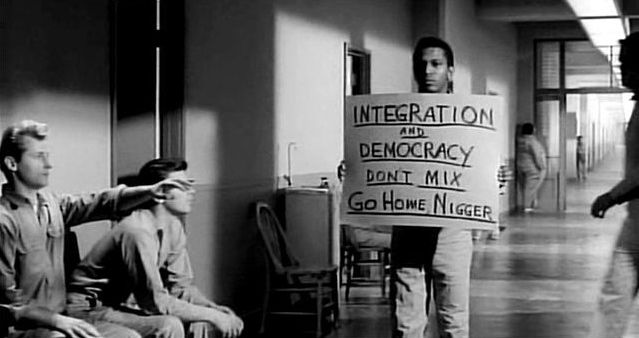
Once inside, the ambitious reporter tries to make sense out of the three witnesses to the murder: Stuart (Best), a former soldier brainwashed by the Koreans into communism and then branded a traitor; Trent (Rhodes), an African American who imagines himself as a Ku Klux Klan member after a horrible time as one of the first black students in a segregated college; and Boden (Evans), a nuclear scientist whose guilty conscience regressed him to the mental state of a child.
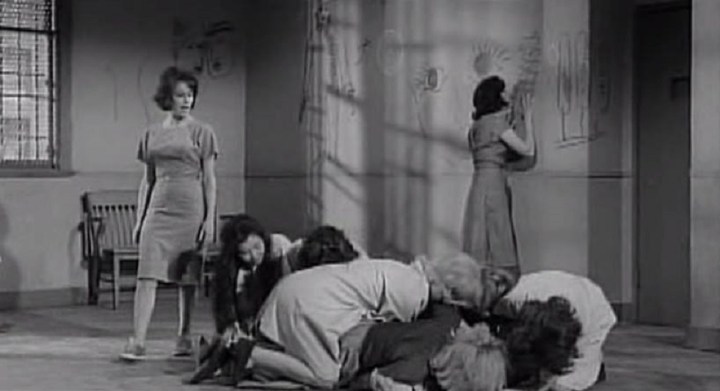
Interestingly, while the men’s ward has patients with a variety of fascinating problems, all the female patients suffer from the same affliction: zombieism nymphomania.
With unreliable witnesses, dire circumstances and an opera singing “sidekick,” will Barrett solve the murder and win his prize? Or will he lose his mind, his girl and his career trying?
“Your guess is as good as mine, ghost-and/or-racist-guy!”
We loved Shock Corridor despite the fact that it features one of the worst reporters in the history of reporting. Seriously, each one of the stories he encounters from the patients he interviews is easily as interesting and important as the story he is chasing, but he is too focused on his goal to see it.
Any personal history which led to this scenario would be Pulitzer worthy in our book
The voice-over is very noiry, which we always enjoy, although we did feel like it made the movie a bit “tell, don’t show” at times. Still, we loved the dream sequences and how we could see what went on in the characters’ heads. We also loved the WTF choreography to Cathy’s striptease, the rainy corridor, and the backstories of all the patients. And we were glad that the horrible, horrible rape scene was portrayed as a nightmare rather than a dream…
Though while we appreciate the aesthetics of such a scene, we are always left wondering who are the poor people tasked with cleaning up after?
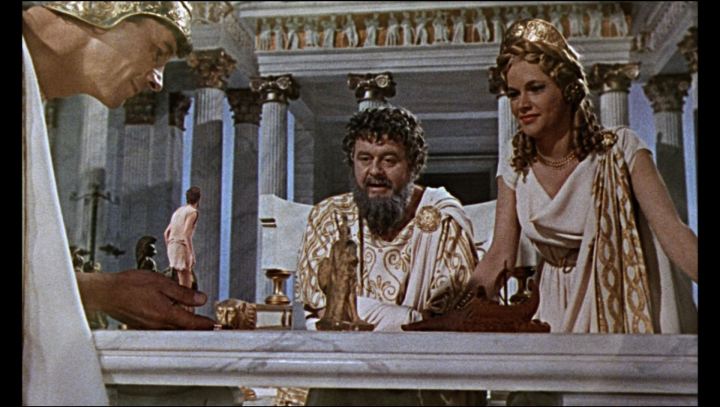
Zeus (MacGinnis) is throwing out prophecies to anyone who will listen, and as one would expect, some of them lead to murder. Pelias (Wilmer) decides to slaughter the entire royal family of Thessaly as its throne is his “destiny,” but one tiny baby escapes. Also, during the slaughter, Pelias manages to desecrate the temple of Hera, which pisses off the goddess, who vows to protect baby Jason (Armstrong. Well, once he grows up, that is).
Years later, Jason saves Pelias from drowning but the latter realises who his saviour is. When learning that Jason is interested in travelling to find the mythical Golden Fleece, Pelias sees an easy way to get rid of our hero, and he even sends his own son Acastus (Raymond) to make sure Jason fails. The gods offer their help as well, and Jason gathers a strong and brave crew and goes on one of the most epic journeys ever put on tape.
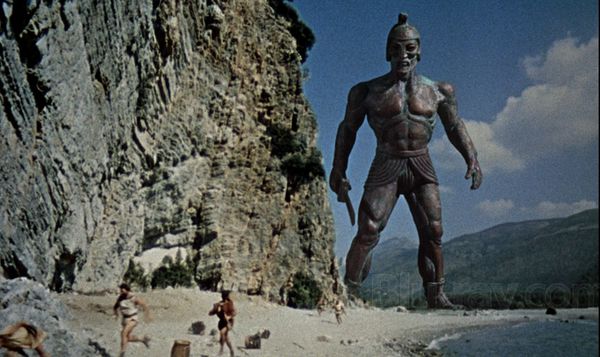
Among their many obstacles: Ridiculously Ripped Metal Man™
Jason and his crew of Argonauts (named for the ship on which they travel) face many dangers, such as living statues, harpies, evil oceans, Triton himself (though benevolent in this case), traitors, love interests, Hydra, and fighting skeletons.
“That’s the most foul, cruel, and bad tempered rodent you ever set eyes on!”
We went into Jason and the Argonauts fully expecting a documentary about a bunch of people, possibly led by a “Jason,” going into Argos for an epic shopping spree, and boy were we disappointed!
We were really looking forward to the fight against Agros’ own Scary Lamp Shade Lady™
Despite our initial disappointment with the subject matter, we ended up really enjoying the squabbling Greek gods, the stop-motion special effects, the harpies and the skeleton army (we want one for Christmas if anyone’s feeling generous). It’s a fabulous epic in glorious Eastman color and a must for any fan of Ray Harryhausen. Or mythology.
Please? Just a tiny little skeleton army? We promise to take good care of it and only use it to fight evil. And slightly annoying people who get on our nerves.
Hello, gentle reader. You may be sad and confused about the lack of recent updates, and our radio silence on social media, and we do not blame you. However, we can explain.
At the beginning of the Easter break, a holiday in Norway traditionally celebrated with cabin trips (the more primitive the cabin, the better), skiing, oranges and crime books, Sister the Youngest went against all that is holy and opted instead for a yoga retreat in India.
Clearly, Jesus disapproved (he agrees that the best way to commemorate his death is by reading Nordic Noir books about serial killers) and punished her by cancelling her flight back home. So now she’s stuck in Goa for an extra few days and as such is not only unable to watch movies, but also tweet about them. Which means Sister the Oldest cannot be arsed writing blog entries until her younger and more technically savvy partner in crime is back to tweet about them.
TL,DR: Sister the Youngest chose yoga over serial killers, Jesus didn’t like it, she’s stuck in India which means no more blog entries until next weekend.
We’ll be back soon! Thank you all for your patience. We love you dearly.
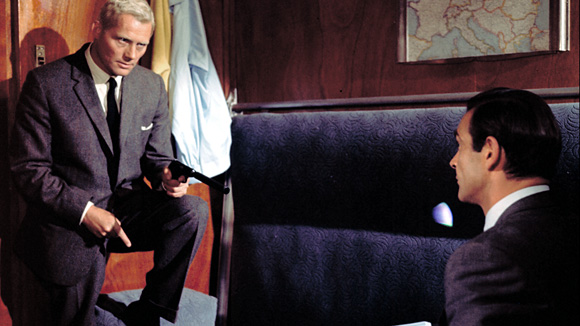
SPECTRE are angry with Bond (Connery) for doing his job and killing Dr No in the last movie. Rude. They decide to take revenge by killing him, but first seducing him to get some sort of plot device. So they send Tatiana Romanova (Bianchi) to do the latter and Donald Grant (Shaw) to do the former.
Of course, Romanova instantly falls for the irresistable (and slightly rapey) Bond, and she betrays everything she has been brought up to believe in for that sweet, sweet D. Grant is not so lucky.
Given five more minutes, Bond would have bedded this guy as well. The signals are clearly there.
Plots thicken, gadgets are used, people are betrayed and double-crossed, enemies are slain and cats are cuddled. It’s everything you’d expect from a James Bond movie, but not everything has aged well.
We’re not just talking about the incessant smoking, although you’d have a hard time getting that approved now
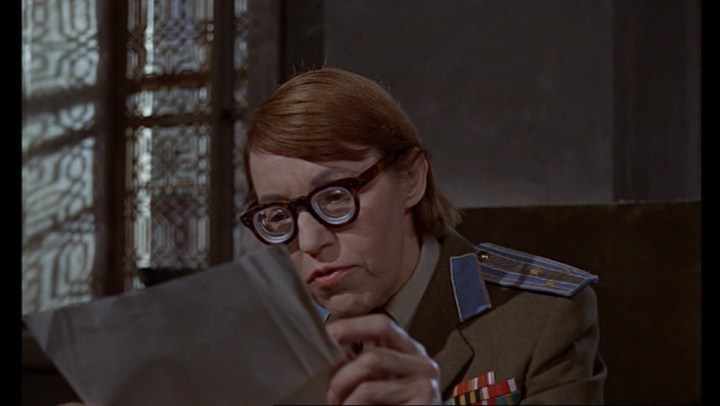
Let’s start with the things we liked about this movie. We loved the cat, Klebb (and her glasses), all the gadgets, Miss Moneypenny (who doesn’t love her?), the furniture, the helicopter shoot-out and the action in general. All of that was amazing and fun.
However, there are so many things that are questionable. From Romanova’s complete surrender after one encounter with the charsmatic spy, to the (completely gratuitous) gypsy girls “gifted” him to have his way with, the portrayal of women reads like an immature boy’s fantasy. One who’s never met an actual real-life woman and certainly never had a relationship.
“Let’s take you girls on a test drive to decide who is worthy of marrying the prince”
Now, we expect a bit of casual sexism in our old-timey action movies, and we’ve seen the Bond films years ago so we should have remembered, but this was just ridiculous. It’s so over the top that it almost seems like a parody, but a parody of itself. A very strange viewing experience indeed. And while it isn’t a movie we particularly liked, it is certainly an interesting one to view in 2019. In a strange way we’re actually looking forward to the rest.
And this is how we’ll drink our wine watching them.
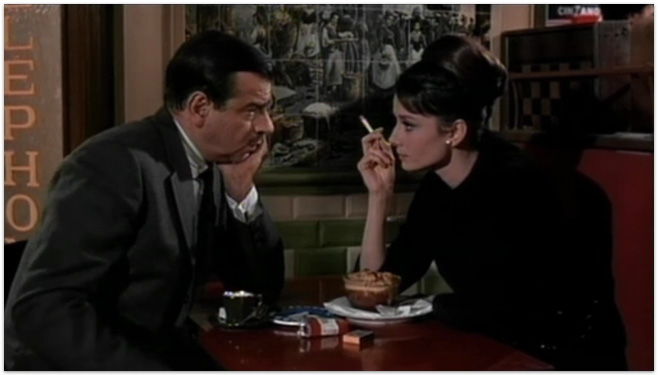
Reggie Lampert (Hepburn) is on a skiing holiday when she decides she wants a divorce from her husband. She is spared the paper work when he turns up dead, leaving her nothing but a letter and a stripped apartment.
Reggie had the foresight to pack her couture funeral outfit so at least she was appropriately dressed for the occasion
Peter Joshua (Grant), a charmer she met on holiday, tries to help her adjust to her newly widowed life. Meanwhile, CIA agent Hamilton Bartholomew (Matthau) warns her that she is in danger from her late husband’s WWII buddies who thinks she’s concealing a fortune they stole during the war.
We’re torn on the villains. On the one hand, they kidnap an innocent kid to force Reggie’s cooperation, which is a serious faux pas. On the other hand however, they actually treat him quite well and keep their word. So, all in all, about a 5 on the villain-scale.
This is how you do a spy thriller/screwball comedy! There’s twist after twist after twist, and the movie is dripping with the charm of the lead actors and the fantastic supporting actors.
They have so much chemistry we didn’t even consider the dodgy 25 year age gap
Charade is one of those movies you just have to see for yourself and no review can do it justice. Suffice to say, we loved the characters, the intro, the banter, the funeral, all the eating and the costumes by Givenchy.
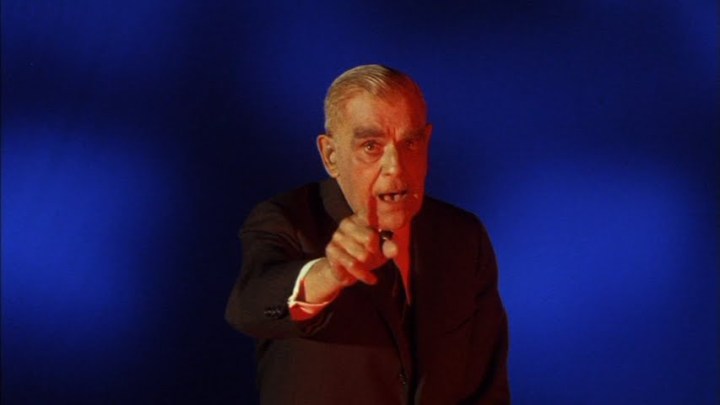
Black Sabbath consists of three separate stories, all tied together by host Boris Karloff, which are freely adapted from classic tales by Tolstoy, Maupassant and Chekhov. The order they appear in depends on which version of the movie you watch (there are at least two), so we will present them according to the version we watched.
We’re currently working on a plan on how to manage to live in all houses featured in this gorgeous movie
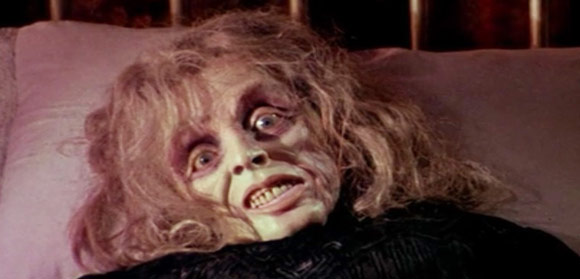
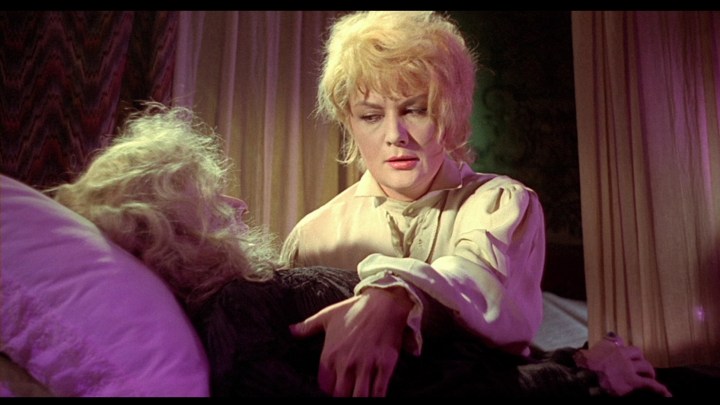
The first story, “The Drop of Water,” is by Anton Chekhov. An elderly medium has died while in a trance during a seance, and when preparing her body for burial, nurse Helen Chester (Pierreux) steals a ring from the deceased. Big mistake.
Given the scepticism with which she views the dead woman, we suspect she knew she would be haunted anyway so she just went for it.
Guy de Maupassant’s contribution is “The Telephone” (or is it? There is some debate as to whether Maupassant ever wrote anything like this). Rosy (Mercier) is at home in her apartment (another place we’re moving into as soon as the payment goes through) when she starts receiving strange phone calls from her former pimp. Instead of calling the police (who she probably doesn’t trust given her profession), she calls old friend Mary (Alfonsi) for help. Big mistake.
“Darling! Calm your nerves with this drink I mixed you with my gloved hands, leave the phone off the hook and let’s pretend we never had a falling out in the past.”
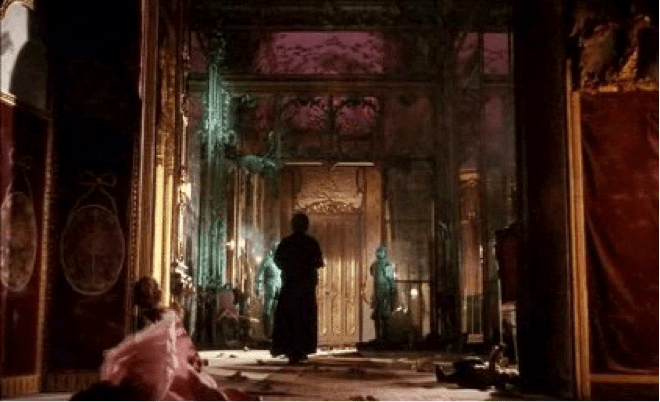
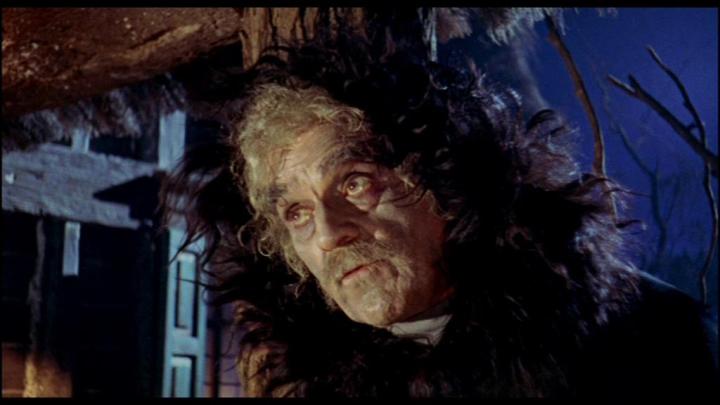
The third and final story, “The Wurdulak,” is credited to Aleksei Tolstoy (not Leo, mind you). In 19th century Russia, rider Vladimir D’Urfe (Damon) finds a backstabbed body on a horse. He brings him to the nearest house to find that the body belongs to a Turkish bandit believed to be a Wurdulak. A Wurdulak, the farmers explain, is a vampire who feeds on his or her loved ones.
Farmer or not, Sdenka takes the time to put on a full face of make-up every day. You know, just in case a single nobleman happens to stop by the house with a body he found on the way, only to fall madly in love with her.
The father of the family, Gorca (Karloff), has been in pursuit of the Wurdulak and has given strict orders not to let him in the house if he is gone for too long as he will have been turned. When he returns too late, with a significant personality change, the family naturally lock him out and take every precaution to stay safe while plotting how to kill him.
Just kidding! They let him in, let him play with his grandchild, follow his commands, go to bed without locking any doors and are then flabbergasted when it turns out he tries to drink their blood. Then again, this is a family who implicitly trusts an unknown Eastern European Count called Vlad while in the middle of a vampire crisis.
Not to victim blame, but is it really a good idea to drink yourself to sleep in the living room when you suspect your dad, roaming the same house, is a vampire..?
We’re suckers for horror anthologies and Mario Bava, so there’s really nothing here we didn’t love. The humour between segments is silly and fun, and the entire film is very aesthetically pleasing, as giallo movies tend to be. A lot of this also feels oddly modern, as if it could have been made today but by someone trying to make it look older (think Garth Marenghi’s Darkplace or “The Devil of Christmas” episode of Inside No. 9). We loved all the apartments (as stated, we’re moving into all of them), the colours, the creepy child and the ghost. Love, love, love this!
Boris Karloff wants YOU to join us in celebrating Black Sabbath
Meet Billy (Courtenay). Billy lives with his parents and works at an undertakers’. Billy juggles girlfriends/fiancées Barbara (Fraser) and Rita (Watts) while harbouring a secret crush on free spirit and original manic pixie dream girl Liz (Christie). He also lies through his teeth.
Why on earth this lovely, innocent girl would let this man bring her to a cemetery is beyond us. Here, she clearly only has a few minutes left to live.
Billy has an imaginary world where he is not only king, but pretty much every inhabitant, at least any person of note. This kingdom of Ambrosia is his escape from his boring, average life, as well as an outlet for his creativity. And a source of frustration for his fed up family.
Who hasn’t dreamt of being a hero, loved and admired by men and women alike?
Sexually frustrated ladies man, compulsive liar, rebellious teen and part time sociopath, Billy’s fantasies often end in him gunning down everyone around him, especially those who inconvenience him. He lies to protect himself and to seem more interesting. He’s not too good with criticism or confrontation, and he dreams of a more exciting life which he is too scared to actually pursue.
We get it, Billy. It’s much easier to be the fictional ruler of Ambrosia than to actually go out and take chances with your life, risking defeat. Go Liz!
Oh, did we mention he also tries to drug one his girlfriends to have sex with her? Which definitely ranks in the top three of “the worst thing that can happen when a man brings a woman to a cemetery”-list.
Lucky for her he bought bad drugs. And also didn’t know which part of her to suck…
You can probably tell that we’re not quite sold on the character of Billy… In fact, we found him somewhat sinister at times. However, there are still a lot of things to enjoy about this movie. As always, we loved Tom Courtenay’s face(s), we loved the banter in the funeral home, the twist dancing, and the flashes between reality and Billy’s fantasy world.
For all his faults, it’s hard to completely hate a man who is so overly dramatic and extra.
We also liked Liz. Where Billy had only his dreams, Liz had the guts and the follow-through. He talked a good game, but she actually went out and did things with her life. The only thing that confused us about her was why she would be interested in someone like him.
“Shit! I just realized I’m Julie Motherfucking Christie! So long, sucker!”
It’s an interesting movie and well worth watching. Apart from his treatment of the women in his life (this goes for girlfriends as well as his mother and grandmother), Billy is relatable in a lot of ways. Frustrated with his mundane working class existence, he retreats into his fantasy world where he can actually achieve and experience things. We can understand that. But like the demolition work going on all around him, he has a destructive streak, and it’s a dark one…
Guido Anselmi (Mastroianni) is a famous film director in the middle of an existential crisis and artistic drought. His new project is going nowhere and neither is his love life.
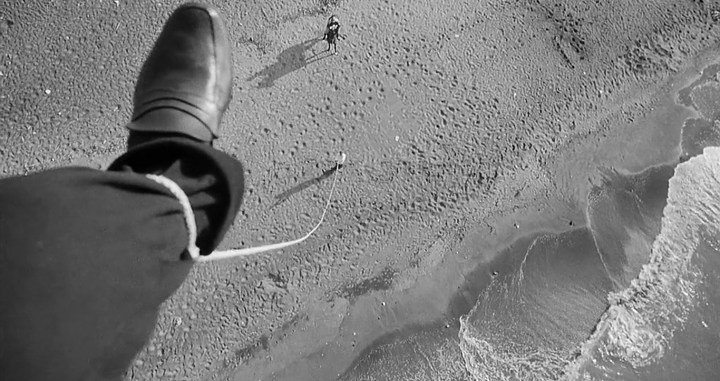
His flying lessons are going swimmingly however, so he’s got that going for him, which is nice
Between balancing his mistress (Milo), wife (Aimée), producers, set designers, and potential starring actors, the director is buckling and cannot get himself to make any decisions about his next movie.
“I need hands! Lots of hands! And frozen faces! And a certain Bergman quality to it all. Or, on second thought, I need a space ship and a bunch of aliens.”
When confronted by the reality of his life (and his affair), he dreams himself away to a fantasy land where every woman he’s ever met worships the ground he walks on, get along with each other, and (more or less) voluntarily remove themselves from his view when they reach an undesirable age.
And if they fail to comply, there’s always the whip
Can religion help? The cardinal in the sauna? The dream woman he’s seen as the star of his movie? His (patient) wife, Luisa? Barbara Steele? The memory of his first sexually charged encounter as a child? In short, will Guido get his groove back?
“Looking for fun and feeling groovy Ba da-da da-da da-da, feeling groovy”
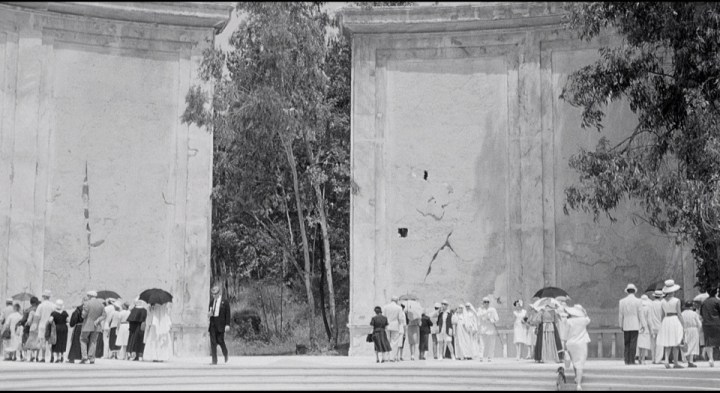
81⁄2 is gorgeous to look at, and very deservedly won an Oscar for best costume design. The architecture is also outstanding, and there are loads of shots of small people in huge structures throughout the film.
Huge crumbling structures littered with tiny insignificant people. Or something.
We’re still in love with Barbara Steele and her face, and we were intrigued by the opening (which reminded us of Bergman – our doggo would have loved it!), especially the arms on the bus and the frozen people. We loved the voice-over, the dream/memory-sequences, the sauna, and the dance in the end, which also brought us back to Bergman.
“Come on, shake your body baby, do the conga, I know you can’t control yourself any longer” – Ingmar Bergman, 1957























 1000 Films Blog
_Hydra_fight.png)