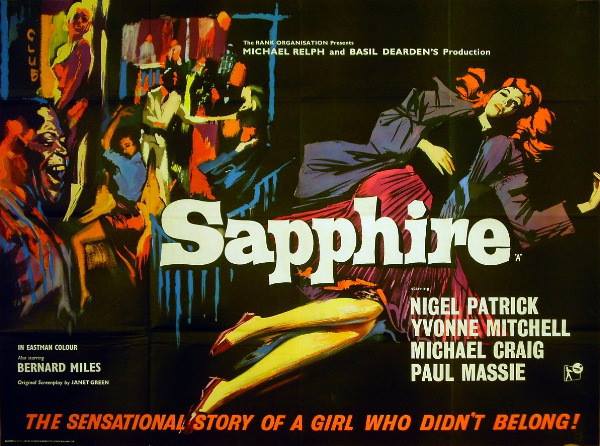
A young woman is found murdered in Hampstead Heath with nothing to identify her but a monogrammed handkerchief. Investigators Hazard (Patrick) and Learoyd (Craig) identify her as Sapphire Robbins and start trying to find the truth behind her death.
“Fill up on pipe tobacco! We shall get to the bottom of this!”
They track down her devastated boyfriend, David Harris (Massie), and her big brother Dr Robbins (Cameron), but surprises keep coming. First off, the autopsy reveals that Sapphire was pregnant at the time of her death, and the investigators are then baffled when her brother comes in as he is black and Sapphire appeared to be white.
“…and you’re absolutely sure none of you were adopted? And that you’re not using the word ‘brother’ in a wider sense..?”
These new revelations lead to an investigation which encounters racism and prejudice, both from the white and black communities and even from within as not all investigators manage to stay neutral. But was her ethnic background motivation for murder? And if so, who was enraged enough by her “transition” from black to white to murder the young girl?
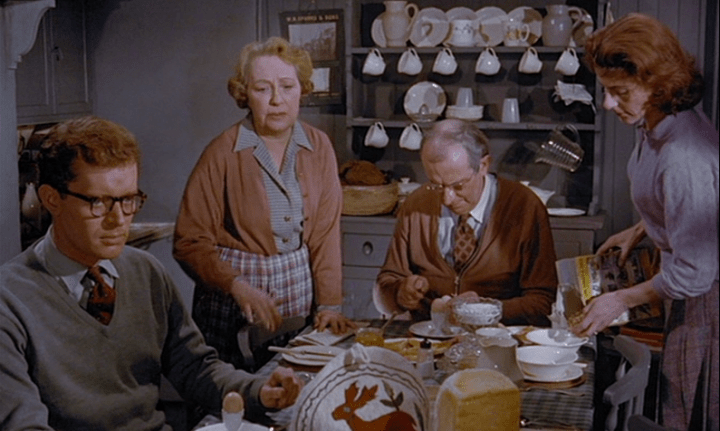
Look at this happy family she was about to marry into! There’s no way anyone in this blissful household would ever kill anyone.
We love a good murder mystery, and we love it even more when it deals with real political and social issues. Sapphire may be from 1959 and deal with racism and prejudice in the wake of the first waves of Commonwealth immigration in Britain, but there are parallels to be drawn to recent debates considering Brexit.
We’re sure there are lots of idiots out there who would love it if all non-whites had stayed in their own clubs like this one…
We were also reminded of Sarah Jane although her and Sapphire’s stories are different and so are their societies. A great mystery movie with real social and political commentary, we can definitely recommend this.
What we learned: School teachers are very respectable and a bit above the rest. Thank you! Also, racism sucks and we need to stop this shit already!
A brawl (of the murderous kind) in a saloon leads to the arrest of Joe Burdette (Akins), criminal brother of a local hot shot rancher. As many forces are looking to get Joe out, sheriff John T. Chance (Wayne) enlists the help of former deputy Dude (Martin) to keep him safely locked away, despite Dude’s alcohol problem and the fact that he was one of the reasons for the brawl in the first place.
Together with comic relief Stumpy (Brennan) they must defend the jail, the sheriff’s office and the town, something which proves difficult when Joe’s henchmen and Big Brother Nathan (Russell) get involved. Reinforcements (reluctantly) arrive in the form of young gunslinger Colorado Ryan (Nelson) and, in another way, poker player Feathers (Dickinson).
“Age gap? 24 years is no age gap! My last boyfirend was 78.”
How will this ragtag team of alcoholics, kids, oldies, cripples and (gasp!) women manage to survive until the Marshall comes to pick up the condemned prisoner? Why, with song and explosions, of course!
Rio Bravo has everything you could ever hope for in a western – rugged men; feisty women; fancy, semi-colour-coded hats; shootouts; explosions; horses; clearly defined bad guys and romance.
One man learns that there exists a different kind of romance than that between a man and his horse
We loved the silent scene at the start, the tension throughout, the character names (Chance, Stumpy, Dude and Feathers – are we sure this isn’t a cartoon?) and Angie Dickinson. Clocking in at well over two hours, this movie just flies by and was great family entertainment when we sat down to watch it with our parents and brother on May 17 – the Norwegian national day. After a day of wholesome fun with nephew and niece, what’s better than watching a bunch of manly, yet sensitive, men kill each other?
“Hear that, boys? The crowd is ready for an encore!”
What we learned: Wild West men were surprisingly sensitive and in touch with their feelings. Also, some will go to great lengths to ensure justice is served.
On a busy beach, aspiring actress/model Lora Meredith (Turner) is looking for her daughter. She finds the girl in the company of an African-American lady, Annie Johnson (Moore), who she hires as a live-in babysitter after learning she and her daughter are homeless.
Ah – the good old days when you could invite random people you met at the beach to come live in your home and it didn’t end in murder-robbery but lifelong friendship.
Lora goes to see a theatrical agent, Allen Loomis (Alda), who basically tells her that to succeed she must prostitute herself, something she’s not yet quite desperate enough to do. However, she gets a break when a playwright likes her honest critique of his play, and is soon catapulted to stardom, much to the chagrin of love interest Steve Archer (Gavin) who’d rather have her be a stay-at-home mom and his wife.
“Why would you possibly desire to have your own career and make your own money when you can just shack up with me? I forbid it!”
Lora and Annie stay friends for the next 10+ years, as the former finds success and the latter eventually gets paid for being her maid. Their daughters grow up, but while Lora’s daughter Susie (Dee) is a well-adjusted blonde with a private school education, Annie’s daughter Sarah Jane (Kohner) is light enough to pass for white and develops some serious identity issues.
“This is America! There’s no way anyone will treat you differently just because they find out that you are black!”
As is tradition, we loved this Sirk film more than we thought we would. Sarah Jane, though an atrocious dancer and slightly annoying, is a tragically intriguing character, Annie is just the best, Susie is pluckily charming, and Lora is self-centred yet understandably ambitious. And there are also some men there, more often than not screwing up the women’s lives.
There are also gorgeous costumes and sunglasses to die for
Lora and Annie’s friendship seems to be fairly mutual even though Annie works for Lora, but we learn that Lora knows absolutely nothing about her friend’s life outside of the house, which is very telling.
“Friends? What friends? But you cease to exist when I leave the house, don’t you?”
Imitation of Life is about friendship and family and heritage and sexism and racism and authority. And probably lots of other things as well. We loved it, and we’re now off to plan our funerals. Those things are not to be left to chance.
What we learned: If you love someone, apparently it gives you the right to decide for them. And control them. And be petulant if they make their own decisions. Also, racism sucks!
In those days Caesar Augustus declared that everyone throughout the empire should be enrolled in the tax lists. This first enrollment occurred when Quirinius governed Syria. Everyone went to their own cities to be enrolled. Since Joseph belonged to David’s house and family line, he went up from the city of Nazareth in Galilee to David’s city, called Bethlehem, in Judea.
“Uh, yeah, I’m here to register..? Yeah, with my wife. She’s about to give birth. No, no, I’m totally the father. Joseph. J-O-S-E-P-H. Know any good hotels hereabouts..?”
We all know that story. However, this is not that story, but set in the same time. In 26 A.D. (probably not called that at the time, to be fair) Judah Ben-Hur (Heston) was a Judean prince and childhood friend of newly returned Roman tribune Messala (Boyd). Despite the intense homoeroticism of their interactions, the two have a falling out over political issues (one wants the other to sell out his people. That sort of thing).
After an accident involving a Roman procession and rooftop tiles, Messala finally has an excuse to arrest the Ben-Hur family and send Judah away to the galleys. His mother Miriam (Scott) and sister Tirzah (O’Donnell) are thrown in a dungeon, the family home is raided, and Judah is sent off.
“I just thought I’d take a gap year. You know, to travel, sunbathe, grow my beard and learn about new cultures.”
Strange destiny eventually brings the eponymous hero back to his hometown, now as an adopted Roman with a new fortune, new status in the Roman Empire, and excellent horse racing skills. His hatred for Messala has not diminished though, despite an encounter with Jesus, and he is also out for revenge and for the salvation of his family…
We all know the best way to really humiliate someone is to beat them at their own game. And also kill them.
Sometimes it’s hard to get in the right mood to watch an almost 4 hour epic from the ’50s, and we must admit we didn’t rush to pick this one up despite all we’ve heard of it. However, we’re glad we did as it lives up to its reputation (despite Heston’s occasional overacting). We loved the Roman perspective on Jesus, the (possibly unintended) homoeroticism between Judah and Messala, the sheikh, the general epicness of the feature, and the fact that we never actually see or hear Jesus.
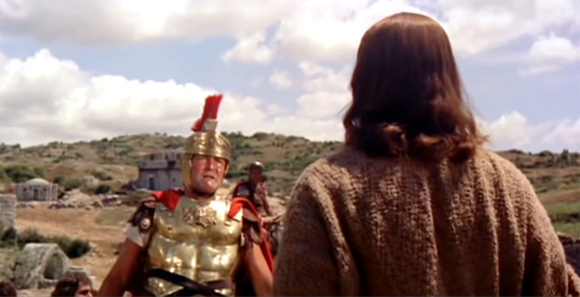
All we learn is that he has fabulous hair and can hypnotise Roman soldiers.
We also loved the Roman uniforms, but mainly because they reminded us so much of Asterix that we spent the entire film quoting Asterix chez les Bretons (1986) and had to pull some strings to get our hands on the Norwegian dubbed version (AKA the only version worth watching) of our childhood favourite. So thank you, Kristian!
“Er’re XVI her óg? Da har vi gått feil igjen, da.” – Classic!
It’s easy to think Ben-Hur is a movie about horse racing (it’s by far the most famous scene), but it is really an epic saga of revenge and redemption with Jesus hanging out in the background. And a badass chariot racing scene.
“Det skjærer meg i hjertet. Hører du, dekurion? Det skjærer meg i hjertet!” One for all Norwegian Asterix-fans. You’re welcome, people who don’t speak Norwegian and/or have no point of reference for this.
Mr & Mrs Vargas (Heston and Leigh, respectively) pass the border from Mexico to the USA only to have a car blow up in front of them. Mike Vargas, a Mexican agent, decides to look into it, while American-born Susan Vargas stupidly decides to follow a random dude back across the border.
She might make stupid decisions, but she’s got spunk and is intimidated by no man!
Vargas is joined by US police officers Hank Quinlan (Welles) and his partner Pete Menzies (Calleia) and gets to tag along on their investigation. However, when Vargas witnesses Quinlan planting evidence in the apartment of their main suspect, he accuses the veteran police captain and starts to suspect that he, perhaps with his partner, has been operating this way for years.
“No, no, you silly Mexican police person! This dynamite was always on the premises. It’s just racist dynamite and will only show up if handled by an American.” “Then how did the Mexican suspect handle it?” “Uh, um, he must be half American or something…”
Quinlan denies any wrongdoing and starts to work to discredit Vargas, or get rid of him altogether. Meanwhile “Uncle” Joe Grandi (Tamiroff) is also putting pressure on Quinlan since Vargas has been investigating Grandi’s brother. To keep her safe, Susan in moved to a remote motel where she finds herself the sole guest only joined by a very strange manager.
Touch of Evil is really very tense, especially Susan’s storyline. We were genuinely worried about her, no matter how spunky and independent she was, and she had some really horrible scenes. We loved the film though – we loved Susan, the Mexican being the good-guy protagonist (even if it was Charlton Heston in brownface), the total corruptedness of Quinlan and the naïve hero worshiping of Menzies.
Also, there’s a brothel run by the fabulous Marlene Dietrich, which in itself is reason enough to watch this movie.
Welles’ version was reedited and released as a very different movie than the one he envisioned. Since its 1958 debut, two other cuts have been released. We’re pretty sure the one we watched was the 1998 version cut together based on Orson Welles’ notes (we base this on nothing other than runtime, as we didn’t check the DVD-case). Just so you know, in case some of you think this is very important to this informal review.
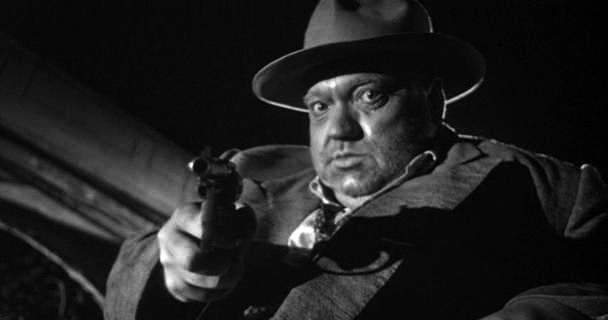
Put down the gun, Orson! We’ll watch your (probably) preferred version! We swear!
No matter which cut you go for, this is a great Noir with a fantastic opening shot (really – check it out!), a great ending, and some kind of a man. Great stuff!
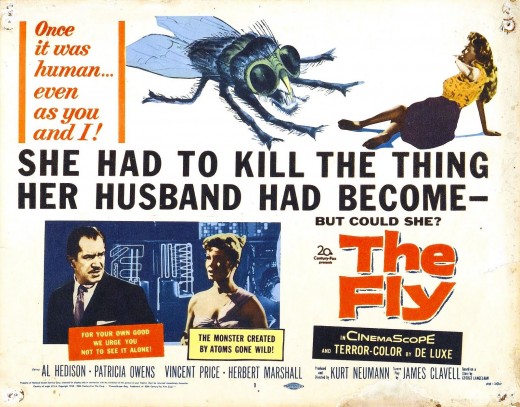
Starring: David Hedison, Patricia Owens, Vincent Price, Herbert Marshall, Torben Meyer
Year: 1958
Runtime: 1h 34min
So, first of all, we must apologize (once again) for the sporadicness (is that a word..? We’ll say it is.) of the posts lately. We’ve both been very busy with moving, redecorating, and having paying day jobs. Hopefully, the worst is now behind us, and we can get back to more regular updates. On the bright side, we bring you a real treat for Easter! The Fly!
Somewhere in Canada (the French part), Gaston (Meyer) is having a bad day. He thought he would just have another uneventful day janitoring, but instead he stumbles across the mutilated, crushed body of scientist André Delambre (Hedison) and witnesses Mrs Hélène Delambre (Owens) fleeing the crime scene. Probably not the day he was expecting.
No one runs like Gaston, no one gasps like Gaston, no one finds mutilated dead guys like Gaston…
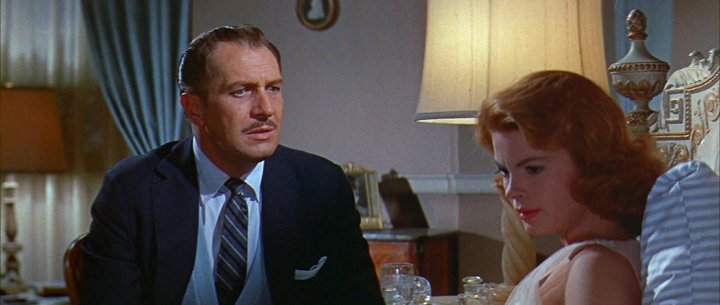
Hélène contacts her brother-in-law François (Price) and while there’s no doubt she killed her husband, she is rich and respected enough to be interrogated by the police in her own bedroom. After a few days of bedrest, with a strange new obsession with flies, she confides in her brother-in-law and recounts the events leading up to her husband’s fatal encounter with the hydraulic press.
“You’re not going to believe this, but in actual fact it was just like killing a fly! Though a bit more technically complicated. That press isn’t easy to operate.”
André, a scientist, had been testing out his new invention, a “disintegrator-integrator” with various results (including one that turns their cat into a disembodied meowing phantom). Not content with just transporting things and animals, he decided to test it on himself, as all slightly megalomaniac scientists are prone to do.
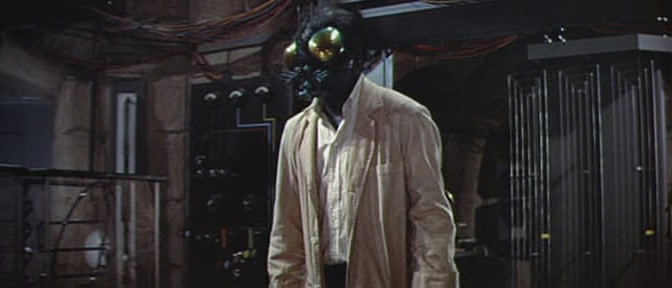
As every moviegoer/reader could have predicted, things went very, very wrong, and André’s DNA got mixed up with that of a housefly. Everything pretty much went downhill from there.
The Fly from 1958 has a very different approach than Cronenberg’s 1986 version, but we love them both. The title even feels like it might refer to different things in the two versions. This has more of a murder-mystery feel, and there’s less focus on the transformation, although that is still very much present.
We loved the flies buzzing around, the murder-mystery approach, and Vincent Price in all his glory. It’s a lovely, creepy horror film, and a must-see for every fan of the genre. Or of flies. We don’t judge.
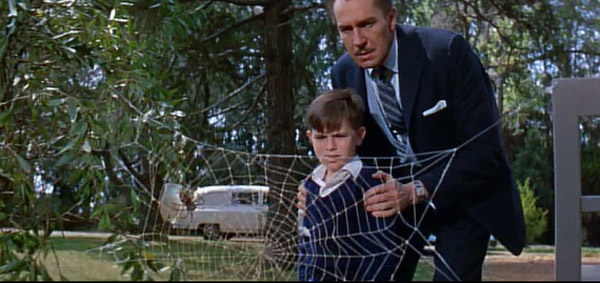
Or even fans of very thick spiderwebs. As we said – we don’t judge your fetish. You do you!
Starring: Zbigniew Cybulski, Ewa Krzyzewska, Waclaw Zastrzezynski, Adam Pawlikowski, Bogumil Kobiela (apologies for any spelling mistakes that may have occured)
Three guys with machine guns are lying in wait by a chapel. They kill two guys that come driving by, one of whom dies falling through a chapel door (and catching slightly on fire somehow). However, it turns out that the assassins have hit the wrong targets…
“There is more than one car on this road? How inconsiderate. They can blame themselves for getting killed.”
It’s the end of World War II in Poland, and the assassins, Maciek Chelmicki (Cybulski) and Andrzej (Pawlikowski) are after communist leader Szczuka (Zastrzezynski) who has recently returned to his home country. They decide to try again at local hotel Monopol, where Maciek takes a room and starts flirting with barmaid Krystyna (Krzyzewska).
As Maciek picks the best, most romantic, and most atmospheric spots for dates, he is naturally successful in his pursuit of Krystyna.
His newfound love, coupled with exposure to the grieving loved ones of his unintentional victims and the bodies of the dead men themselves, combine to change Maciek’s view of the world. He goes to his friend and superior officer Andrzej and tells him he doesn’t want to carry out this assassination. He wants to settle down with Krystyna and live in peace.
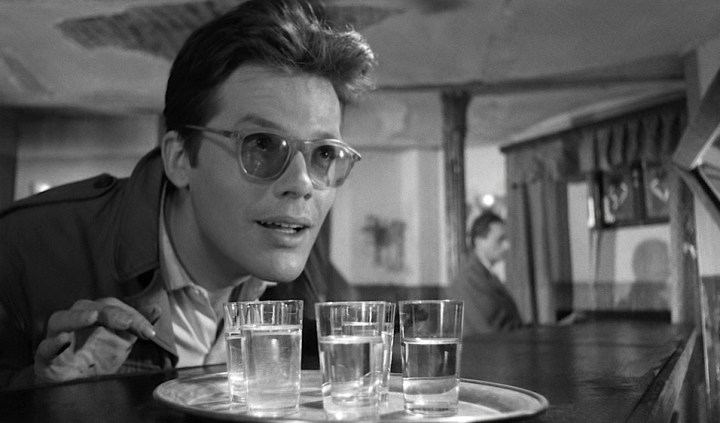
Just him, his girl, and loads of shots. What a life!
However, Andrzej is not sympathetic and tells Maciek backing out now will make him a traitor and that he’ll just have to tough it out. How will this all end?
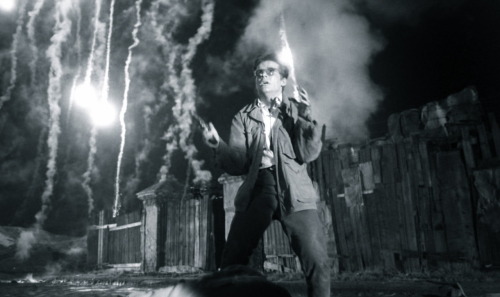
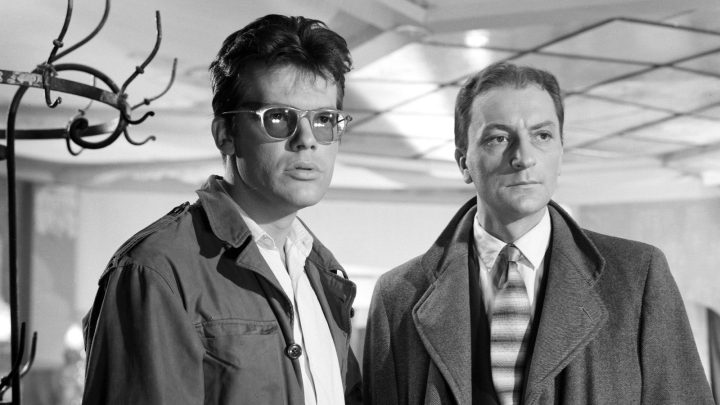
Ashes and Diamonds is the third installment in Wajda’s war trilogy, and the second one on the list after Kanal. We loved the part in the crypt and Maciek’s decidedly ’80s vibe (we think it’s the sunglasses he sports and how the shadows often give the illusion of a mullet).
The ultimate hipster – rocking a mullet before it was cool
Like its predecessor, this film is quite weird and somewhat unsettling at times, with damaged women acting as saviours for damaged men, and lots of religious symbolism. Also, we found the dancing in the end reminiscent of Bergman’s The Seventh Seal. We really enjoyed it, and at an opportune moment, we will go back and watch the first film in the trilogy, A Generation (1955) even though it didn’t make the list.
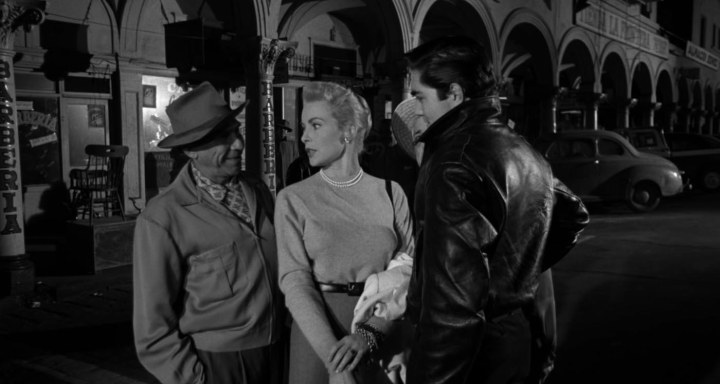
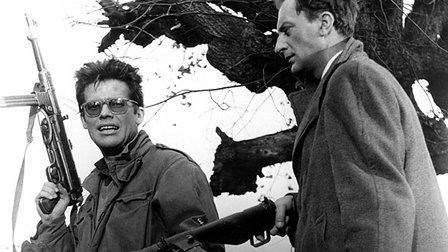
Seriously though – doesn’t this look like it could be a still from some 1980s cop movie..? The young, charming maverick paired up with the old, cranky, by-the-book veteran?
First off, we can only apologize for the sporadic updates lately. Sister the Youngest has bought herself her own apartment, so we’re in the middle of moving and painting and everything that comes with it. Unfortunately, that means that at the moment we have less time to watch and review movies. We’ll come back stronger once she’s all settled in her new place and Sister the Oldest can once again enjoy the tranquility of her own place… Ah… The silence…
That being said, we’ve reached a new year, and 1958 starts on a very uplifting note with the epic tale of the RMS Titanic.
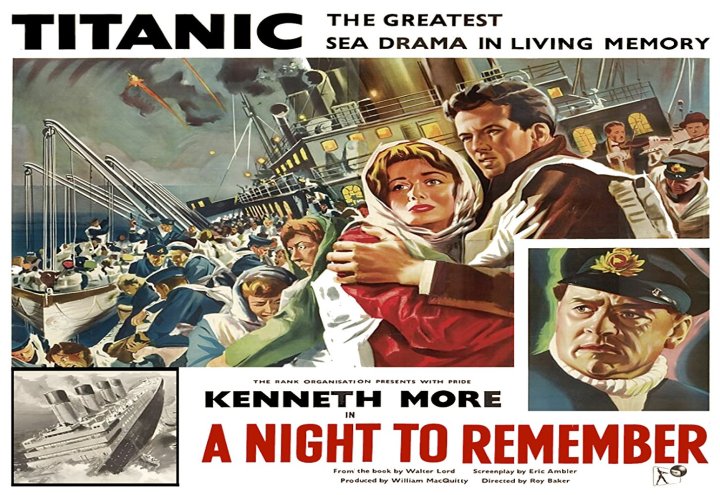
The year is 1912 and the Titanic, the largest, most unsinkable ship ever (in 1912), is on its first trip from Southampton to New York City. The passenger liner carries 2,224 souls from all walks of life, and we get to meet several of them, most notably Second Officer Lightoller (More). It is shaping up to be a wonderful voyage despite a few ice berg warnings.
Them icebergs have better get out of the way, ’cause here we come! Whoot whoot!
The Titanic is not the only ship out there – the Californian and the Carpathia are both sailing in the same waters, and they exchange warnings about the ice in the area. They also warn the larger ship, but because every passenger on the Titanic is eager to send messages home to brag about their whereabouts, the radio operator is too busy sending social calls to properly receive the warnings.
“I simply MUST send a message home telling everyone we met a Second Officer! My friends will swoon!”
Now, we all know how this ended. The ship sank, there were nowhere near enough lifeboats (thank you hubris and lax regulations), and around 1500 people died. Still, despite the awful ending, the film is really enjoyable and we loved it. We’ve been morbidly fascinated with the story ever since our grandmother (a.k.a. “Besta”) would sing sad songs about it when we were kids, so anything relating to this tragedy is eagerly consumed by both sisters.
We were impressed with the effects, which hold up really well even in this day and age.
A Night to Remember tells the tragic story of the maiden voyage of the ill-fated Titanic far more effectively (in our opinion) than James Cameron’s 1997 film. We loved that rather than to focus on just a couple of people, we got to follow a whole range of them, such as crew members, first class, second class and steerage passengers.
We’re pretty sure Cameron stole some characters from this film, such as Plucky New-Moneyed American Woman™ (above) and Lively Irish Dancing Steerage Passengers™ (not pictured)
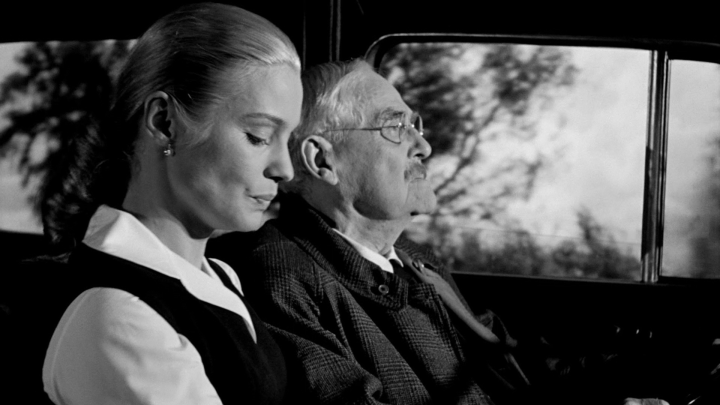
Dr Isak Borg (Sjöström) has one son, one daughter-in-law, one mum, one housekeeper, and one dead wife. He is a disillusioned man with very creepy dreams. He also has an honorary degree, which he will travel to Lund to accept. After a last minute decision not to fly, he goes on a road trip with daughter-in-law Marianne (Thulin) and various other passengers they pick up on the way.
She’s thrilled to be stuck in a car with him for several hours
The two stop at his childhood summer home where Marianne goes swimming while Isak has flashbacks of his summers there, and of his cousin Sara (Andersson) who he was to marry. That was, until she went for his brother Sigfrid instead and left Isak emotionally cold and detached.
“I couldn’t help myself. He assaulted me, and you know what the Bible says about those situations.”
After reliving the emotional trauma from his youth, Isak and Marianne pick up a bunch of hitchhikers mirroring his various relationships, and pay a visit to his cold, distant mother before arriving at the home of his equally cold and distant son. We see a pattern.
Modern day Sara seemed more fun than olden day Sara, to be honest
We had actually never seen this before, probably because it seemed a bit too “drama,” but we ended up loving it. Wild Strawberries is very engaging, sad, melancholy, funny and at time unsettling.
Such as this creepy guy, shown completely without context
Isak is a tragic figure who has cut himself off from all human emotion since his childhood sweetheart left him and his wife cheated on him and later died. His relationship with his housekeeper closely resembles a marriage though, and the two seem to be fairly happy together despite their bickering.
Our favourite character and everything we aspire to be
The second Ingmar Bergman entry on the list taught us that our dog has a more refined taste in movies than us. He was completely riveted by this – especially the dream sequence which he paid full attention. Then again, he is technically 77 years old, so he probably related more to the main character than we did. Either way, our conclusion is that Bergman appeals to older dogs and (somewhat) younger humans alike. It’s a win-win!
Older dogs and younger humans. It’s a beautiful thing.
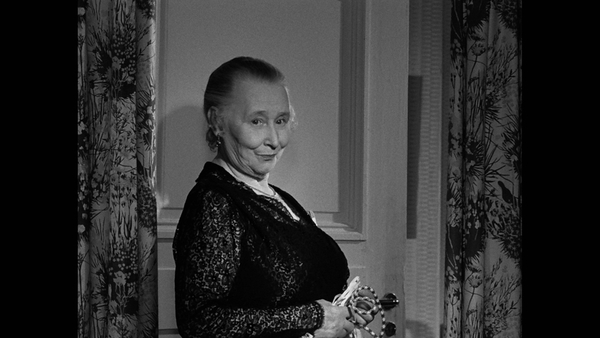
General Washizu (Mifune) and General Miki (Chiaki) are on their way to Spider’s Web Castle to have their excellent work recognized by Lord Tsuzuki (Tachikawa) when they get lost in Spider’s Web forest. They run into a magical old lady spinning her own web while singing depressing songs (Naniwa). She tells them that Washizu will be named Lord of the Northern garrison and Miki will take over his old post. She also predicts that eventually Washizu will become Lord of the Castle, succeeded by Miki’s son.
As systems of government go, it’s a step up from women lying in ponds distributing swords, but it’s still far removed from general elections.
While Washizu is content enough in his new, improved position, his wife Asaji (Yamada) becomes obsessed with the last part of the prophecy and keeps spurring him on to make it a reality. Asaji’s ambition combined with her husband’s skills as a warrior mean that soon the two start clearing the path for their social climbing, killing and manipulating their way to the top.
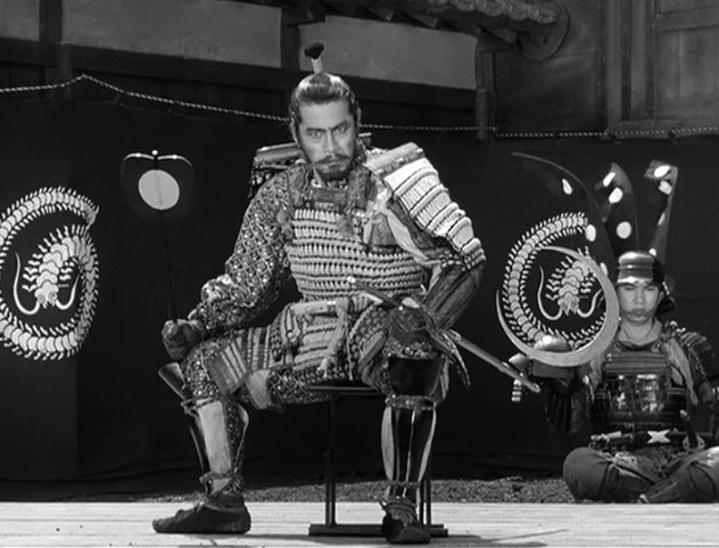
“I admit it. I only want to be Lord because samurai armour is very cumbersome when you’re getting up off floors, and I ain’t getting any younger. Now I get a chair!”
However, as the bodies start piling up, both Washizus descend into madness, and keeping their new status proves decidedly harder than getting it in the first place.
Throne of Blood is Kurosawa’s adaptation of Shakespeare’s Macbeth, and despite it being set in a very different culture and time, it is a very true adaptation. Mifune is amazing as feudal Japanese Macbeth, and Yamada is deliciously insane and creepy as his ambitious and ruthless wife.
Just doing some hovering in the background in the blood stained room. Nothing sinister going on here.
We love us some samurai, some murder and some madness, so naturally we loved this. It is grotesque and creepy as well as engaging and exciting. As all Kurosawa, it is also beautifully shot and gorgeous to look at. It’s a Shakespeare tragedy, so from the very beginning you have some idea of where this is going, but watching it all unfold is still a fantastic ride.
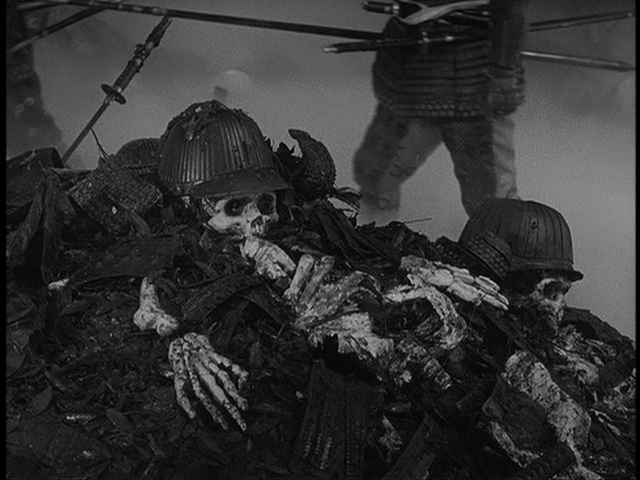
It’s like this shot in the beginning is some sort of foreshadowing or something.
























.jpg)