Doctor James Xavier (Milland) is getting an eye exam in anticipation of doing some sort of experiment on himself. His mission, should he choose to accept it (which he probably will as he is the one who came up with it in the first place), is to attempt to expand the spectrum of human vision.
In other words: he wants to be able to see through people’s clothes at parties
After a fatal test run on a monkey, he goes straight to a human test subject: himself. Which seems a bit presumptive given the fatality of the first test, but hubris has always been a great blinder. As are, it turns out, the eye drops he uses to change his own vision.
“It’s so weird how the same eye drops that killed the monkey have some averse effect on human beings too! As a scientist, I never could have anticipated that.”
Sure, at first the main effect of the drops is a new ability to check people for diseases, broken bones, internal injuries and unflattering underwear, but Xavier soon grows addicted to the drops, and his vision changes for each new dose. How far is he willing to go?
Creepy, shiny, slightly cross-eyed contacts-far? Or even further?
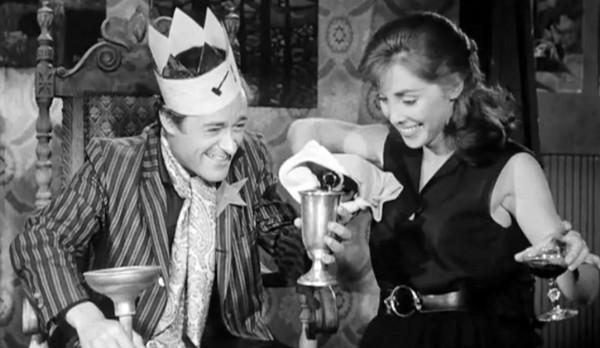
X: The Man with the X-Ray Eyes is just the right amount of fun, silly, schlocky and overly dramatic to appeal to our sensibilities. Add to that a wonderful cameo by Dick Miller, eating as per usual, and Ray Milland as the eccentric genius and we’re completely sold.
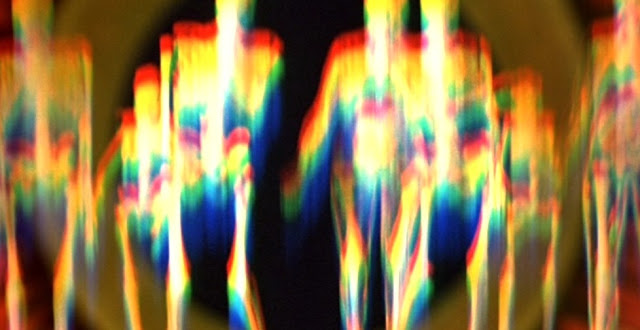
We also enjoyed the effect created by the I-can’t-believe-it’s-not-3D “Spectarama”
X: The Man with the X-Ray Eyes reminded us quite a bit of The Invisible Man, although the main character is slightly less crazy. Slightly. We loved the circus act, the amazing dancing at the party, the creepy contacts, and the drama of it all. This may no longer be on the list, but we’re not ones to turn down a Roger Corman movie if we have an excuse for one. A good choice if you’re looking for something a bit silly for a lost weekend. (See what we did there?)
This is a man who has survived a Roger Corman movie marathon
What we learned: The main character is called Dr Xavier and can see what others cannot, similarly to Professor Xavier from X-Men. This movie was released in September 1963, just like the first X-Men comic which featured Professor Xavier. Mind. Blown.
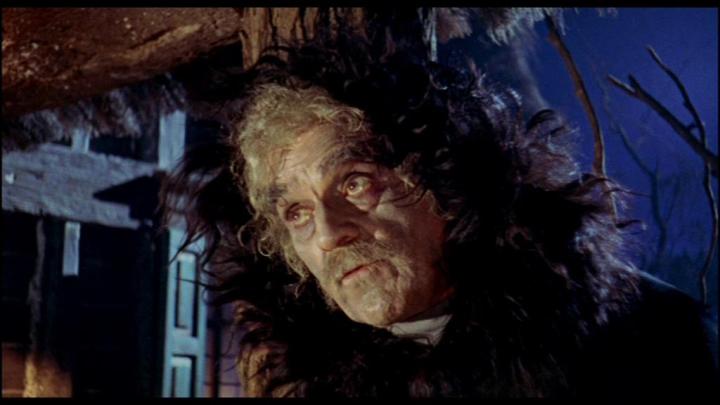
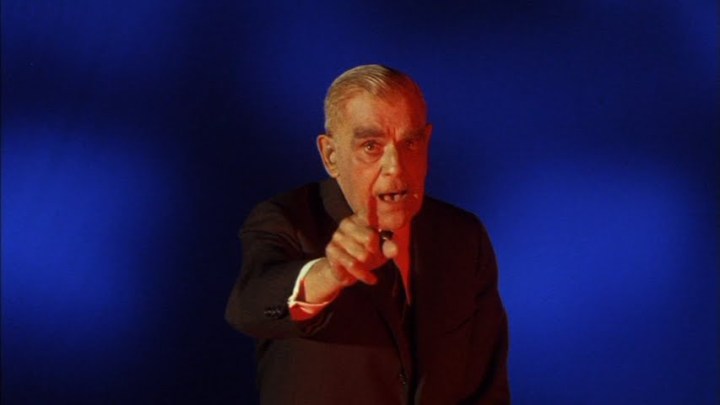
Black Sabbath consists of three separate stories, all tied together by host Boris Karloff, which are freely adapted from classic tales by Tolstoy, Maupassant and Chekhov. The order they appear in depends on which version of the movie you watch (there are at least two), so we will present them according to the version we watched.
We’re currently working on a plan on how to manage to live in all houses featured in this gorgeous movie
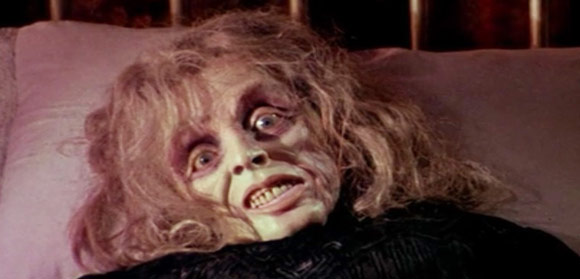
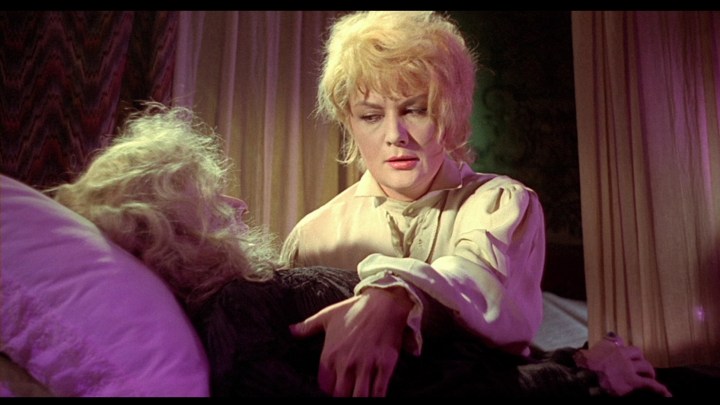
The first story, “The Drop of Water,” is by Anton Chekhov. An elderly medium has died while in a trance during a seance, and when preparing her body for burial, nurse Helen Chester (Pierreux) steals a ring from the deceased. Big mistake.
Given the scepticism with which she views the dead woman, we suspect she knew she would be haunted anyway so she just went for it.
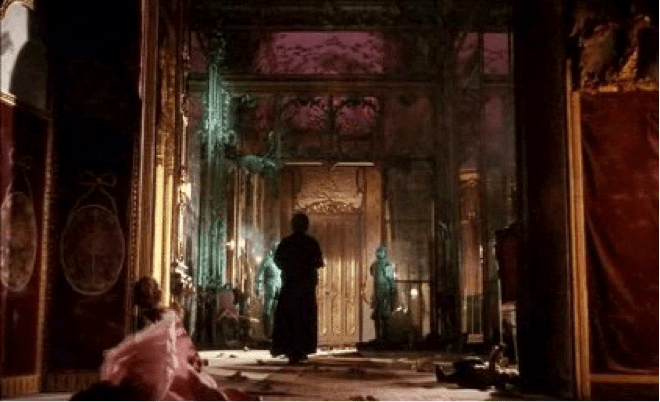
Guy de Maupassant’s contribution is “The Telephone” (or is it? There is some debate as to whether Maupassant ever wrote anything like this). Rosy (Mercier) is at home in her apartment (another place we’re moving into as soon as the payment goes through) when she starts receiving strange phone calls from her former pimp. Instead of calling the police (who she probably doesn’t trust given her profession), she calls old friend Mary (Alfonsi) for help. Big mistake.
“Darling! Calm your nerves with this drink I mixed you with my gloved hands, leave the phone off the hook and let’s pretend we never had a falling out in the past.”
The third and final story, “The Wurdulak,” is credited to Aleksei Tolstoy (not Leo, mind you). In 19th century Russia, rider Vladimir D’Urfe (Damon) finds a backstabbed body on a horse. He brings him to the nearest house to find that the body belongs to a Turkish bandit believed to be a Wurdulak. A Wurdulak, the farmers explain, is a vampire who feeds on his or her loved ones.
Farmer or not, Sdenka takes the time to put on a full face of make-up every day. You know, just in case a single nobleman happens to stop by the house with a body he found on the way, only to fall madly in love with her.
The father of the family, Gorca (Karloff), has been in pursuit of the Wurdulak and has given strict orders not to let him in the house if he is gone for too long as he will have been turned. When he returns too late, with a significant personality change, the family naturally lock him out and take every precaution to stay safe while plotting how to kill him.
Just kidding! They let him in, let him play with his grandchild, follow his commands, go to bed without locking any doors and are then flabbergasted when it turns out he tries to drink their blood. Then again, this is a family who implicitly trusts an unknown Eastern European Count called Vlad while in the middle of a vampire crisis.
Not to victim blame, but is it really a good idea to drink yourself to sleep in the living room when you suspect your dad, roaming the same house, is a vampire..?
We’re suckers for horror anthologies and Mario Bava, so there’s really nothing here we didn’t love. The humour between segments is silly and fun, and the entire film is very aesthetically pleasing, as giallo movies tend to be. A lot of this also feels oddly modern, as if it could have been made today but by someone trying to make it look older (think Garth Marenghi’s Darkplace or “The Devil of Christmas” episode of Inside No. 9). We loved all the apartments (as stated, we’re moving into all of them), the colours, the creepy child and the ghost. Love, love, love this!
Boris Karloff wants YOU to join us in celebrating Black Sabbath
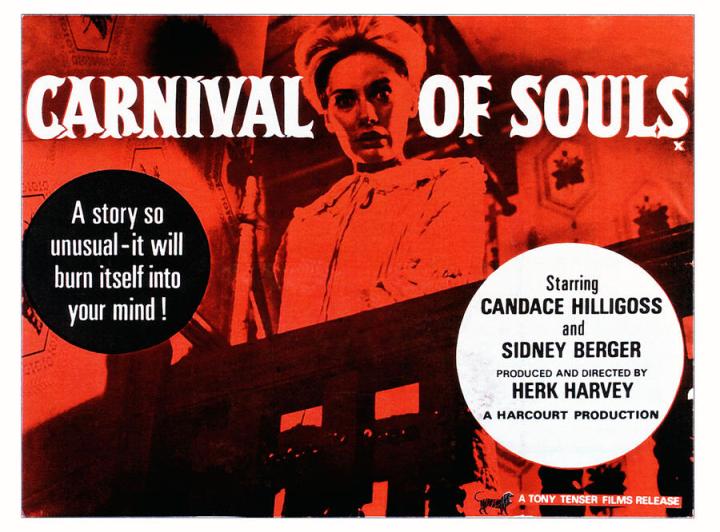
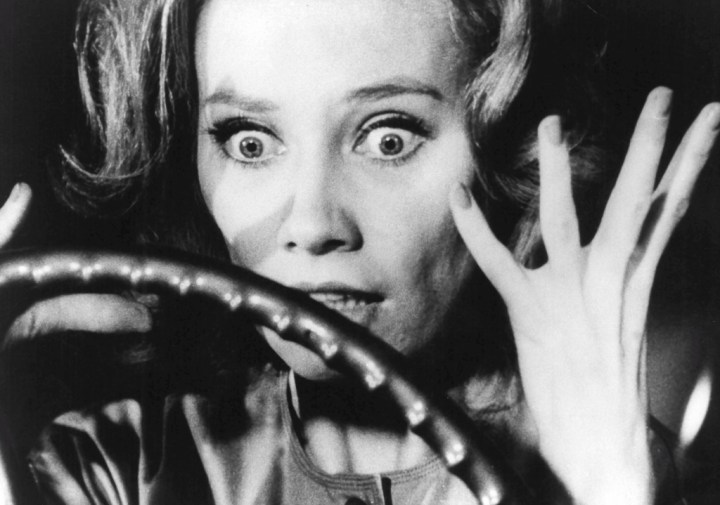
Three friends accept a challenge to a drag race (though not the fun one with RuPaul) and their car ends up in the river. Only Mary Henry (Hilligoss) comes out of the water, but soon after the accident she starts to experience strange things.
“What is this thing?? How do you even drive a car?!? Who on earth placed me behind a stearing wheel?”
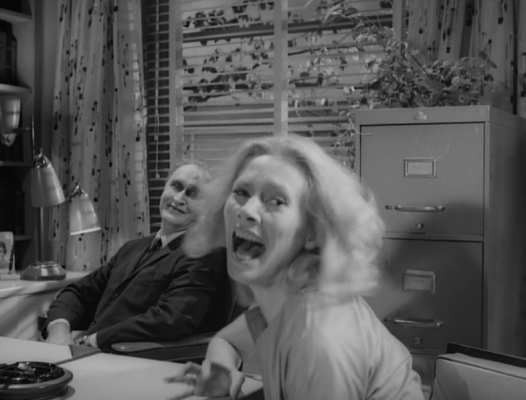
Newly moved to Salt Lake City, Mary finds herself slightly obsessed with an abandoned pavilion formerly used as a carnival. Even worse, she is haunted by the creepiest neighbour in the state of Utah. Oh, and also by a ghostly visage which pops up in windows, visions and dreams. But the neighbour is almost creepier than the spectre.
Let us lay some wisdom on you: if your neighbour gives you the willies worse than this guy, it’s time to move. We don’t care how low your rent is.
While Stalky McCreeperson, real name John (Berger), next door continuously tries to get in her pants, Mary tries to stay sane and perform well at her job as an organist. But she is troubled by her hallucinations (or are they?) and some unusual episodes in which all sounds disappear and people seem unable to see her. What is really going on with our heroine?
She is tormented by confusion. How can a man simultaneously look so frightening and so amiable?
Honestly, we went into this not expecting much. It’s part of a DVD box set we own with 50 horror films, and most of them are sub-par to say the least (with some notable exceptions). But we were pleasantly surprised by this atmospheric and unsettling cult classic.
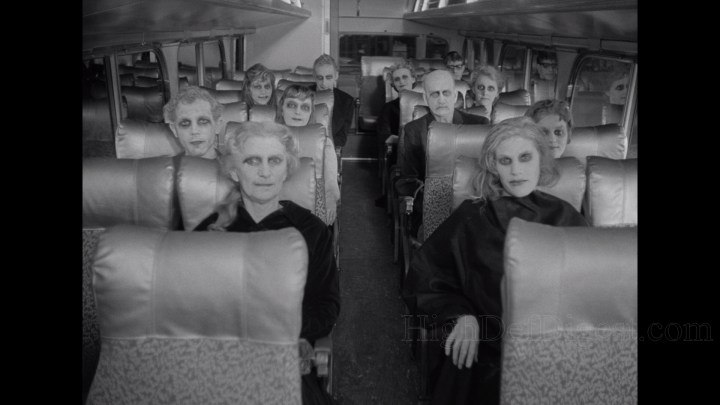
This single image will haunt our dreams for the rest of our lives. And now yours. You’re welcome. #sharethetrauma
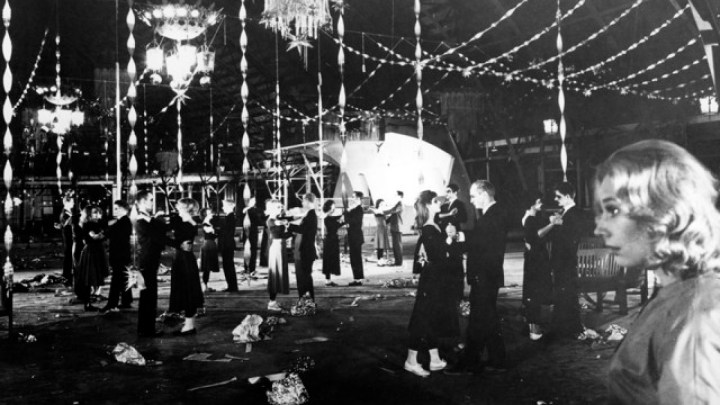
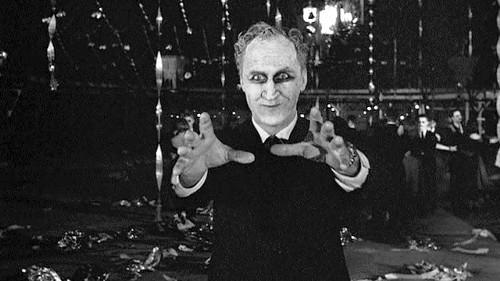
We loved the intense lighting and the reflections during Mary’s drive to Utah; the truly distressing ghosts; the main character (Mary is actually quite independent and don’t need no man!); the music; the make-up; and the dancing ghouls.
This isn’t from the film, by the way. We just really wanted to share some pictures from our New Year’s party. ‘Twas a strange affair…
Sadly, this was Herk Harvey’s only foray into the world of horror, although some of his other credits would suggest otherwise: “Dance, Little Children,” “To Touch a Child” and “Shake Hands with Danger” are all, unfortunately, enlightening and moralizing short films despite their evocative titles, and not the psychotic horror thrills we had envisioned. Our lack of research led to a very disappointing movie night indeed…
All we’re saying is, when you settle in to watch a film called “Pork: The Meal with a Squeal” directed by this guy, you expect some Hannibal Lecter stuff.
What we learned: We found 2019’s Halloween make-up. It’s a done deal now. Also, you should check out Herk Harvey’s credits as director. There are some real gems among these titles.
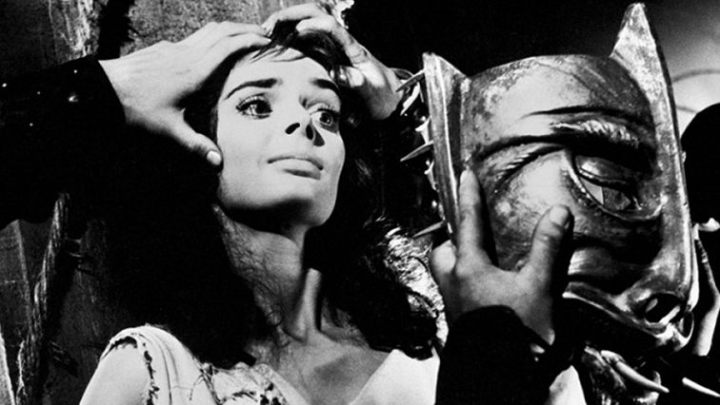
In 17th century Moldavia, Princess Asa Vajda (Steele) is sentenced as a witch by her brother and executed after having the “mask of Satan” nailed to her face. But before she dies, she curses her brother and all his descendants.
To be fair, if someone tried to nail this thing to our faces, we’d probably curse them too
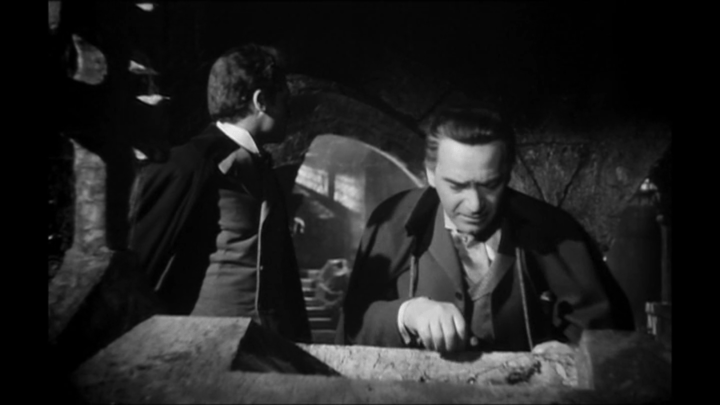
Fast forward 200 years and two travelling doctors stumble upon her grave. One of them, Kruvajan (Checchi), is attacked by a bat which he kills over Asa’s tomb smashing the cross guarding it in the process. He then proceeds to remove her mask and spill blood on her.
“Let’s open this tomb with the strangely preserved corpse and drip some blood on it” – a man who has never seen a horror film
Kruvajan and his young companion Andre Gorobec (Richardson) then run into a mysterious young woman who bears a striking resemblance to the dead witch, Katia (Steele again) and Andre is smitten.
After the meddling with the dead witch’s grave, the surviving members of the Vajda family start to experience strange phenomena, and it becomes clear that Asa and her companion Javuto (Dominici) are back for revenge.
We’re back in our favourite genre with this horror film, and we have a bit of a thing for Mario Bava (especially Sister the Oldest), so naturally we loved Black Sunday. It’s an unsettling and atmospheric Gothic horror with gorgeous lighting and some very good effects. We loved Asa’s resurrection and Katia’s transformation, Barbara Steele’s eyes (emphasized by intense make-up) and the creepy castle.
Not what most people associate with a “come hither look,” but strangely effective nonetheless
Sure, there are some issues with this movie, such as the slightly iffy dialogue and the fact that everyone keeps treating Katia like an idiot child (even with everything going on and several corpses piled up, the men don’t really believe her when she claims to have seen someone in her room), but we still love it.
In the men’s defence, Katia does tend to act a bit like an idiot child, so they may be justified
In a beatnik café, pretentious poet Maxwell H. Brock (Burton) is performing his latest work, to the fascination of busboy Walter Paisley (Miller). Inspired by the artists he surrounds himself with, and also driven by their ridicule of him, Walter decides to try his hand at sculpting.
“So, how did we do this in Arts and Crafts again..? I just knead it for a while and then it turns out amazing? Can’t be more to it than that!”
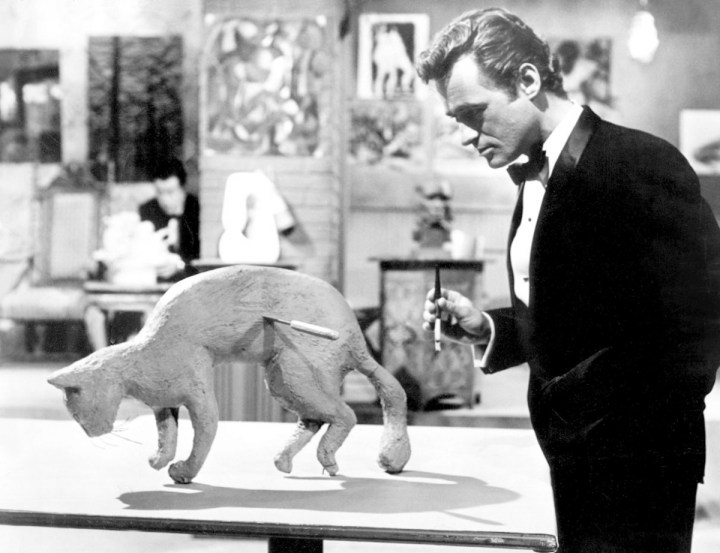
Realising that sculpting is harder than it looks, he takes a break to save his landlady’s cat who’s stuck inside the wall. However, stabbing through it, he accidentally stabs the poor cat. Naturally, he proceeds to cover the dead animal in sculpting clay and the next day he turns up to work with his new sculpture.
“Dead Cat” is an instant success, admired by art lovers and drug enthusiasts alike
Walter’s newfound success leads to admiration from his crush Carla (Morris) and other patrons of the café, and a lady gives him some heroin as a gift, as one does. This in turn leads to an attempted arrest as an undercover cop follows Walter home and tries to book him for drug possession. Afraid, Walter hits him over the head with a frying pan, killing the cop instantly.
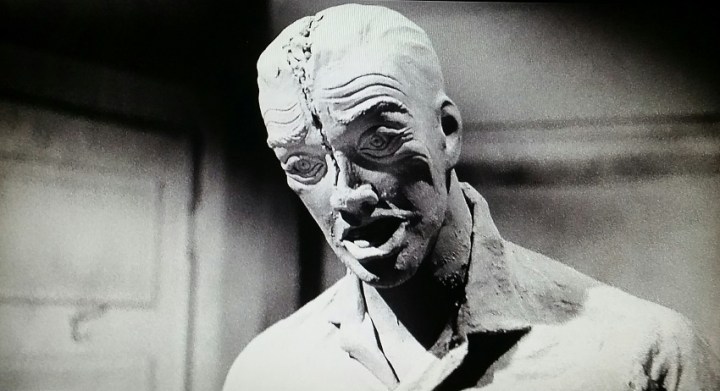
What do you do when you accidentally kill a cop? Why, cover the body in clay and pass it off as a life sized sculpture, of course!
Walter gradually goes from underestimated and accident-prone simpleton to calculating killer who lets every small slight become justification for murder. He is, however, not smart enough to avoid killing people he knows and is known to dislike.
“It is so sweet that you made a sculpture of a strangled woman who looks exactly like the one who spent last night insulting you very publicly. I simply must kiss you!”
Leonard (Carbone), the owner of the café, is the only one to see through his newly discovered talent, but he is making money off of Walter’s work and has a vested interest in keeping up the illusion. But how long can this go on? And who is next on Walter’s kill radar?
“This severed head has been bothering me all week, so I clayed it!”
A Bucket of Blood is the farcical version of House of Wax. The concepts are similar, but this one is more comedic and strangely also more sinister in many ways. Walter is the epitome of the stereotypical “good guy” – he sees himself as sweet, kind, underestimated and misunderstood, but if he’s rejected by someone, or made fun of, he becomes violent and murderous while simultaneously justifying his actions in his head.
“I’m a famous and celebrated sculptor now, so you must date me. Unless you’re just a bitch and a whore!”
We loved his first attempt at sculpting Carla’s face, the extremely pretentious Maxwell and the morbidity of the whole film. We also understand perfectly why Roger Corman made so many films based on the works of Edgar Allan Poe – it’s a match made in heaven! Or probably hell, to be quite frank.
“If it’s hell, can I still be king..?” “Of course you can, Mr Futterman.”
After Professor Harrington dies under mysterious circumstances, his niece Joanna Harrington (Cummins) teams up with the late professor’s colleague John Holden (Andrews) to find the truth. Joanna thinks her uncle’s death is related to a “satanic cult” he was investigating, and specifically the leader Dr Karswell (MacGinnis).
“He’s not a satanic cult leader! He’s just a happy-go-lucky clown!”
While Holden has made it his life’s mission to discredit occultism, Ms Harrington is a bit more open to the concept of her uncle’s death being supernatural in origin. But when Holden finds a mysterious paper in his belongings (after a chance encounter with Karswell in the British Library – the no. 1 hang-out place for academics and satanists) and his symptoms start resembling those of the dead man, he gradually starts to come around to Joanna’s way of thinking.
If you’re chased through the woods by a strange smoke cloud, satanic forces is usually the first and only theory.
Night of the Demon (or Curse, if you’re American) is less subtle than Tourneur’s earlier work (Cat People and I Walked with a Zombie), where you’re never sure if something supernatural is happening or not. In this, the demon is shown on screen several times, although arguments could be made that they are only seen by the doomed men who believe a demon is out to get them.
They both see the same, slightly cross-eyed demon though…
Apparently, this was at the insistence of the producer rather than the vision of Tourneur, and it might have been a better movie without it. Despite the somewhat outdated special effects though, this is still a very enjoyable movie.
Karswell is nice and sinister throughout, when he’s not in clown make-up that is
We loved Karswell acting all serious in full-on clown mode; the seance with the singing; the scene on the train; and the general plot. It’s a fun, slightly camp, horror film which is slightly dated but still a good watch – especially if you’re a horror fanatic.
Or if you’re really into huge, cross-eyed demons floating through dark woods. It’s a fetish, we’re sure.
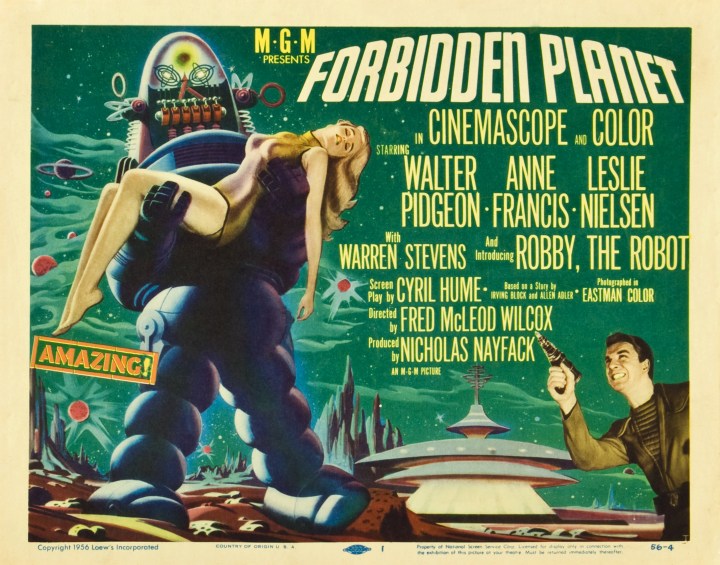
Commander Adams (Nielsen – before he became everyone’s favourite deadpan comedy actor) and his crew are travelling through space to a distant, Earth-like planet in order to rescue any survivors from a previous mission.
When they reach their destination they find only two survivors; the mysterious Dr Morbius (Pidgeon) and his young attractive daughter Altaira (Francis). They live alone with their robot Robby and a menagerie of wild animals while Dr Morbius explores the remains of an advanced ancient civilization which used to inhabit the planet. Also, there’s a killer monster roaming around, but the good doctor and his daughter seem somehow immune to it. Curiouser and curiouser.
Must be her scandalously short dresses keeping them safe. Monster doesn’t want to seem too forward.
The all-male crew start creeping on Altaira pretty quickly, leading to the commander berating her for her short dresses. ‘Cause, you know, it’s her own freaking fault. Naturally, the two then fall for each other, and Altaira decides to leave her home and father for Earth. This does not please Father, nor the monster…
You silly girl. You must understand that your dress is distracting my crew and this is your fault and not a great opportunity for us men to reconsider our view of women and our capability to control our urges. Go change.
Forbidden Planet is an awesome sci-fi adventure, based on Shakespeare’s The Tempest, but greatly influenced by Freud as well. For its time, and genre, it had a big budget and is presented in colour and Cinemascope – quite rare for ’50s sci-fi.
We’re suckers for old-timey sci-fi and so naturally we loved this film. Add to that Leslie Nielsen, mysterious monsters, ancient civilizations, action, a score of “electronic tonalities,” Freud, and incestuous undertones (again, Freud) and we have a winner.
Forbidden Planet has the honour of being the first film on the list where someone let us know when we started this project that they wanted to join us for the viewing, so we had a viewing party! Sort of… Well, three people and pizza constitute a party in our book. The next one which has sparked interest is Flash Gordon (1980), so we’re looking forward to that. In a few years. We don’t get out much.
We’re pretty sure this kind of thing is waiting for us out there, so we prefer to stay inside where it’s safe…
What we learned: We’re all monsters in our subconscious, but we have laws and religion to keep us under control. Also, never trust the sole surviving member of an exploration party where everyone else died under mysterious circumstances.
Police pick up a shell-shocked little girl in the New Mexico desert. They also spot an abandoned car and trailer, and when they check them out they find a war zone sprinkled with sugar. What on earth could have happened?
As more similar crime scenes appear, Police Sergeant Ben Peterson (Whitmore) investigates with the help of his trooper, who quickly becomes another victim of the unseen threat. FBI Agent Robert Graham (Arness) replaces the dead trooper, and with their only clues being strange tracks, sugar, and huge amounts of formic acid in the victims’ bodies, the investigators call in some experts. Dr Harold Medford (Gwenn) arrives, accompanied by his daughter, Dr Patricia Medford (Weldon). The two of them have some crazy theories.
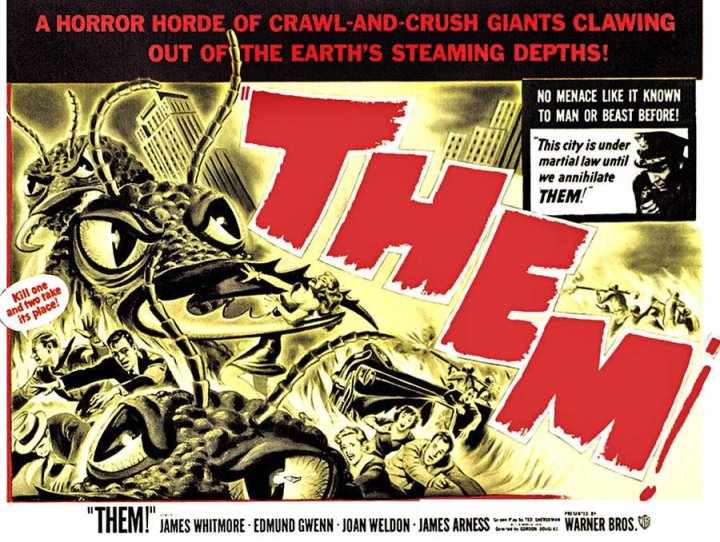
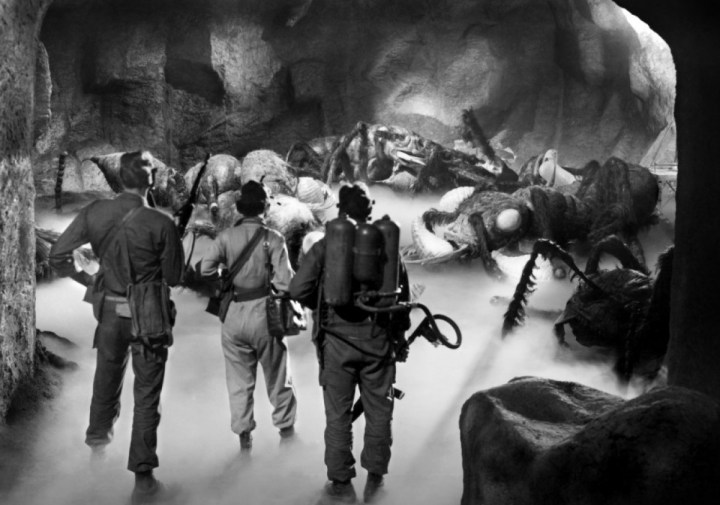
Surprise! The crazy theories were spot on and there really are enormous killer ants running around in the desert!
The culprits are giant ants, mutations made by radiation from nuclear bomb tests in New Mexico (see “Godzilla: Bombs are Bad“). The team manage to destroy the nest, but realise that three queens have managed to escape. Now they must track them down and destroy them before they destroy all of humanity.
Pretty much the most fun you can have with nuclear mutation mistakes
As mentioned, we watched this as a double feature with Godzilla, and they really are a perfect match. Atomic monsters threatening major cities who must be destroyed by scientists and the military working together, with a sprinkle of romance and humour. We loved them both, although Them! seems the slightly sillier version of the same general idea.
Giant dinosaury sea monsters beat giant animatronic insects in terms of fright factor, in our opinion. The insects win for fun factor, though.
A cult classic which is surprisingly tense given the premise, Them! is a great film if you’re a fan of creepy creature features with slightly dated effects but otherwise great performances and lots of eerie sounds. We loved both Doctors Medford, and had a great time watching this.
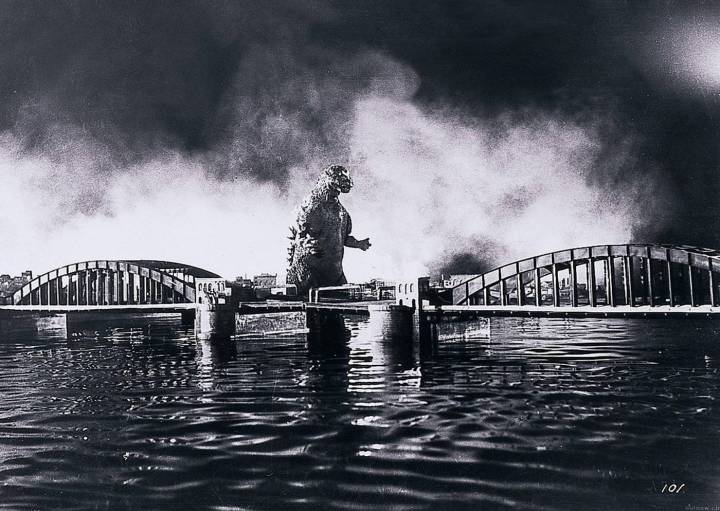
Godzilla – King of the Monsters! Hydrogen bombs off the coast of Japan have awoken the mighty beast from its oceanic slumber and it is coming for Tokyo. Send in the army, sacrifice your daughters, and RUN!
Not sure how a girl is supposed to placate this beast, but for a while that was the only viable plan
As Godzilla, a dinosaury creature of local legend, wreaks havoc on the shores of Japan, scientists and military personnel work to pacify and/or kill the monster. Some, such as Dr. Yamane (Shimura), are convinced they should let the rare specimen live.
Others, particularly the military, but later also Yamane’s daughter Emiko (Kôchi) and her two boyfriends (it’s complicated) Hideto and Serizawa (Takarada and Hirata, respectively), begin to realise that their only course of action is to destroy it before it destroys all of Japan and possibly the world.
Godzilla is a legendary creature feature which has spawned countless sequels, remakes, and reboots. However, none of them have quite managed to capture the magic of the original. Sure, there have been more advanced special effects in some other Godzilla-films, but the original man (technically men; Haruo Nakajima and Katsumi Tezuka) in the monster suit is strangely effective.
It might be an advantage to the overall effect that the movie is quite dark and a lot of details are slightly obscured
It’s atmospheric and intense, with a dramatic score, great performances and real threats. We watched this as a part of 1000filmblog’s Atomic Double Creature Feature Night™ together with Gordon Douglas’ Them! (#124) from the same year, and it was a fantastic combination. As we’re going through the fifties and sixties, we’re looking forward to more atomic/space-agey horror and sci-fi – we love us a good monster movie and a good atomic scare!
We’ll leave you with the poster for the American edition of this Japanese classic – now with added Americans!
Ed Wood is commonly known as the worst director of all time, which may or may not be true (there must be someone worse out there, although it’s possible they’ve never released anything major), due in large part to the cult classic Plan 9 From Outer Space (1959). Slightly less well known, though still fairly (in)famous, and (hopefully) slightly more autobiographical is Glen or Glenda from 1953.
Despite his infamy, Ed Wood threw the best and most surreal parties!
Transvestite Patrick/Patricia has committed suicide, and the investigator, Inspector Warren (Talbot) wants to learn more about their motive. He talks to Dr Alton (Farrell) who tells him two stories about different forms of gender identity, starting with the story of Glen/Glenda (Wood).
Some men have different reasons for admiring lingerie in shop windows…
Glen is a fairly normal heterosexual man who is engaged to marry Barbara (Fuller), and who likes to dress in women’s clothing and to feel like a woman. He describes it as a sort of split personality and he cannot quite make up his mind whether he wants to continue doing this or whether he wants to stop. He also has a hard time deciding how to tell his fiancée about his alter ego. This is the most clearly autobiographical narrative in the film, since the director himself went through a similar process (as we’ll see in Tim Burton’s Ed Wood when we reach 1994).
He feels like it’s sinful and wrong too, poor guy/girl
Dr Alton also tells Warren the story of pseudohermaphrodite Alan, who after a long period of confusion, goes through a sex change to transition to female. In between these two narratives, Bela Lugosi pops up in a lab straight out of a Frankenstein film and talks about human nature while doing experiments that have nothing whatsoever to do with the rest of the film. There’s also a (drug-fueled?) dream sequence heavy with symbolism (we think).
An old Universal horror? A Hammer film, perhaps? Nope, it’s a docudrama about gender identity
A film as indecisive about its nature as its eponymous character, Glen or Glenda cannot seem to make its mind up about in which genre it wants to belong. The scenes with Bela Lugosi fall firmly into the horror realm, while other parts of the film fluctuate between documentary, drama, romance, pantomime, silent movie, and symbolism heavy art feature. It is a very interesting film to watch though, and its cult status is understandable. The artistic merits of the film do not, however, quite match the level of the progressive and important subject matter, and it’s a strange experience watching it. Well worth it though!