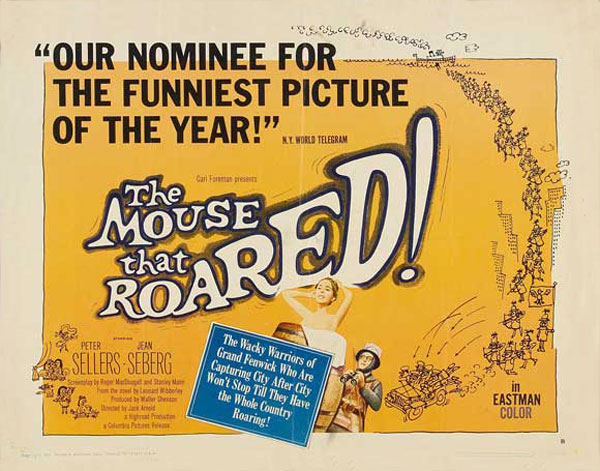
The tiny Duchy of Grand Fenwick is in a financial crisis after their sole export, Pinot Grand Fenwick wine, is priced out of the market by a cheap American imitation. Their solution: declare war on the United States, lose, and collect aid from their former “enemy.”
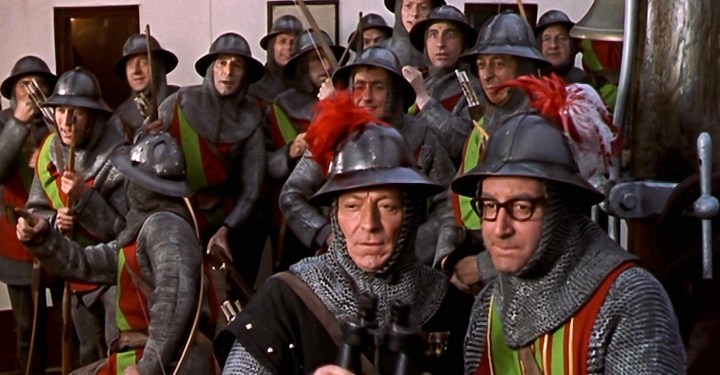
And with a well-equipped and modern army such as this, how could an invasion go wrong?
Unfortunately, through a series of unlikely events they end up winning, and Prime Minister Count Mountjoy (Sellers), Grand Duchess Gloriana (Sellers), and Field Marshall Tully Bascomb (Sellers) must find a way out of their newfound power and notoriety.
“Good lord! Only a true megalomaniac would want to rule to world! Or the USA…”
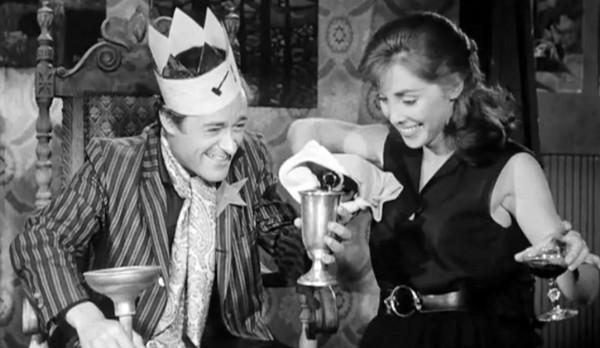
The Mouse that Roared is no longer on the list, but we post this in our we-already-bought-the-fucking-DVD-so-we’re-watching-it-dammit category. It’s a very silly and very enjoyable comedy with an excellent Peter Sellers. We loved all the characters, especially the Duchess; the narration, the fox, the army uniforms, and the peace treaty. While no longer deemed good enough to occupy a precious space on the list, it’s still very much worth watching. Such fun!
For those interested, this is how we usually dress up for a movie night. Furs, flags and all!
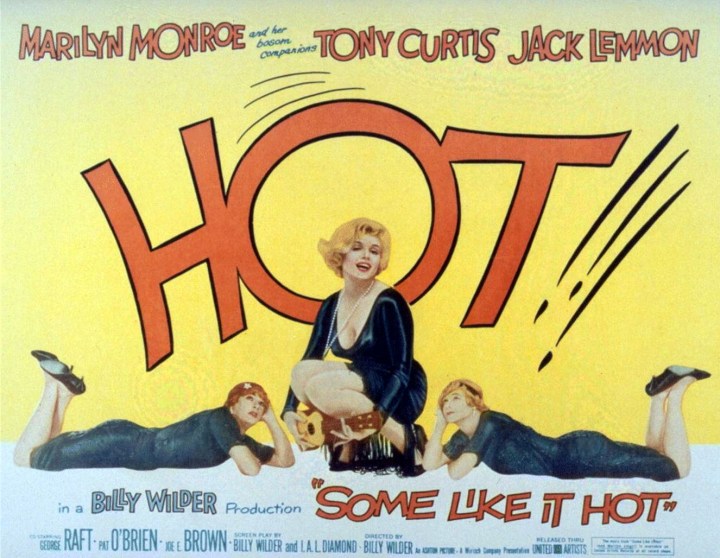
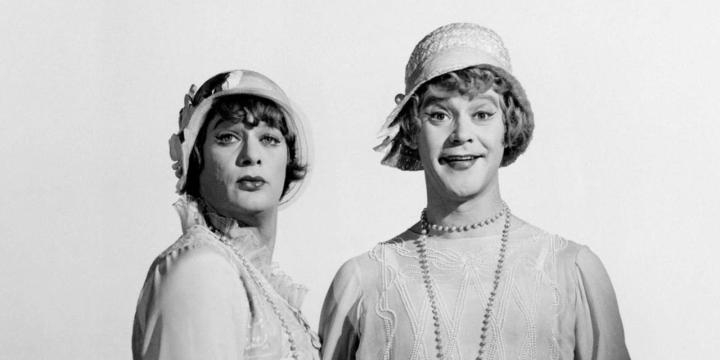
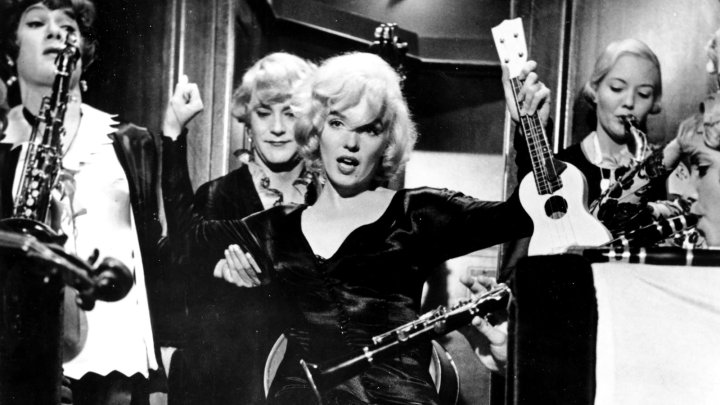
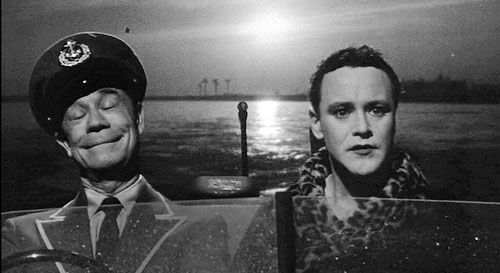
Joe and Jerry (Curtis and Lemmon, respectively), two musicians employed at a speakeasy in Chicago, witness a mob hit and must go on the run to avoid becoming the next targets. They look for out-of-town work, but the only one hiring is an all-girl band going on tour. What happens next should surprise absolutely no one who has ever seen a silly comedy.
As with “all” best friends, there’s the pretty one and then there’s the funny one
The pair take their new identities Josephine and Daphne (she never liked the name Geraldine) and join the band, where they meet charming ukulele player Sugar Kane (Monroe). On the way to Miami, both fall for Sugar, but are unable to act upon it as they are supposed to pass for women.
To be fair, you didn’t have to be a man to be attracted to Marilyn Monroe in her prime
Once in Miami, Joe assumes a third (male) persona, that of heir “Shell Oil Junior,” in order to woo Sugar. Meanwhile, Jerry is pursued by creepy (but ultimately quite sweet) millionaire Osgood Fielding III (Brown), to whom “Daphne” later becomes engaged. Also, to add to the complications, the Chicago mobsters the musicians are hiding from have decided to do their yearly meeting at the same Miami hotel the band is staying at. Hilarities ensue.
Hilarities include, but are not limited to, a rather scandalous dress and an even more scandalous seduction technique
Despite the fairly simple set-up, this movie truly is hilarious. Given their actions, all the characters should be repellent, but thanks to utterly wonderful actors they come across as strangely likable, and you find yourself rooting for them all.
Amid all the sexism (it’s from the ’50s and set in the ’20s) and deceit, there is a sweetness and tolerance in this film which might be more relevant than ever. We loved Sugar’s outfits, Daphne’s tango date, Osgood (post initial assault), and the dialogue. Also, the ending is perfect, without any of the hurt feelings and apologies we find in all contemporary romantic comedies. Everyone just accepts what has happened and how others have tricked them and they move on with their lives and their loves. Perfect!
In a beatnik café, pretentious poet Maxwell H. Brock (Burton) is performing his latest work, to the fascination of busboy Walter Paisley (Miller). Inspired by the artists he surrounds himself with, and also driven by their ridicule of him, Walter decides to try his hand at sculpting.
“So, how did we do this in Arts and Crafts again..? I just knead it for a while and then it turns out amazing? Can’t be more to it than that!”
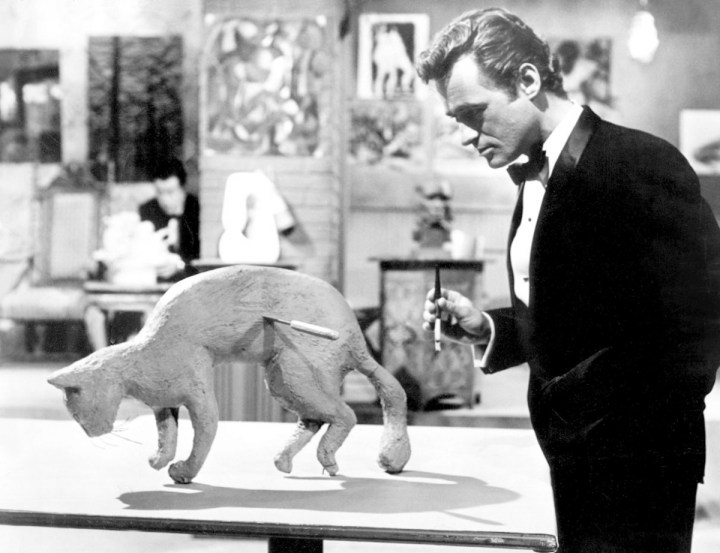
Realising that sculpting is harder than it looks, he takes a break to save his landlady’s cat who’s stuck inside the wall. However, stabbing through it, he accidentally stabs the poor cat. Naturally, he proceeds to cover the dead animal in sculpting clay and the next day he turns up to work with his new sculpture.
“Dead Cat” is an instant success, admired by art lovers and drug enthusiasts alike
Walter’s newfound success leads to admiration from his crush Carla (Morris) and other patrons of the café, and a lady gives him some heroin as a gift, as one does. This in turn leads to an attempted arrest as an undercover cop follows Walter home and tries to book him for drug possession. Afraid, Walter hits him over the head with a frying pan, killing the cop instantly.
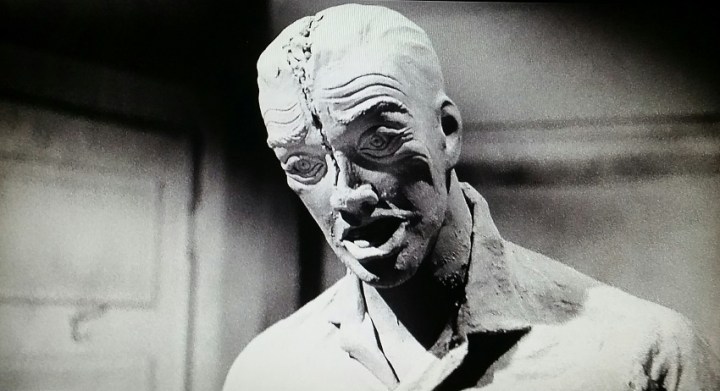
What do you do when you accidentally kill a cop? Why, cover the body in clay and pass it off as a life sized sculpture, of course!
Walter gradually goes from underestimated and accident-prone simpleton to calculating killer who lets every small slight become justification for murder. He is, however, not smart enough to avoid killing people he knows and is known to dislike.
“It is so sweet that you made a sculpture of a strangled woman who looks exactly like the one who spent last night insulting you very publicly. I simply must kiss you!”
Leonard (Carbone), the owner of the café, is the only one to see through his newly discovered talent, but he is making money off of Walter’s work and has a vested interest in keeping up the illusion. But how long can this go on? And who is next on Walter’s kill radar?
“This severed head has been bothering me all week, so I clayed it!”
A Bucket of Blood is the farcical version of House of Wax. The concepts are similar, but this one is more comedic and strangely also more sinister in many ways. Walter is the epitome of the stereotypical “good guy” – he sees himself as sweet, kind, underestimated and misunderstood, but if he’s rejected by someone, or made fun of, he becomes violent and murderous while simultaneously justifying his actions in his head.
“I’m a famous and celebrated sculptor now, so you must date me. Unless you’re just a bitch and a whore!”
We loved his first attempt at sculpting Carla’s face, the extremely pretentious Maxwell and the morbidity of the whole film. We also understand perfectly why Roger Corman made so many films based on the works of Edgar Allan Poe – it’s a match made in heaven! Or probably hell, to be quite frank.
“If it’s hell, can I still be king..?” “Of course you can, Mr Futterman.”
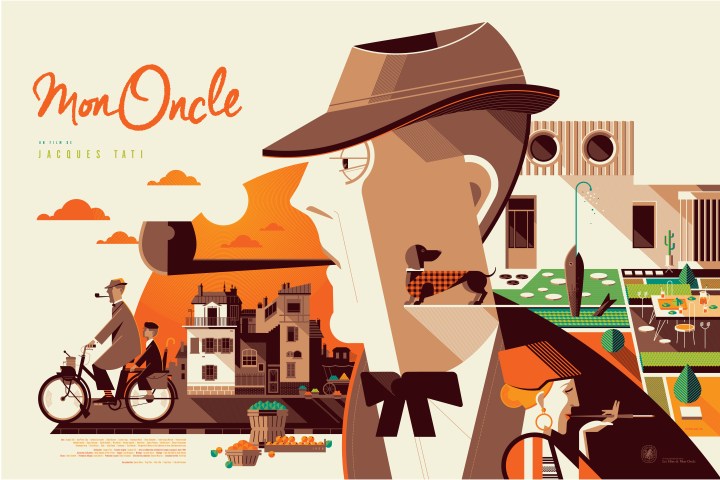
Our second encounter with Monsieur Hulot (Tati) was perhaps even more enjoyable than our first. Mon Oncle introduces us to his extended family: his sister, his brother-in-law, and his adorable nephew. Oh, and their dog, of course. Cannot forget the dog.
Hulot’s brother-in-law Charles Arpel (Zola) and sister Mme. Arpel (Servantie – who doesn’t even have a name in this) live in their ultra-modern and technologically advanced house Villa Arpel, where everything goes wrong on a regular basis. In addition to their fancy house, they have son Gerard (Bécourt) and the aforementioned dog, both of whom like to play with strays.
“I’ll tell mother you followed me home. I’m sure she’ll let me keep you!”
While the Arpel’s try to keep up appearances to their neighbours, colleagues and anyone who should happen to pass by, Gerard is disenfranchised by it all and loves spending time with his unassuming uncle. However, Charles thinks Hulot is a bad influence, and that he should get a proper job, a proper house, and a proper life. Like he has.
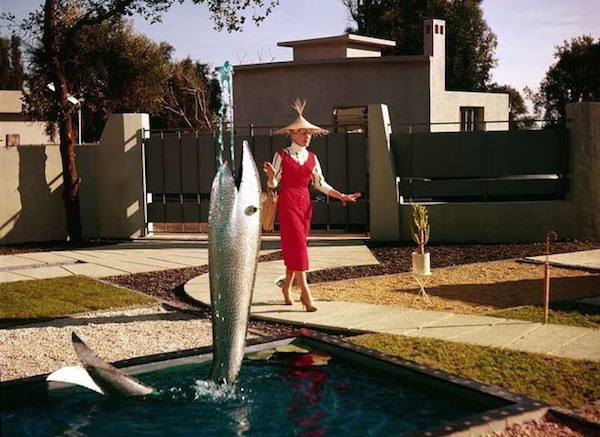
“A proper house with a proper wife in a proper plastic house-cleaning dress and with a proper fish fountain in the front garden. Is that too much to ask?”
There’s so much in this movie we loved! The opening credits, Mme. Arpel’s plastic house dress, the traffic moving in time with the music, the dogs, the hats (oh, the hats!), the slapstick, the hark back to the silent movie era (especially Modern Times), the trotting secretary, and the garden party populated by the worst kinds of people in the world.
Another excellent short film by Chuck Jones, What’s Opera, Doc? is a Bugs Bunny/Elmer Fudd version of several of Richard Wagner’s great operas, especially Der Ring des Nibelungen (check out our classical music knowledge, people!).
It has the added benefit of featuring the most fabulous horse in cinematic history
As it’s a seven minutes animated short, it’s hard to say anything deep and profound about it (you know, because we’re usually known for our incredibly analytical and intellectual approach to film reviews). However, lucky for you, you can watch the whole thing here and make up your own mind. Enjoy!
Dick Avery (Astaire), fashion photographer, bursts into the life of intellectual book seller Jo Stockton (Hepburn) with an impromptu photo shoot in her shop. Fashion editor (and personal hero) Maggie Prescott (Thompson) shuts her out of her shop for being a nuisance, but Dick manages to convince the brilliant lady to make Jo her new “Quality girl” and model.
Thus starts the arduous task of making a glamorous model out of this hideous beast
Dick talks the reluctant Jo into the job by promising her a trip to Paris – her biggest dream is to travel to the French capital to hear her personal hero professor Emile Flostre (Auclair) talk. He is the inventor of empathicalism, a philosophy Jo follows and Dick ridicules.
“You silly girl! Stop trying to think and put on a pretty dress!”
They go to Paris, Jo blossoms into a great model, Dick and Jo fall in love (for some reason), Jo gets to meet her hero (which the adage tells us never to do, and we learn why), and Maggie and Dick get to go undercover as Floridian singers to great success. Also, there are complications and conflicts, as there should be.
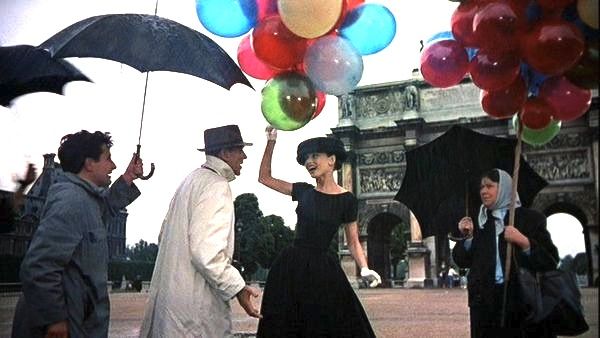
Even Parisian rain can be endured with Givenchy dresses and colourful balloons
We’re slightly conflicted over Funny Face. There is so much about it we love: the colours, the musical numbers, the sets, the costumes, the choreography, Maggie Prescott, Audrey Hepburn’s slightly clumsy elegance, the fact that she got to sing her own songs, and generally the overall feel of the entire film.
What we don’t quite get is the romance at the centre. It’s not so much the age difference, although 30 years is a lot (and we’re not strangers to the concept). It’s mainly Dick’s constant treatment of Jo as if she’s just a silly little girl incapable of thought and of seeing the real intentions of her hero. He berates and controls her, and he tries to change her priorities to make her more like the fashionistas he works with.
Then again, who wouldn’t be persuaded to become a model if it meant wearing dresses like this?
It feels a bit as if he might be better off finding someone else if he wants to change her that much. And that she would be happier with someone who at least supported her intellectual pursuits. We sort of thought Maggie and Dick would have been a better couple. But perhaps that’s just us.
Overall, we like the film, but the romance feels very dated unless it’s supposed to be a bit uncomfortable. The musical numbers and the gorgeous cinematography sort of makes up for it though. Sort of.
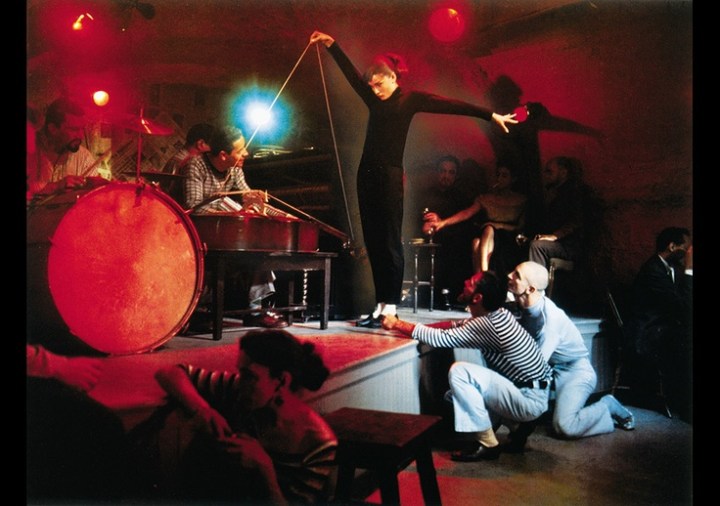
It made us want to dance in sordid, French night clubs with men in striped shirts for sure
Mrs Wilberforce (Johnson) is a sweet little old lady and frequent visitor at the police station reporting on various observations, who is looking for a tenant for her vacant room. When Professor Marcus (Guinness) shows up looking for a room where he can live and rehearse with his string quintet, she may have gotten more than she bargained for.
Naturally, Professor Marcus and his cohorts (the rest of the men credited) are not what they appear – they are a band of criminals planning to rob a security van at King’s Cross and they want to use Wilberforce’s house, and the old lady herself, as part of their plan.
As if classical musicians could make this much money
However, the gang had not counted on Mrs Wilberforce, her observational skills, her morals, or her ability to make them all feel like naughty little boys being scolded by Mother.
The Ladykillers is a fantastic comedy, perfectly cast and entertaining throughout. Katie Johnson, who gets ridiculously low billing, is amazing as the old widow, and her adversaries are all brilliant as well – screen legends as many of them are.
Some of the characters are better than others are fake-playing their instrument
An old favourite of ours, it is always a treat to rewatch it, and we recommend it to everyone with no stipulations. If you can’t get some sort of enjoyment from this, you’re dead inside.
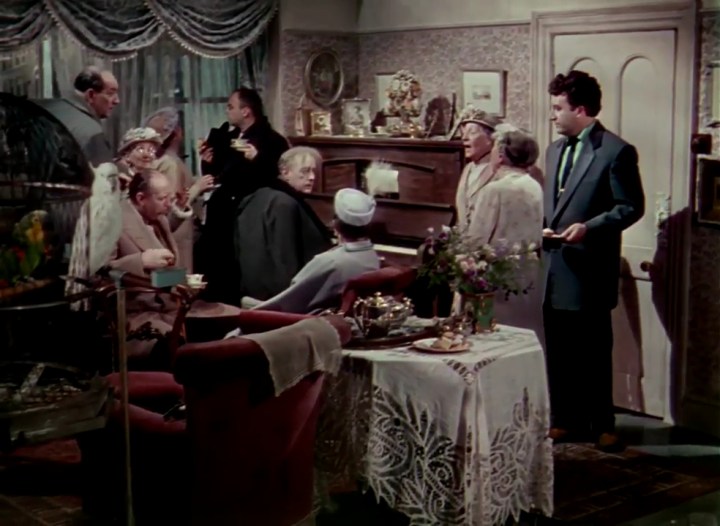
Happiness overload when Mrs Wilberforce had all her little old friends over for tea. They’re so sweeeeet!
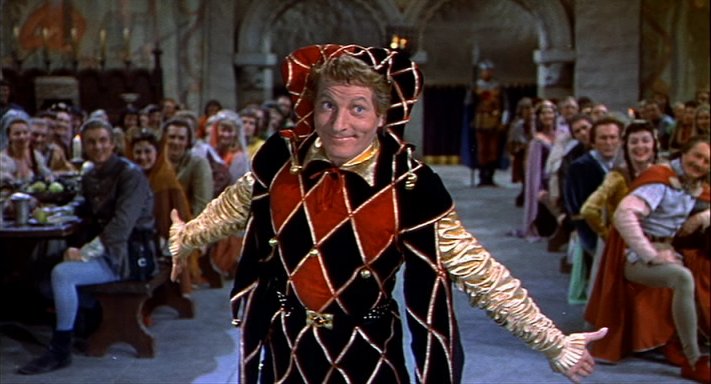
A Royal child has survived the massacre of his family, and is being kept safe in the forest by Not-Robin-Hood “The Black Fox” and his singing, dancing and fairly merry men. The usurping king is not very happy about this and sends out his men to track down and kill the child who bears the tell-tale birthmark “The Purple Pimpernel”
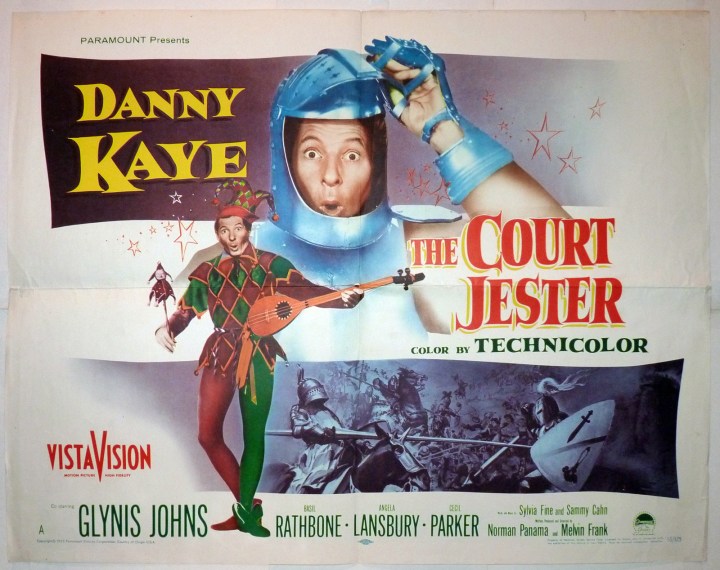
We chose this image to avoid being banned for lewd pictures, but it gives you a certain idea of where the birthmark is placed
Among The Black Fox’s merry men is carnival performer Hubert Hawkins (Kaye) – a minstrel who really wants to fight for the rightful heir but who is tasked with entertaining the troops instead. Along with Captain Jean (Johns), he is sent to smuggle the child to safety, but as the pair run into the new unrightful king’s new jester, they make their own plans.
Once at the court, complications arise as Sir Ravenhurst (Rathbone) thinks he’s an assassin, Princess Gwendolyn (Lansbury) thinks he’s her one true love, and her Nanny Griselda (Natwick) hypnotizes our hero to be all those things. Additionally, Jean is kidnapped into prostitution at the castle, and the infant King must be kept hidden under the nose of his would-be killer. Let the farce commence!
The prostitution-thing is not explicitly stated, but very heavily hinted at
The Court Jester is very silly and very funny, with great musical numbers (we especially loved the opening song) and gags galore! It’s a swashbuckling adventure which reminded us in style ofThe Adventures of Robin Hood (we’re guessing not accidentally) and in humour of Mel Brooks – particularly Men in Tights, of course.
Also, the inspiration for a certain famous scene with dancing, singing “knighets”!
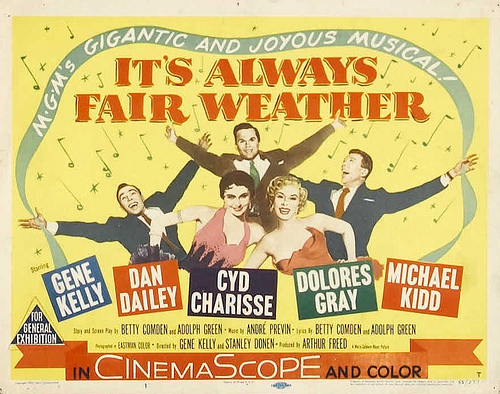
Three friends, Ted Riley (Kelly), Doug Hallerton (Dailey), and Angie Valentine (Kidd), return to New York from World War II. They get drunk, engage in a stomp-style dance routine and promise each other (and bartender Tim) to meet up again in ten years.
“We’ll totally be this happy and optimistic for the rest of our lives, and we’ll never grow apart, and we’ll live up to all our potential, and never fail, and everything will be awesome forever!”
The ten years pass, and would-be lawyer Ted is a gambler, aspiring artist Doug is an ad-man, and ambitious chef Angie is the owner of a hamburger stand. They meet up, but are disappointed in each other, their once great friendship, and themselves.
“Well, weren’t we overly optimistic annoying little gits in that last scene..?”
As they are stewing in their resentment in a fancy restaurant, Jackie Leighton (Charisse), who is also in advertising, is introduced to them by an associate of Doug.
They’re shielding their eyes because her dressed ripped in the last scene. They’re gentlemen. Except for dude on the left.
She fends off Ted’s advances at first, but then comes up with the idea to show the three men’s reunion on a TV show hosted by (the glorious) Madeline (Gray). Also, there are gangsters.
Nothing like a bit of violence to rekindle an old friendship
We’re suckers for Gene Kelly musicals, and so naturally we enjoyed this one. We loved the time lapse showing how their careers developed over the years; the thoughts they have about each other to the tune of The Blue Danube; the boxers in Stillman’s Gym (very Bugsy Malone!); the roller blade tap routine; the dresses and Madeline. Funny yet slightly moody and depressing at times – great stuff!
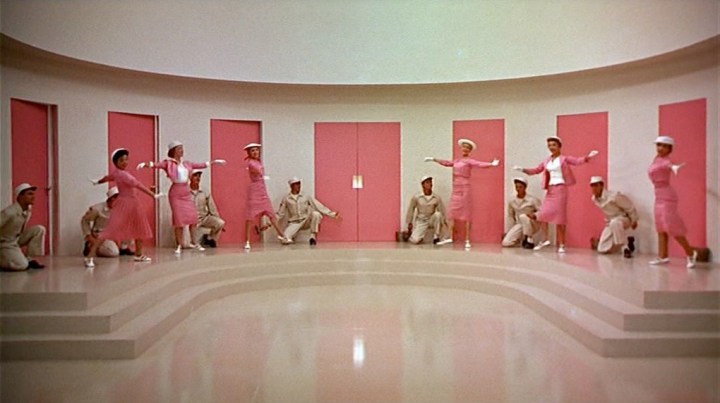
It might be the gloomiest Kelly-musical, but it’s not all dark and serious
What we learned: K-L-E-N-Z-R-I-T-E spells Klenzrite – the only washing soap for us. Also, how to scare men off with facts. As if we needed more help in that department…
In honour of Baby Driver‘s Norwegian première, we decided to skip the list for a day and bring you Edgar Wright’s latest masterpiece instead. As you’ve probably gathered, we are avid fans of Mr Wright’s work and so threw a bit of a temper tantrum when the Norwegian release date was not pushed forward along with the rest of the world. Luckily for Sister the Oldest, she was already going to London in July so managed to catch it there a few weeks ago, but now the Norwegian realease is finally upon us and we have gathered a crew to go see it (again) tonight. Yay!
We got our iPods loaded and ready to go! True fact: we’ve never stopped using them.
As this is a new film, we won’t spoil the plot (the less you know going in, the better), but in short, Baby (Elgort) is a getaway driver who uses music to get in the right frame of mind to drive, and to drown out his chronic tinnitus. It’s an incredible action film which uses music as well as any musical we’ve ever seen. As Guillermo del Toro tweeted: “This is An American In Paris on wheels and crack smoke” – a very apt description indeed.
This is more of a pure action film which has (somewhat) less comedy than the Cornetto Trilogy, but the film references which Wright does so well are definitely there along with his signature style, and it’s thrilling, exciting, original and fun. Definitely the must-see film of the summer. And we’re not at all biased. At all.
Go! See it! It’s an amazing cinematic experience, and we can’t wait for tonight!
While you wait, you can see the trailers here and here, and the first six minutes here. Now, if that doesn’t make you want to drive (somewhat recklessly) to your nearest cinema, we really can’t help you.
What we learned: All you need is one killer track.